













































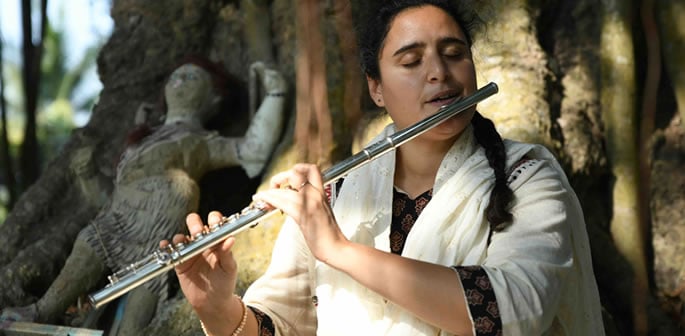
"This is the album I have listened to the most in my life.”
Naïssam Jalal is a French-Syrian flautist whose work bridges jazz, contemporary, and world music, but her upcoming album, Landscapes of Eternity, delves deeply into the heart of Indian classical tradition.
For over 20 years, Hindustani music, the classical music of North India, has been central to her artistic life, shaping her understanding of melody, silence, and spiritual expression.
She has studied the music of maestros such as Hariprasad Chaurasia, Bismillah Khan, N Rajam, and Salamat and Nazakat Ali Khan, drawing inspiration from their mastery of raag, taal, and improvisation.
These influences inform the album’s compositions, which blend her contemporary sensibilities with the structural and emotional depth of Hindustani music.
In an interview with DESIblitz, she reflects on how the sounds, philosophies, and sacred landscapes of India guided her music and shaped Landscapes of Eternity.
Discovering Silence Through Hindustani Music
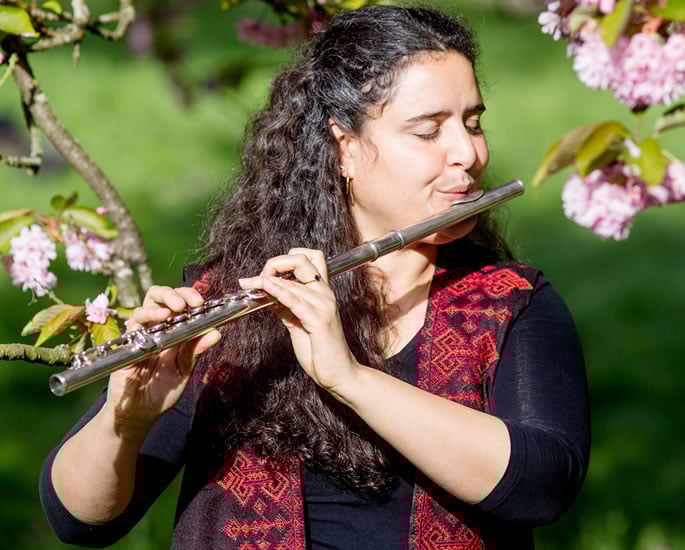
Naïssam Jalal traces her musical identity back to a formative encounter with Hindustani classical music:
“When I was 17, a double bass player friend of mine gave me a record of Hariprasad Chaurasia.
“Hariprasad Chaurasia is the greatest Hindustani flute player of all time.
“I have been listening to that album since that time at least once a week, but sometimes few times a day. That was 20 years ago. This is the album I have listened to the most in my life.”
Her introduction to raag, the foundation of Hindustani music, shaped her understanding of space, silence, and spirituality.
Jalal says: “Hindustani music is based on raag.
“The raag is not only a melodic scale, but also a mode, a colour and a path.”
“Alap is very powerful and really influenced my relationship to silence in music, which is central in my work as a musician.”
Jalal identifies parallels between Hindustani and Arabic music, noting that the emphasis on silence stems from spirituality:
“Alap and Quranic recitation taught me how much space and silence are central in music… The word Khayal (which is one of the styles of Indian classical music) means imagination in Arabic.
“The way you can play only one note with all the spirit you can input. I think that Hindustani music is incredibly powerful because it was born out of the encounter of different cultures.”
Her approach to improvisation reflects this, allowing each note to breathe with intention and making silence an expressive element rather than an absence.
Journeys Through India and Personal Transformation

While creating Landscapes of Eternity, Jalal spent months travelling alone through North India, visiting sacred sites and engaging with local musicians. Yet her artistic philosophy remained steadfast.
She says: “It didn’t. I am just clearer and more convinced that I absolutely refuse dogma in my life. But what was really special in India is the way the landscapes resonated for me.
“I didn’t feel at home but felt as if the landscapes had always been part of me.
“And that was super surprising and strange. I am still not able to explain this feeling.”
The experience deepened her sensitivity to the environment and place.
The natural and spiritual landscapes she encountered informed her compositions, shaping both the imagery and emotional resonance of her music.
This approach underscores her belief that music emerges as much from internal reflection as it does from external encounters.
Breath, Ragas and the Spiritual Voice of the Flute
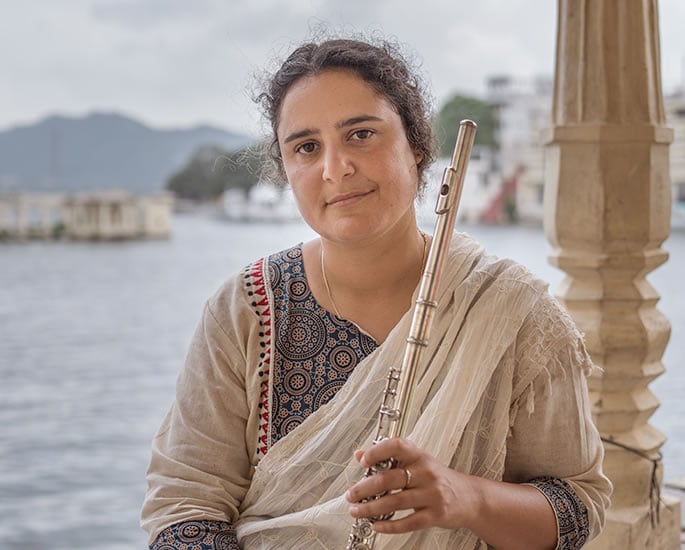
The flute emerges as a central instrument on Landscapes of Eternity, serving as a conduit for both melody and spirituality.
Jalal explains: “That’s a very deep question.
“I am super happy that you can hear my flute playing as a spiritual voice because it is really the way I express my spirituality… Breath is the soul.
“Not only in Hindustani music but in many cultures. In Hindustani music, breath is central in the Alap part of the raag development. And it has a huge importance in my music.”
Each composition is informed by specific raags, chosen to evoke particular times of day and emotional textures.
She continues: “Bhairav is an early morning raag and I used it to express the mystery of dawn in my composition named ‘in the rice fields at dawn’… I use Yaman, which is a night raag in ‘bath of forgiveness in the moonlight’ because it’s a joyful raag and because the landscape I was describing is taking place at night.
“As for Kafi, I love this raag so much. The scale of Kafi is the same as Dorian scale in Western music, which is very soft and yet deep at the same time – it’s bright.”
Her compositions bridge time and culture, drawing inspiration from the moods inherent in each raag while remaining entirely personal.
This allows Jalal to honour Hindustani tradition without being constrained by it.
“I respect them a lot… Traditional musics are the soul of communities.
“But also, I am not naive. I know that traditional music can sometimes be oppressive… I can act freely and be inspired by them without being oppressed.”
Poetry, Healing and the Divine in Music
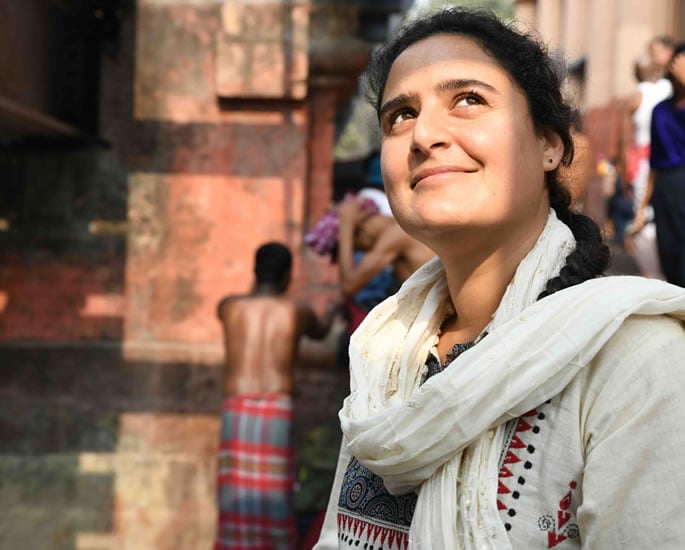
Naïssam Jalal integrates Kabir’s poetry to deepen the spiritual and narrative layers of her music.
She says: “After I had composed the music, and we had performed it several times, I heard Arooj Aftab’s album.
“I was mesmerised by the sound of Urdu/Hindi in a context that is not Hindustani.
“I then felt we needed to hear Hindi in my composition, so I got into Kabir’s poetry and found verses that resonated with my story.
“Kabir’s poetry and philosophy is the encounter of Islam and Hinduism as Hindustani music; Kabir’s poetry is expressing the link between artistic expression and spirituality as Hindustani music.”
Healing remains a central theme, with Jalal highlighting the transformative power of instruments like the tanpura.
“I believe that the healing soul of Hindustani music is the tanpura.
“This instrument plays the drone and liberates dozens of harmonics… It is super powerful.”
Landscapes of Eternity fits naturally within her trajectory, continuing a pursuit of music as a sanctuary for spiritual reflection and self-repair.
She adds: “Yes exactly, Landscapes of Eternity is a natural step on my musical and personal path, searching for the divine in music as a shelter, a space to heal myself and be at peace.”
Through breath, silence, and a profound engagement with culture and spirituality, Jalal crafts music that is at once deeply personal and universally resonant.
Her work demonstrates how immersion in tradition can inspire contemporary expression without sacrificing authenticity.
Landscapes of Eternity positions Naïssam Jalal at a crossroads of tradition and personal expression, where Hindustani music informs but does not define her.
Through breath, raag, and silence, she channels the spiritual resonance of Indian classical music while remaining entirely her own artist.
Set to release on March 27, 2026, the album reflects journeys both external, across the sacred landscapes of North India, and internal, into meditation, healing, and devotion.
By blending collaborators from multiple musical worlds, Jalal creates a sound that is at once contemporary and timeless, rooted yet expansive.
The result is a work that invites listeners to pause, reflect, and experience music as a vessel for both connection and introspection.