

















































"When I read it, it struck me on two levels."
Tennessee Williams’ The Two-Character Play brings two siblings into an unsettling world where theatre, memory and reality become increasingly difficult to separate.
The intimate two-hander follows Clare and Felice, a brother and sister whose shared past has left them deeply dependent on one another and increasingly isolated from the outside world.
As they perform a play based on their own lives, the distinction between what is being acted and what is actually happening begins to disappear.
The play explores trauma, family, identity and belonging through a relationship that is both deeply connected and psychologically fractured.
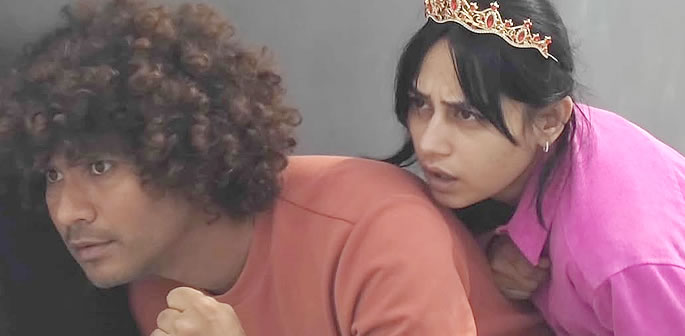
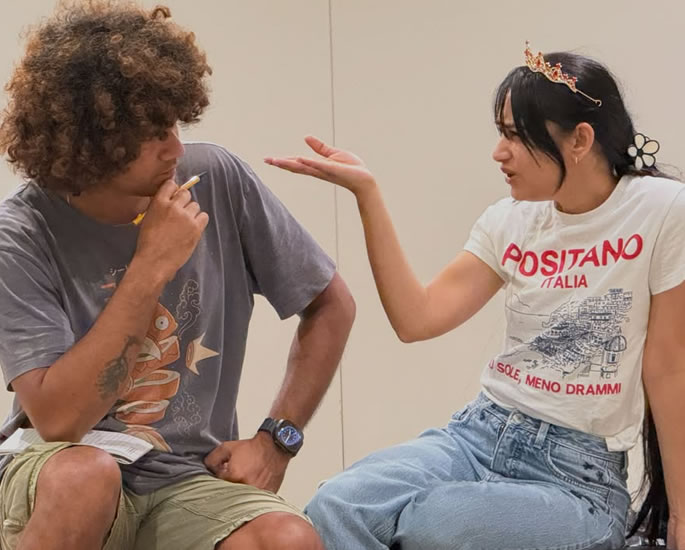
This new production places South Asian performers at the centre of Williams’ work, with Tanmay Sarkar and Shreya Bora playing Felice and Clare, while the latter’s father, Ramesh Bora, directs.
Ahead of its run at the Drayton Arms Theatre in London this October, Shreya and Ramesh Bora talk to DESIblitz about the play, their approach to the characters and the ideas behind their production.
Reimagining The Two-Character Play
Tennessee Williams’ The Two-Character Play has an unusual place within his body of work.
The play centres on siblings Clare and Felice, who are both actors and find themselves performing a drama that closely mirrors their own lives.
That combination of family trauma, theatre and psychological instability was what drew Ramesh Bora to the play, as he explained:
“My daughter Shreya gave me this play to read during her MFA course. She wanted to prepare a monologue of Clare’s and asked for my opinion.
“When I read it, it struck me on two levels.
“First, through two gifted sibling actors, it shows how family conflict and feuds leave a lasting mark on a child’s tender mind. Second, within the play itself, the brother and sister perform a drama based on their own lives.
“Its strange, wonderful and absurd circumstances pulled me in, and I decided to stage it.”
Shreya had already developed a long-standing connection with Williams’ writing.
She said: “I first came across The Two-Character Play years ago, and it has stayed with me ever since.
“At its heart it is about those deemed too broken, too strange, too damaged to belong and what the world does when it decides someone no longer counts. That is the failure of society. And I related to it deeply.
“Tennessee Williams shaped my understanding of theatre long before I ever set foot on a British stage.
“Through his characters, I recognised my own longing, my own dilemmas, my own sense of not quite belonging anywhere.
“I didn’t want to wait eternally to be given a chance to live inside his stories. And Clare is an extremely difficult character; I wanted the challenge of her.
“But that process doesn’t come to you while you sit at home, so I created the opportunity for myself.”
The production also reflects a deliberate decision to approach a classic work without reducing it to the cultural background of its performers.
Shreya sees Williams’ characters as capable of existing beyond the circumstances in which they were originally written:
“This production is also my way of saying that his stories are ours too especially at a time when contemporary theatre frames them through a narrow lens of race, accent or geography, stripping away the universality and depth of the original work”
Finding the People behind Clare & Felice
Clare’s history cannot be separated from her relationship with Felice, making their shared childhood central to how Shreya has approached the character.
The actress said: “I approached Clare through her relationship with her brother, Felice, because that’s what shapes who she is in the world of the play.
“Who is she in relation to him? What was her childhood like, the way she speaks about her mother and father? And who might she have been as a woman if her life had been ordinary?
“I tried to bring all of those elements into her. I wanted to understand her trauma, and through that trauma, her resilience.”
Their relationship has become both a source of protection and confinement. The siblings have survived through their dependence on each other, but that same dependence has left little room for either to imagine another life.
“I think at the heart of their bond is the shared trauma they lived through as children. Out of that, they became the only two people who could truly hold each other, but the same bond has trapped them in a world where there is only ever the two of them.
“And that kind of closeness breeds its own resentment. When your survival depends entirely on one person, they become both your shelter and your cage.
“Clare and Felice have given up any life outside each other, and part of them resents the other for it.”
“Staying together keeps them alive, but it slowly kills the people they might have been. So they stay, and they blame, and they cling knowing there is no choice that would ever set them free.”
Another part of Clare’s history became important during rehearsals: the successful theatrical career she once shared with Felice.
Shreya continued: “What fascinated me most was imagining Clare before in the days when she and Felice were celebrated as stars of the theatre.
“A life like that isn’t lived in isolation.
“When you’re at a creative height, you’re surrounded by people, collaborators, admirers, those drawn to your light. So I found myself wondering who Clare was then.
“The Clare we meet now, she still carries the aura of a proud, radiant, magnificent artist.
“It clings to her the way a spotlight lingers on a stage after the performance is over. That is who she is beneath the ruin, someone who was, and in some unbreakable way still is, a star.”
That contrast has also altered Shreya’s perception of Clare as rehearsals progressed:
“What surprised me most is how much strength lives inside her fragility.
“On the page, Clare can read as the broken one, the fragile sister, the one who is always medicated, managed, and looked after by her brother.
“But the more I’ve worked on her, the more I’ve found her ferocity, her pride, her sharpness. She is not a victim of her circumstances so much as someone still fighting them.
“I expected to find someone diminished, and instead I keep finding someone who refuses to be.”
Ramesh approached that psychological complexity through the question of identity, as he detailed:
“Every person gets their first identity from family, society and community. As they grow up, they create their own separate identity.
“But what happens when they do not get support and acceptance?
“Making this my basis, I tried to explore the reasons and dimensions of the fear that lives inside Felice and Clare.
“Both characters understand very well their state of being and not being worthy of being. I have tried to present that same state as a visual poem on stage.”
A South Asian Lens
Although The Two-Character Play features South Asian actors, neither Shreya nor Ramesh sees heritage as something that needs to be imposed on Williams’ characters.
Instead, their cultural perspective informs the emotional understanding brought to the work.
Shreya believes Clare and Felice’s circumstances could exist across different cultures, with differences appearing in expression rather than in the fundamental experiences of the characters.
She said: “I don’t believe heritage is what this work turns on.
“These two characters could be from any background. The story could have happened anywhere, and nothing essential would change.
“Their circumstances, their psychological turmoil, actions and reactions would all remain the same.
“Perhaps only gestures, accent and body language would shift depending on where they were from.
“That universality is exactly why we can claim it as ours. As a South Asian actor, choosing a play where heritage isn’t the subject and claiming it fully is its own act of reclaiming.
“So the approach both in how we’ve staged it and how I play Clare was never to perform someone we’re not.
“Even where the lines carry a very American rhythm, we wanted to hold the truth underneath them and let the subtext carry the character because that truth doesn’t belong to one culture. It belongs to everyone.”
The production’s South Asian emotional context also connects with changes in family structures, particularly in India, where Ramesh says the traditional joint family is becoming less prevalent:
“No art is bound by the borders of a country. A good work of art has a universal element that crosses borders, and Tennessee Williams’ play is no exception.
“The theme has become even more relevant today.
“In a country like India where the joint family has always created a safe environment for children, it is now breaking apart everywhere and we are seeing its widespread ill-effects.
“So I felt that staging it in a South Asian emotional context would not be an injustice to Williams, but would give it another colour and dimension.”
That perspective is also reflected in the sibling relationship, with Ramesh drawing on South Asian ideas around the responsibilities between brothers and sisters while keeping those elements secondary to Williams’ central narrative.
The director elaborated: “For me, theatre is not of the East or the West. It is universal.
“Through this play I have tried to show the emotional bond of brother-sister in South Asian culture.
“Here a sister is called ‘Suasini’ – one who is given the best place in the house. And all brothers are taught to care for and protect their sister.
“I have tried to show a glimpse of that relationship without letting it dominate Williams’ story.”
The question of who gets to inhabit established stories sits alongside that approach, as Shreya said:
“To me, reclaiming narrative spaces is the freedom to play any story, any character, across borders and cultures. Because what is the point of acting if all you are ever allowed to be is a stereotype of yourself?
“If I were freed from being defined by my race, I could simply be a woman.
“A woman in love, a woman on a mission, a woman in space, a woman who drinks blood. Just a woman.
“Yet too often, an actor like me is planted in a white woman’s story to serve her journey, there to help her arrive, and to add a touch of diversity where none was truly needed.
“Reclaiming the space means refusing that. It means insisting that these characters, these journeys, this whole human range, are ours to play too.
“It runs deeper than casting. These stories are handed to us as children and then quietly taken back.
“You sell Alice to the whole world, place her in the hands of every little girl, in every language and then tell the girl of colour that Wonderland was never meant for her.
“But I had already fallen down the rabbit hole. How can she belong to everyone, and never to me? Reclaiming the space means saying it out loud: these stories were always ours too.”
Meanwhile, Ramesh detailed: “My work contributes by insisting that instead of looking at skin colour, audiences should see with what artistic skill Shreya and Tanmay are embodying Williams’ two characters.
“Art is universal. Any artist in the world can become Kalidasa’s Dushyant and for the lead role of King Oedipus you don’t need to be of any particular origin. Anyone can perform any play, anywhere, anytime and should.”
Creating an Actors’ Theatre
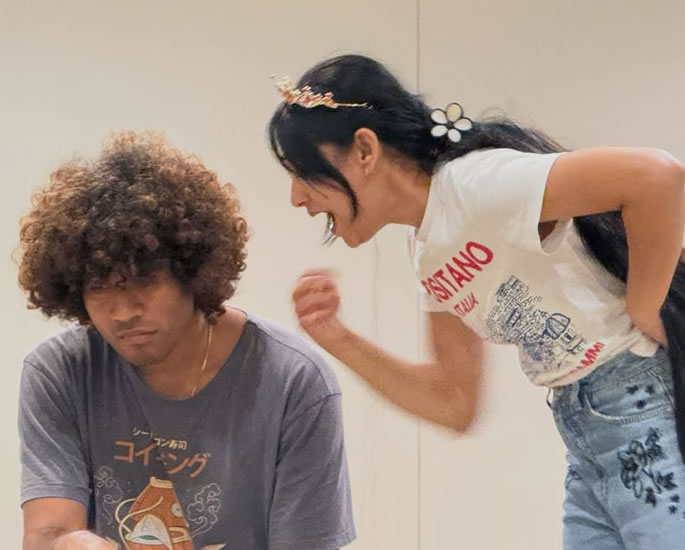
The production’s two-person cast places particular demands on Shreya Bora and Tanmay Sarkae, leaving little room for the performance to lose momentum.
Shreya admitted: “It’s challenging; it’s only the two of us carrying the whole weight of the story.
“Lose a single beat and the play collapses. So you learn to catch each other, to build real chemistry, to make sure you are never competing but always carrying one another.”
Ramesh’s own acting background has shaped his work on the play-within-a-play, particularly the shifts required between the different theatrical layers.
He said: “I have worked a lot as an actor and so I had no difficulty understanding this ‘play within a play’.
“My difficulty was in finding those nuances in the brother-sister’s behaviour between the two layers, which sometimes demand natural acting, sometimes dramatic, sometimes theatrical, and sometimes breaking the fourth wall like Brecht.
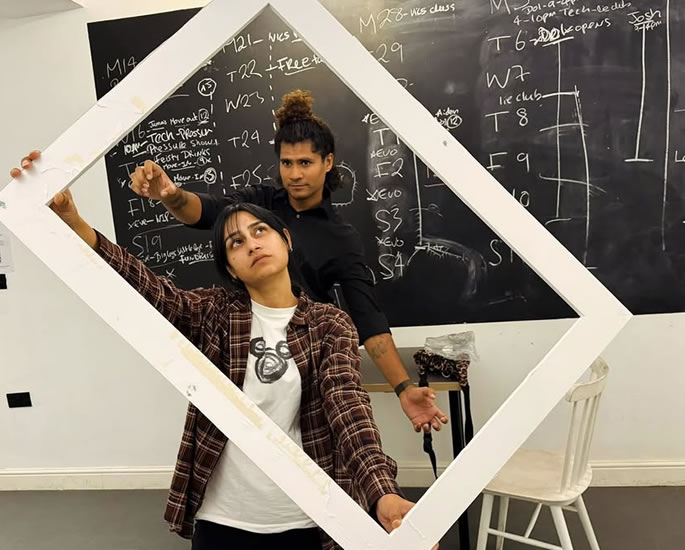
“To reach the soul of this play, I did many exercises with Shreya and Tanmay. This process started in Delhi and later we moved online. When a sketch began to emerge, I came to London.”
Both actors developed their performances through different methods, as Ramesh explained:
“Shreya and Tanmay are two different kinds of actors. Both are regular artists of my theatre group Natakwala.”
“Shreya first feels the character in her mind, then translates those emotions into voice and physical action.
“Tanmay first creates a pattern, then adopts the physicality and then tries to get inside the character.
“The chemistry they have created while preparing in their own ways is worth watching.”
That actor-led approach reflects Ramesh’s wider directing philosophy after more than four decades in theatre.
His work has developed around practical limitations as well as a belief that strong preparation can carry a production without relying heavily on technical resources.
Shreya has taken on responsibilities beyond the stage as executive producer, balancing the production with a demanding 9-5 job, forcing her to “grow in ways acting alone never would have”.
She revealed: “It taught me the business from the inside.
“I now see what productions actually look for, what makes a casting pitch land, why some emails get answered and others don’t. I’ve learnt to build a team, to trust them enough to delegate, and never to put down the leadership hat while I do.
“But the real shift is this: once you understand how the machinery works, you stop waiting to be chosen. You create the opportunities yourself and then you create them for others too.”
The Two-Character Play ultimately asks audiences to sit inside the unstable boundary between acting and lived experience.
Shreya added: “More than anything, I want audiences to lose themselves in Clare and Felice, laid bare, exactly as Williams wrote them.
“What I want them to feel is the collapse between performance and reality, two actors performing a play, until you can no longer tell where the play ends and their real terror begins.
“If an audience feels that, and forgets we are anything but Clare and Felice, then I’ve done what I set out to do.”
The Two-Character Play brings an intense and intimate piece of Tennessee Williams’ theatre to the Drayton Arms Theatre, with its two-person cast carrying the production’s shifting relationship between performance and reality.
With Shreya Bora performing as Clare and Ramesh Bora directing, the production offers a South Asian perspective on a work that examines family, trauma, identity and the need to belong.
Tickets are available to buy for those who want to experience the production at the Drayton Arms Theatre.
Performances
Tuesday, October 20, 2026 – 7:30 pm
Wednesday, October 21, 2026 – 7:30 pm
Thursday, October 22, 2026 – 7:30 pm
Friday, October 23, 2026 – 7:30 pm
Saturday, October 24, 2026 – 7:30 pm