
















































This rise took off in 2017 when Canada relaxed its visa policy
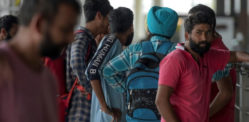
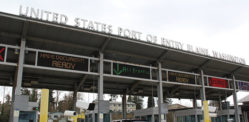
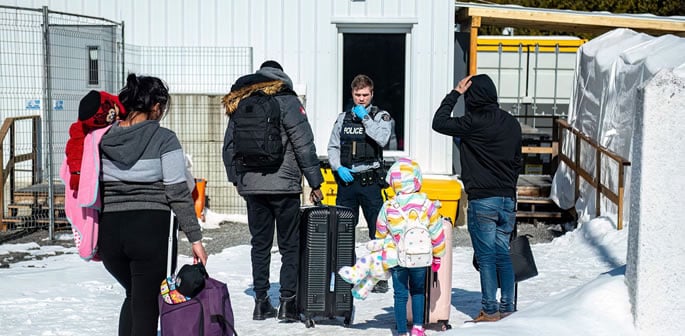
It has been reported that the number of undocumented Indians entering the United States on foot via Canada has reached an all-time high.
This surge has placed Canada’s visa screening process under scrutiny.
According to US Customs and Border Protection (CBP) data, 5,152 undocumented Indians entered the US from Canada in June 2024.
The monthly number of Indians entering the US via Canada has surpassed those crossing over from Mexico since December 2023.
According to CBP data, the average monthly number of Indians detained, expelled or refused entry (encountered) at the US-Canada border between January and June 2024 increased by 47%.
These figures assume significance given the contrast with the rising economic influence of the legally settled Indian population in the United States.
A study by Boston Consulting Group estimated that US Indians make up only 1.5% of the US population but pay about 5-6% of all income taxes there.
A Canada Regulatory Council immigration consultant said:
“Canada offers the ideal combination of an accessible visa and a soft border.
“It’s a much safer option than taking one of those ‘dunki’ (illegal) routes via West Asia, Africa or the Caribbean, to join the crowd waiting to cross the heavily guarded Mexico border.”
Canada is seeing a dramatic rise in asylum claims from Indians.
Compared to 9,060 claims received in 2023, the first quarter of 2024 attracted 6,056 claims from Indians.
This rise took off in 2017 when Canada relaxed its visa policy to entice foreign students.
Between 2016 and 2022, the number of international students in Canada rose by 61% from 523,000 to 844,000.
Despite growing evidence of visa abuse forced a course correction, Indian immigrants entering the US on foot had already shifted overwhelmingly to the northern border, overtaking Mexico’s numbers by December 2023.
Between January and June 2024, the northern border was twice as busy (22,398 encounters) as the southwestern border (11,052 encounters).
At the same time, the US Presidential Proclamation temporarily suspended the entry of certain non-US citizens.
The mechanism linking asylum eligibility to the volume of encounters helped decrease the number of encounters at the Mexico border by over 50%.
However, these restrictions do not apply to the northern border.
Professor Devesh Kapur, who teaches at the Johns Hopkins University School of Advanced International Studies, said:
“Entering from the southern border is much more dangerous and harder given that this border has much stronger border security.
“If one can get a Canadian visa easily then it makes more sense to come from the northern than the southern border.”
In 2023, 28 members of the US Congress came together to launch the Northern Border Security Caucus. a coalition that has been pushing Homeland Security against the increased human and drug trafficking, apart from highlighting the decrease in Border Patrol agents and lack of security.
Political scientist Shinder Purewal said:
“In the past, migrants from the US moved northward but now there are few opportunities to stay and work in Canada.
“Since visiting visas, and student visas until recently, were relatively easy to obtain, people landed in Canada and moved down South to settle.”