
















































"give users as much creative freedom as possible.”
In March 2025, OpenAI unveiled an upgraded image generator as part of its ChatGPT-4o model.
The tool significantly improves the ability to generate text within images. But concerns are growing over its potential for misuse.
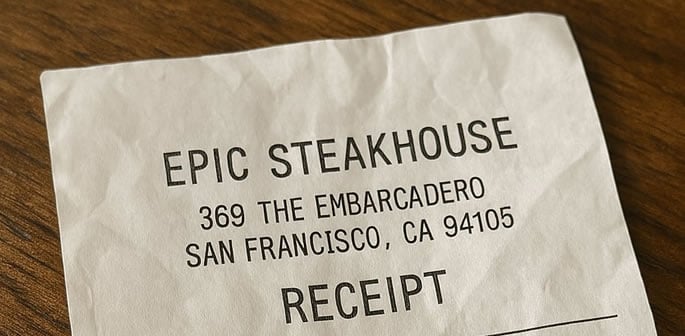
Social media users have already started using the generator to create fake restaurant receipts.
This raises fears that fraudsters could exploit the tool to forge documents, adding to the growing list of AI-generated deepfakes.
Experts warn that these advancements make it easier to commit financial fraud, as forged receipts could be used to claim false reimbursements.
Venture capitalist Deedy Das demonstrated the tool’s capabilities by posting a fake restaurant receipt on X.
The receipt mimicked one from a real San Francisco steakhouse and looked authentic.
Others replicated similar results, adding realistic elements like food stains.
Some fakes had flaws, such as incorrect math and misplaced punctuation, that indicated they were AI-generated. However, minor edits with photo software or better prompts could easily remove these signs.
The ability to generate fake receipts so easily has raised alarms in business and financial sectors.
Experts say fraudulent expense claims could cost companies and insurers millions.
While AI-generated fake documents are not new, improved realism makes them harder to detect.
In an era where AI is already being used to create deepfake videos and voice recordings, the risk of document fraud is now catching up.
OpenAI has responded to the concerns.
Spokesperson Taya Christianson said all images generated by ChatGPT include metadata identifying them as AI-created.
You can use 4o to generate fake receipts.
There are too many real world verification flows that rely on “real images” as proof. That era is over. pic.twitter.com/9FORS1PWsb
— Deedy (@deedydas) March 29, 2025
Christianson added: “OpenAI takes action when users violate its usage policies and is always learning from real-world use and feedback.”
However, questions remain about why the tool allows fake receipt generation at all.
OpenAI’s policies prohibit fraud, but the technology’s ability to create forgeries seems to contradict that stance.
Christianson explained: “Our goal is to give users as much creative freedom as possible.”
She argued that AI-generated receipts could be used for non-fraudulent purposes, such as teaching financial literacy or making advertisements.
Critics argue that relying on metadata is not enough, as it can be stripped from an image.
Some experts are calling for stronger safeguards, such as digital watermarks or stricter usage policies. Others say AI companies need to work more closely with regulators to prevent abuse.