

















































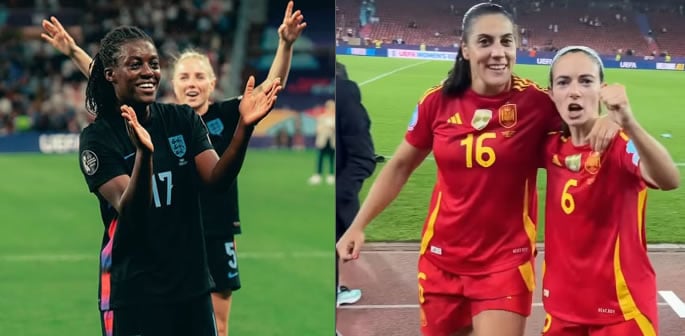
In their last meeting, England did just that.
England woke on July 24 with a simple yet daunting mission: outwit a near-unstoppable Spain and retain their European Championship crown.
The final on July 27 pits the reigning champions against a side that, despite their favourites’ tag, showed signs of vulnerability in a tense semi-final.
Spain edged past Germany in Zurich but were pushed to the brink.
For the first time this summer, Montse Tomé’s side looked beatable.
After the match, Tomé said: “I feel like the hard work has paid off.”
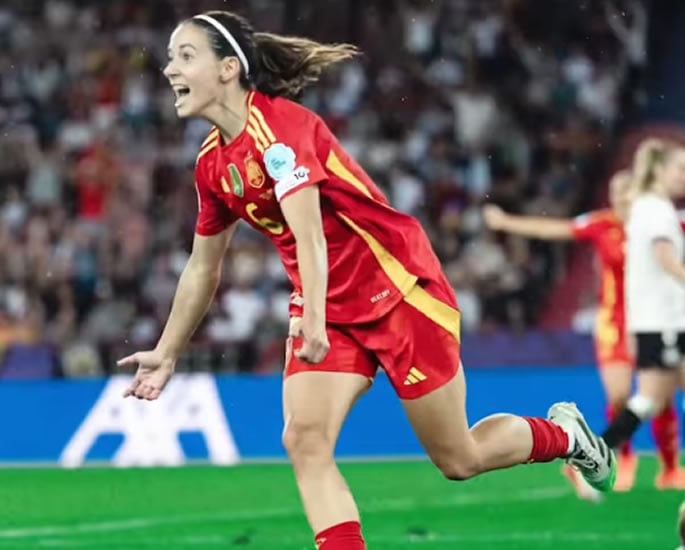
Her players were forced into uncomfortable positions by a dogged German outfit that compressed space and countered with purpose.
Goalkeeper Cata Coll was kept busy, producing crucial saves to keep Spain alive.
England, watching closely, will see opportunities to exploit.
Germany’s counterattacks created chaos, especially down the flanks. Klara Bühl exposed Spain’s left side with a directness and confidence that Lauren Hemp may look to mirror.
Bühl’s speed and fearlessness gave Spain’s backline, particularly full-backs Ona Batlle and Olga Carmona, plenty to think about.
On the opposite flank, Jule Brand was a constant menace, showing that Spain’s defence is not impenetrable.
If brave enough to attack wide and early, England could find space to punish.
But questions linger. Will Sarina Wiegman adjust her preferred possession-heavy style to adopt Germany’s more reactive, gritty approach?
In their last meeting, England did just that.
A February friendly at Wembley saw the Lionesses grab a 1-0 win with just 41% possession. Jess Park’s goal sealed a hard-fought result, and that team was built on discipline over dominance.
The majority of players who started that night also featured in this week’s semi-finals, but since then, England have failed to hit similar levels of cohesion.
Two late goals, one in extra time, were enough for England to defeat Italy and reach the final.
Spain knows about England’s vulnerabilities, too. Amid the post-match celebrations, Mariona Caldentey pointed out that England have yet to fully sparkle this tournament.
That may be true, but sparkle might not be necessary if the Lionesses can dig in and disrupt.
Germany’s midfield three, Elisa Senss, Sara Däbritz, and Janina Minge, suffocated Spain’s creativity.
Aitana Bonmatí, normally a free-flowing force, was quiet until her late winner. Alexia Putellas had little influence, and those signature Spanish runs between the lines were few and far between.
If Wiegman wants to replicate that success, Grace Clinton could be key.
Clinton impressed in the Nations League win over Spain five months ago and could bring added energy next to Keira Walsh and Georgia Stanway.
Midfield aggression and discipline will be vital to prevent Spain from controlling the game.
Defensively, Spain have not been flawless.
They conceded three goals in the group stage, two against Belgium and one against Italy, and were caught out by long balls through the centre in the semi-final.
These moments of fragility could offer England just enough encouragement.
Still, they will need to be clinical. Germany created chances but failed to capitalise.

If England are to take anything from Spain’s rare dips, they cannot afford to be wasteful.
Spain’s celebrations after defeating Germany reflected more than just relief; they revealed how much this final means to a side chasing a historic first European title.
Tomé said: “An infinite joy.”
But with expectation comes pressure.
Many of Spain’s starting 11 play for Barcelona and they will remember the pain of losing to Arsenal in the Women’s Champions League final just two months ago.
Bonmati stated: “This is not over yet.”
The message is clear: England are far from beaten.
They remain the team with everything to prove and a World Cup final defeat still lingering in their minds.
Germany’s approach has offered a blueprint.
Whether England can execute it better, and whether they’re willing to forego their usual style to do so, could determine if Sunday ends in triumph or heartbreak.