


















































"I act like I don't need a man, but it would be nice, of course."
As 2025 comes to an end, many British Asians are reassessing how they navigated intimacy, honesty and commitment.
Dating has never offered more choice, yet emotional avoidance remains a defining feature of modern relationships.
For South Asians, this avoidance is often intensified by cultural expectations around reputation, timing and respectability.
Regret, in this context, is rarely about who they dated but how they behaved within those connections.
These reflections reveal the quiet emotional costs of self-protection and people-pleasing.
Speaking candidly with DESIblitz, British Asians shared the relationship decisions they now wish they had handled differently.
Ghosting as a Response to Emotional Safety
 Ghosting has become normalised in dating culture, yet it often masks fear rather than indifference.
Nina’s regret highlights how consistency can feel threatening when emotional vulnerability is unfamiliar.
She shared, “I met this guy through mutuals in June. He was literally everything on paper, but the minute things started getting ‘real’, I panicked.”
Rather than articulate that fear, she disappeared without explanation.
Nina admitted, “I didn’t even give him a reason, I just stopped replying.”
Her behaviour did not bring closure or relief.
She confessed, “I’ve spent the rest of the year watching his Instagram stories like a total creep.”
Reflecting further, Nina added, “I just went MIA because I was scared of a bit of consistency.”
Her experience reflects how emotional safety is often mistaken for boredom or loss of independence.
Managing Sexual History Under Cultural Scrutiny
 For many British Asian women, sexual honesty remains entangled with judgment and respectability politics.
Jaspreet’s regret sits at the intersection of modern dating openness and traditional expectations.
She said, “It’s so peak because I actually like the guy I’m seeing, but I’ve started our whole situation on a lie.”
The pressure surfaced early in conversations around sexual history.
Jaspreet explained, “When we first started seeing each other, the body count conversation came up.”
Anticipating judgment, she adjusted the truth.
She admitted, “He’s a bit more traditional, so I cut my number in half.”
What initially felt protective became emotionally draining.
Jaspreet reflected, “I thought I was protecting myself from the ‘good Punjabi girl’ judgment.”
She added, “Now I’m constantly stressed about him meeting my friends or someone letting a story slip from the uni days.”
Her experience reveals how honesty is often compromised long before intimacy even begins.
Staying in Relationships Out of Comfort and Fear
 Not all regrets come from missed opportunities.
For some, the regret lies in staying long after the emotional connection has faded.
Karam described his year as one of avoidance disguised as stability.
He said, “My regret is basically wasting twelve months of my life.”
Despite knowing early on that the relationship was over, he remained.
Karam admitted, “By January this year, I knew it was dead. But I stayed.”
Practical comfort outweighed emotional truth.
He explained, “My mum liked her; she lived like ten minutes away, and the thought of going back on Hinge made me want to jump off a bridge.”
The relationship drifted rather than evolved.
Karam said, “We spent the whole year just Netflix and chilling.”
Looking back, he acknowledged, “It’s not fair to her, and it’s been a massive waste of my time.”
His story highlights how convenience can quietly replace commitment.
Ambition, Worth and Emotional Filtering
 Career success is often celebrated within South Asian communities, particularly for women.
However, Sonia’s* reflection questions the emotional cost of constant optimisation.
She described herself as “that typical ‘career girl’.”
Dating became another area where achievement was measured and assessed.
Sonia admitted, “I swiped left on so many guys just because I didn’t like their jobs.”
She explained that ambition became a proxy for compatibility.
Now, having secured her promotion, the emotional trade-off feels clearer.
Sonia said, “Now it’s December, I’ve got the job, but there is a part of me that wishes I had someone to share that with.”
Despite projecting independence, vulnerability remains.
She added, “I act like I don’t need a man, but it would be nice, of course.”
Her regret reflects how self-protection can masquerade as empowerment.
Sexual Inexperience and Masculine Performance
 For British Asian men, sexual confidence is often expected rather than developed.
Arjun’s* regret reveals the pressure to perform rather than admit uncertainty.
He said, “This sounds so bait, but I lied about having experience.”
Fear of stereotypes shaped his choices.
Arjun admitted, “I was terrified of being the ’24-year-old virgin’ stereotype.”
This performance undermined intimacy rather than facilitating it.
He explained, “It made the actual sex beyond awkward.”
Shame followed quickly.
Arjun confessed, “I couldn’t face her after that, so I haven’t seen her since.”
His experience shows how masculinity scripts leave little room for honesty.
Family Pressure and Accelerated Timelines
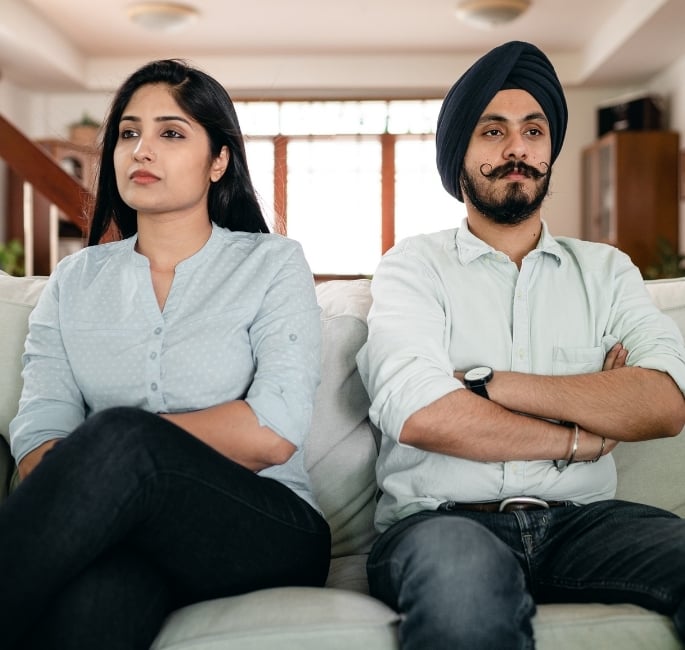 Family involvement continues to shape dating trajectories for many British Asians.
Reema’s* regret reflects the emotional impact of accelerated timelines.
She said, “I let my mum get to me this year.”
Trying to ease pressure, she compromised her instincts.
Reema explained, “I agreed to meet this guy through a family introduction, and I forced it for a few months.”
Warning signs were ignored in favour of compliance.
She admitted, “I ignored every red flag just because I wanted the nagging to stop.”
When the relationship ended, insecurity remained.
Reema reflected, “We broke it off in October, and I’ve ended the year feeling more ‘behind’ than I did at the start.”
Her story highlights how comparison culture extends beyond social media and into family life.
Emotional Detachment Disguised as Confidence
 Casual dating is often framed as emotionally progressive.
Mandeep’s regret challenges that narrative. He believed detachment signalled control.
Mandeep said, “I thought I was being cool by keeping things casual.”
Clear boundaries became emotional walls.
He admitted, “I kept telling her I wasn’t looking for anything serious because I wanted to keep my options open.”
When she moved on, the consequence was immediate.
Mandeep reflected, “I regret playing it so cool that I chilled myself right out of her life.”
He offered a broader observation about modern dating behaviour.
Mandeep said, “I think we keep up this persona, men and women, to impress, but it just backfires.”
He added, “The people on the other end have had enough, and I don’t blame them, to be honest.”
His reflection underscores how emotional distance often reads as disinterest.
Taken together, these regrets point to a shared pattern of emotional self-preservation.
Fear of judgment, rejection and vulnerability shaped decisions more than compatibility.
Cultural expectations continue to influence how British Asians approach sex and commitment.
Yet the willingness to name these regrets signals growth rather than failure.
Many now recognise that honesty, even when uncomfortable, creates clarity.
As 2025 closes, these voices suggest that emotional courage may be the real marker of maturity.