
















































“It includes irreplaceable historical material"
Avon and Somerset Police are asking the public to help identify four men linked to the theft of more than 600 artefacts from a Bristol museum storage site.
The items were taken from the Bristol Museum’s British Empire and Commonwealth collection on September 25, between 1 am and 2 am.
Police say a group of four men gained access to a building in the Cumberland Road area that was housing the material.
Officers released descriptions of the men.
Male one is white and of medium to stocky build. He was wearing a white cap, black jacket, light-coloured trousers and black trainers.
Male two is white and of slim build. He was wearing a grey-hooded jacket, black trousers and black trainers.
Male three is white and was wearing a green cap, black jacket, light-coloured shorts and white trainers. He appears to walk with a slight limp in his right leg.
Male four is white and of large build. He was wearing a two-toned orange and navy or black puffed jacket, black trousers, and black and white trainers.
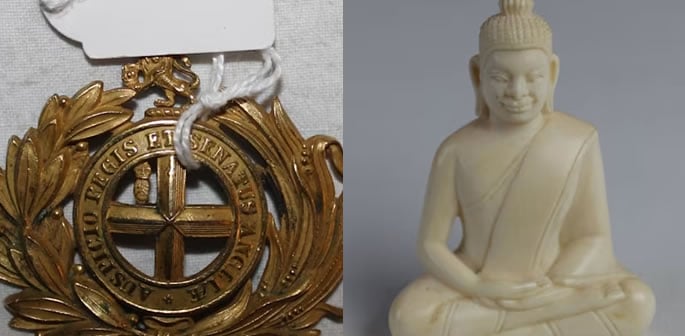
Items stolen in the burglary include military memorabilia, decorative art, jewellery and natural history pieces.
The collection forms part of one of the country’s most significant archives relating to the British Empire.
Professor Simon Potter, who specialises in the history of the British Empire at the University of Bristol, says the stolen items are of “huge value” to historians.
He said: “It includes irreplaceable historical material from all around the world… It was collected as a unique collection, 20 or 30 years ago, and it contains material from lots of different public institutions and private individuals.
“It’s something quite unique, and it’s something that’s of huge value if you want to understand the history of the British Empire, British colonialism, the history of many African and Asian countries in the Pacific.”
Professor Potter also referenced the raid on the Louvre Museum that took place in October 2025.
Speaking about global museum security pressures, he said:
“I think the Louvre case probably shows that even in a very big, high-profile national institution with a global reputation, it’s incredibly hard to protect and safeguard these enormous collections, which take up a huge amount of space.
“This is perhaps a reflection of a much bigger set of problems that museums face, particularly in times of austerity, where funding for public institutions is at risk.
“How do you prioritise safeguarding these collections when so many of your resources are stripped away?”
DC Dan Burgan from Avon and Somerset Police said the stolen items carry “significant cultural value”.
He said: “The theft of many items which carry a significant cultural value is a significant loss for the city.
“These items, many of which were donations, form part of a collection that provides insight into a multi-layered part of British history, and we are hoping that members of the public can help us to bring those responsible to justice.
“So far, our enquiries have included significant CCTV enquiries as well as forensic investigations and speaking with the victims.
“If you recognise the men pictured or have seen any of the possible items being sold online, please call us on 101 and quote reference 5225269603.”

Philip Walker, head of culture and creative industries at Bristol City Council, said the authority was “deeply saddened by the theft of the artefacts”.
He said: “These artefacts were part of a collection that documents the links between Britain and countries formerly part of the British Empire from the late 18th century to the late 20th century.
“The collection is of cultural significance to many countries and provides an invaluable record and insight into the lives of those involved in and affected by the British Empire.
“We’re grateful for the support of Avon and Somerset Police and continue to work closely with officers to investigate this crime and seek to apprehend the offenders and recover these artefacts.
“Security at the facility has been tightened and members of our museum community have been informed.”
During the era of the British Empire, many historical artefacts were taken from other countries without their consent.
Some items, like the Benin Bronzes from Nigeria, were seized during military campaigns, while others were removed from archaeological sites without permission.
Countries such as Egypt and Greece have repeatedly called for the return of treasures like the Rosetta Stone and the Elgin Marbles.
From the Indian subcontinent, notable examples include the Koh-i-Noor diamond, which was acquired by the British East India Company.
Other significant artefacts include Tipu Sultan’s ring and sword, taken after he died fighting the British, and the Sultanganj Buddha, a large metal sculpture that was discovered by a British engineer and is now in a Birmingham museum.
The Nassak Diamond, originally from a temple in India, was taken by the East India Company during the Anglo-Maratha War.