








































"It's freedom through the song."
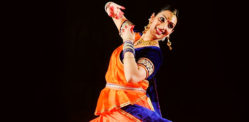
The virtuoso dancer Aakash Odedra is a connoisseur of storytelling through the art of dance and movement.
His show, Songs of the Bulbul, is a ferocious and contemplative solo and had its world premiere at the Edinburgh International Festival in 2024.
The performance was created in collaboration with the Delhi-based choreographer Rani Khanam.
It was also developed with the London-based composer Rushil Ranjan, who is known for his unique ability to meld Indian classical and Western classical traditions.
Songs of the Bulbul presents Aakash’s dance landscape in an original and exciting performance.
In our exclusive chat, Aakash Odedra delved into this show and the representation of South Asian dance in the UK.
Can you tell us about Songs of Bulbul and what it entails?
 This show is loosely based on a Sufi myth about songbirds. This bird is meant to be so prized – so highly prized that actually you can’t put a value on it.
It is said that when this bird was caught and given to a royal, the bird had to go through a process of training to get the best song out of it, and the first stage was to put the bird in a cage near a window.
So when the bird sang, it sang. For its sense of freedom that it had looking at the skies.
Seeing other birds fly and their melodies would have this sort of melancholic sense to it.
And then eventually the next stage of it was the bird is removed from this area where the window is, and then there’s a only a fragment of light that breaks through, and the bird would be surrounded by predominantly darkness.
So the bird would sing, almost trying to capture that ray of light, and again its song becomes more desperate. The next stage was the cage was bound, and it was completely darkness.
So the bird would sing in search of light for the desperation, for light to touch its eyes, to touch its soul.
The final stage of it was when the bird’s eyes were removed. So, the bird is blinded. And when this bird is blinded, there’s no other way forward.
But why is a caged bird song so powerful and so potent? Because it sings of something that you and I and everyone around us yearn for, which is freedom.
What inspired you to take on this performance?
 This connected to me and the choreographer Rani Khanam.
There was a parallel for me between the life of an artist, the journey of an artist, and this bird’s life. Because every time I go on stage or not, it goes onstage.
You die a little because you leave a part of your soul behind on stage. So until in the end, there’s nothing left to give.
I’ve always wanted to work with the idea of Sufi and Kathak because I feel Sufism is a kind of mysterious world where it blurs boundaries between religions and cultures, and it kind of transcends them in a way.
This story actually is very spiritual, and I wanted to create an environment where it feels like a universe within itself.
It’s also a very poetic and fragile story. So, I felt like the team was incredible.
The music is composed by Rushil Ranjan from Orchestral Qawwali, and he has created a sound score that’s so powerful that even if I didn’t dance and we just switched on the lights in the auditorium and let the lights play, you would be able to see a story by itself.
So, it’s a collaboration between Manchester Camerata. They all played live, about 40 musicians, and they recorded it.
We’ve taken this very eastern concept and kind of transformed it and transferred it into a way that it can globally connect to anyone.
You don’t have to belong to that background of Sufism or India or the subcontinent or any of that.
You can just come and kind of connect to the story because the music, the scenography, the dramaturgy is so powerful.
What was it like collaborating with Rani Khanam and Rushil Ranjan?
 Rushil Ranjan, to me, is a one-in-a-million protege. He is a very special person.
Rushil doesn’t come from a musical background originally. He was born in Mumbai, grew up in Cyprus, and then came to Oxford University to study law.
So, he was actually a lawyer, and he’s a self-taught musician and composer.
With that, he brings a whole new sensitivity and vision and a fresh vision into music. I feel like he understands people and what moves people otherwise.
Sometimes, music or dance or choreography can become so insular and so niche that people from the outside world can’t understand it.
I feel Rushil brings this kind of new, fresh perspective to music. He can touch people from every walk of life, whether you’re a music expert or a beginner.
He can bring this entire spectrum of colour and help the music create the visual elements, even without the dance.
Rani Khanum is one of my favourite choreographers. I feel she’s so intertwined into the world of Sufi spirituality and the idea of the soul in dance that words didn’t need to be exchanged.
She understood what needed to be done, what the body was asking for, and what the soul was asking for.
She’s an extraordinary choreographer and also a performer – someone who I’ve admired and someone who has really brought the sense of soul that this world needs now.
Because there’s so much ugliness around us, there’s so much darkness around us.
She’s brought this sense of soul and this sense of innocence to the piece, which I think no one else would have been able to do.
What inspired you to explore dance as a pathway?
 I think imagination is important because the culture possesses within its fabric so much sense of imagination.
You can look at certain things very scientifically, or you can look at them poetically, or you can look at them philosophically.
And I felt this kind of adaptability of perspective, depending on who is perceiving it culturally, was incredible.
In this world, all the kind of figurative of my imagination moved. They danced and created a world where I was able to escape sometimes this very grey environment that we live in.
So I feel like Kathak had a multitude of colours to offer me and an entire universe for me to explore.
I’m still exploring the same universe and still feel like I haven’t found the end of the rainbow, so to speak.
I feel culture and the rich heritage that we have spoke to me very loudly, and I felt like it had to be expressed.
Even on a cellular level, something in my genetics was awoken when I heard classical music or Indian music.
Do you think the UK represents South Asian dance adequately?
 There’s never going to be enough representation of South Asian dance. But it has come a long way in the last ten years or so.
It’s more about helping younger generations develop a dual identity.
Because when we’re talking about South Asians, we’re not just talking about people who have come from India or people who are, born in England of Indian descent.
We’re talking about a dual identity, both psychological and also cultural.
I feel England is so much more than what we think it is. I think it is a melting pot of cultures, and I feel that there is now a willingness to explore culture.
As a brown dancer, I didn’t have an option of failing. There’s a very typical stereotype about Asian parents saying: “Did you pass? You didn’t pass; you failed life.”
You can count on your fingers how many dances there were. And for each venue, there was one, maybe one brown dance. Let’s say a few venues had one brown dancer.
It’s taken a lot of work, and I feel it’s really beautiful to see a vast demographic in the auditorium – a dynamic audience that comes to see the show. It’s not Asian, and it’s not just brown.
I think it’s very important that dancers are allowed to be able to fail, to find, to fail to get up, to fail, to get up, to find their voice.
And then, when they’re ready, they will still be given a chance to go onto the platform that they’ve worked for.
I’m not saying that everyone deserves it or that no one deserves anything. Everyone should work for it.
But I feel it’s really important to be able to allow them to explore this dual identity. That has been suffering for generations.
What do you hope the audience will take away from Songs of the Bulbul?
 The message of freedom. Even though it’s freedom through death, it’s freedom through the song. It’s freedom through desperation.
I would hope if people can come to the auditorium and be in the moment – even if it’s for five minutes – I feel they’ve achieved some level of freedom from the thoughts that bind them in this cage that we call the body.
So I feel, for me, it’s the sense of freedom. Call it spiritual freedom, freedom of speech, or whatever it is to feel a sense of liberation where you’re not hindered by anything or even yourself.
I feel the show and its message is about. The voice of freedom.
Songs of the Bulbul promises to be an inspiring and immersive experience not just for dance aficionados but for all audiences.
Aakash Odedra’s words encapsulate the importance of being free, and he offers some diverse thoughts about the representation of South Asians in the UK.
With Fabiana Piccoli as the dramaturg and the lighting designer, Songs of the Bulbul has won the Edinburgh International Award for ‘Best Show’.
You can find out more information here.
Watch the trailer of the show: