










































"We should work towards preserving our older languages."
There is a vast array of languages spoken in India and they are evolving.
India is an incredibly diverse country as well as one of the largest democracies in the world.
The People’s Linguistic Survey of India revealed that the nation speaks approximately 780 languages.
Meanwhile, according to the 2001 Census of India, it has 122 major languages.
Such significant numbers show the diversity of India and the different types of people in the country.
We are proud to list 15 languages spoken in India.
Hindi
 The Cambridge dictionary defines the term ‘lingua franca’ as any “language that is used for communication between groups of people who speak different languages”.
For India, its lingua franca is Hindi.
It is the fastest-growing language in the country and is also one of the most spoken languages in the world.
In 1950, the Indian constitution declared Hindi to be the official language of the union.
Merged with English, a different type of Hindi can be created.
This is informally known as ‘Hinglish’ and involves English words mixed with Hindi, such as a Hindi syllable joining onto a Hindi term.
Malayalam

In the state of Kerala, Malayalam is the official language.
Within India, over 35 million people speak Malayalam.
In terms of etymology, the term ‘Malayalam’ originates from the words ‘mountain’ and ‘region’.
The term ‘Malabar’ was also used as a word to describe the language in circles of foreign trade.
According to the 2011 Census of India, Kerala was the nation’s second-most urbanised state.
These facts suggest that Malayalam is one of the most popular languages spoken in India.
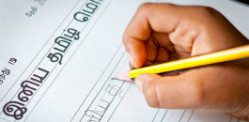
Tamil

This language serves as the official method of oral communication in Tamil Nadu.
Puducherry, also known as Pondicherry, also marks Tamil as its official language.
A classical language is any language that has achieved an independent body of literature.
Tamil is one of the world’s most enduring classical languages.
The renowned poet AK Ramanujan asserts that Tamil is “the only language of contemporary India which is recognisably continuous with a classical past”.
Punjabi
 One of the most prominent languages spoken in India, Punjabi has over 148 million native speakers.
The term comes from the word ‘Punjabi,’ which means ‘five waters’ in Persian.
These five waters refer to the eastern tributaries of the Indus river.
On YouTube, an American content creator discussed how Punjabi helped him in Amritsar:
“People were extremely kind and would often give you free stuff, particularly when I tried speaking to them in Punjabi, the local language.”
This shows the attachment a language can have between different people.
Telugu
 Native to Andhra Pradesh and Telangana, Telugu is also designated as a classical language.
The language has four regional dialects.
These are Telangana (Northern), Rayalaseema (Southern), Coastal Andhra (Central), and North Andhra (Eastern).
Laxminarayan Duvvuri told the BBC: “I am sure [Telugu] is spoken by many immigrants from Andhra Pradesh to the British Isles.
“The language has its origins traceable to about second to third century AD.
“It belongs to the Indo-Dravidian group of languages.”
Sindhi
 Over 1.7 million people in India speak Sindhi.
It originates from Sanskrit – a language used in the texts of several ancient Indian scholars.
In 1967, Sindhi was regarded as a scheduled language in India.
A scheduled language represents a list of languages that are entitled to representation on the Official Languages Commission.
In 1972, Sindhi became the first provincial language in Pakistan.
Haryanvi
 As its name suggests, Haryanvi is commonly spoken in the state of Haryana.
It is part of the dialect group in Western Hindi, which also includes western Uttar Pradesh and Bundelkhand in Madhya Pradesh.
Haryanvi is one of the common languages spoken in India and has been used significantly in cinema.
In 2016, the Bollywood biopic Dangal used Haryanvi as its main method of speech.
Other films like Sultan have also adopted the language in their content.
Marathi
 Primarily spoken in Maharashtra, Marathi is the official language of the state.
The aforementioned 2011 Census of India states that the country has over 80 million people who speak Marathi.
In a 2022 interview, Aamir Khan spoke about his desire to learn his state’s language:
“At the age of 40 or 42, I realised that I don’t know the language of my state.”
“I can understand it a little, but I can’t speak it. That was a shameful thing.”
“I felt I must learn it.”
The thoughts of Aamir show how a language can make one feel more connected to their roots.
Kannada
 In Southwestern India, Kannada is mostly heard in the state of Karnataka.
Another of the classical languages spoken in India, it was used in several dynasties as a court language.
With over 40 million native speakers, Kannada is a popular language.
Kannada also intertwines with Malayalam as the latter spoken by the Lakshadweep population infuses the Kannada lexicon.
Bengali
 In 2024, Bengali, as a language, had over 250 million native speakers.
Bengali is a rich and beautiful method of communication.
In India, some of the most famous and influential musicians have all shown traces of the language in their work.
These include SD Burman, Lata Mangeshkar, and Kishore Kumar.
The veteran actor Dev Anand likened melody to Bengali-speaking people:
“I think Bengalis are very, very melodious in music.”
Kashmiri
 Also called ‘Koshur’, Kashmiri is an Indo-Aryan language.
Over five million Kashmiris speak it as a primary method of vocal communication.
In 2020, the language was classified as an official language of Jammu and Kashmir.
Delhi-based YouTuber Aakriti Khaibri spoke about the roots of Kashmiri:
“Kashmiri is influenced by Dard, Persian, and Sanskrit.
“I feel we should work towards preserving our older languages, scripts, and cultures.
“And educate the younger generations about our culture and values.”
Bhojpuri
 Bhojpuri is native to the Bhojpur-Purvanchal region of India and it descends from the ancient language known as Magadhi Prakrit.
Bhojpuri was initially written in Kaithi script.
Kaithi is a historical script that was used in Northern and Eastern India. It was primarily used in legal, administrative, and private records.
But in 1894, Devanagari became the primary format.
Jharkhand gave Bhojpuri second-language status in 2018.
Awadhi
 Awadhi sounds quite similar to Bhojpuri.
The language derives its name from Ayodhya, the ancient city from Ramayan.
Awadh is an Indian region that encompasses Uttar Pradesh, where Awadhi is primarily spoken.
Awadhi has been heard in several popular films including Gunga Jumna (1961) and Lagaan (2001).
Amitabh Bachchan praised Dilip Kumar’s mastery of the language in the former film:
“It was very difficult for me to imagine how someone who did not come from Uttar Pradesh was able to pronounce and enact all the nuances that were required in the language of Awadhi.
“That has been the ultimate performance for me.”
Gujarati
 Hailing from the state of Gujarat, this is one of the most widespread languages spoken in India.
It is spoken by over 50 million people in the country.
Gujarati’s influence transcends the borders of Gujarat, going to Mumbai, Pakistan, London, and Africa.
It evolved from Sanskrit and has been emulated in Indian television dramas.
These include Baa Bahoo Aur Baby and Saath Nibhana Saathiya.
Although it derives from Sanskrit, Gujarati shares some differences including vowel length and consonant clusters.
Assamese
 The official language of Assam, Assamese is thought to have derived from Maghadi Prakrit.
LingoLizard on YouTube delves into the phonology (sounds) of Assamese:
“Assamese retains the four-way distinction between voiceless, aspirated, voiced, and murmured plosives found in most South Asian languages.
“The cases are formed with suffixes, and certain postpositions go along.”
The video amassed positive reactions, with one user commenting:
“Assamese is usually very soothing with soft pronunciation.
“So I think you truly understood the essence of the language.”
Indian languages pose a fascinating plethora of information and culture.
With so many of them enriching India, it is no surprise that India is such a vast democracy.
Furthermore, the fact that these languages span across to international places strengthens their influence.
As society progresses and people are always learning more, languages spoken in India offer a wide array of knowledge and history.