








































"All the sacrifices seem to have been worth it."
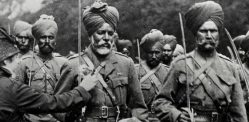
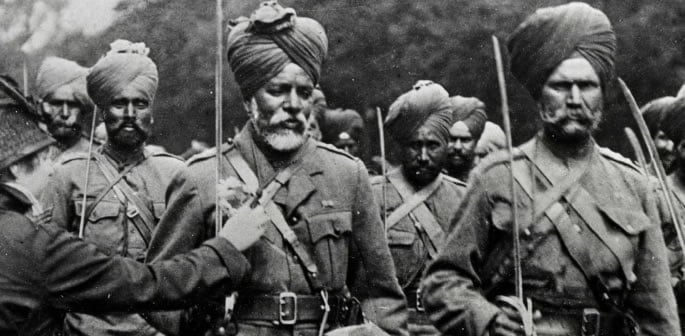
Thousands of forgotten soldiers from pre-partition India who served and died during the First World War are finally being recognised in the biggest update to casualty records in more than 80 years.
The names of 9,909 British Indian Army servicemen have now been added to the Commonwealth War Graves Commission (CWGC) casualty database after years of research by historians and volunteers.
British volunteers spent years looking for the names in unique registers compiled in the state of Punjab shortly after WW1.
Among them is Leicester-based dentist Sunney Palahey, who spent years trying to learn more about his great-grandfather, Kesar Singh.
Palahey had long heard family stories that his great-grandfather had gone to war and never returned.
However, researchers recently contacted him to confirm that Kesar Singh’s name had been uncovered in the newly examined registers and would now be officially recognised by the CWGC.
He said: “It’s been recognised by an authority, which it never was before. He is now an entry in the Commonwealth War Graves Commission.
“All the sacrifices seem to have been worth it.”
Palahey said the recognition has strengthened his connection to a wider global community linked by the sacrifices made during the First World War.
Around 1.4 million people from the Indian subcontinent, including present-day India, Pakistan and Bangladesh, served in the British Indian Army during the conflict.
Their contribution has increasingly become the focus of efforts to ensure the history of the war reflects its global nature.
After the war ended, British officials undertook an extensive effort to document the service and deaths of soldiers from Punjab.
Officials visited towns and villages throughout the province to record the names and fates of approximately 320,000 servicemen from the region alone.
Following the partition of India in 1947, Punjab was divided between India and Pakistan, leaving many of these historical records separated from the communities whose histories they documented.
Today, the surviving registers are housed at the Lahore Museum in Pakistan. The collection consists of fragile, leather-bound volumes containing handwritten records and organised by village.
The project to digitise and analyse these documents was initiated by members of the UK Punjab Heritage Association.
The work has taken several years and involved teams of researchers and volunteers examining thousands of historical entries.
The research conducted by volunteers has since been incorporated into the official records maintained by the Commonwealth War Graves Commission. The organisation says this represents its largest update to casualty records since the end of the Second World War.
According to historians at the CWGC, most of the 9,909 newly recognised servicemen had previously been excluded because they died away from the battlefield, often from injuries sustained during service.
At the time, decisions made by the British Indian Government meant these men were not granted official war graves status. Those rulings have now been overturned.
The newly recognised casualties reflect the religious diversity of the British Indian Army during the First World War.
Approximately 25% of those added to the records were Sikhs, around 25% were Hindus and roughly 40% were Muslims.
The CWGC says the decision to include these servicemen is not only about ensuring their names are preserved, but also forms part of a wider effort to challenge historically Eurocentric interpretations of the First World War.
The Commission argues that remembrance and commemoration must accurately reflect the global reality of the conflict and acknowledge the contributions and sacrifices of all those who served.
For thousands of families across Britain, India, Pakistan and beyond, that recognition has finally arrived more than a century after their relatives made the ultimate sacrifice.