

































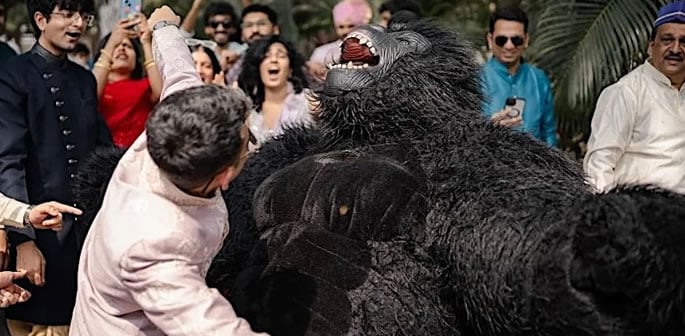
"It really uplifted the mood of everyone."
Indian weddings embrace different trends and the latest seems to be dancing gorillas.
What began as a viral clip has moved into real ceremonies, becoming part of baraats and wedding events across India.
Couples are stepping away from rigid formats and choosing elements that reflect their personalities instead.
The focus has shifted towards enjoyment, spontaneity, and shared moments rather than simply following tradition.
Social media has played a key role in accelerating this change, turning niche ideas into widely adopted trends.
The result is a wedding culture that feels lighter, more expressive, and increasingly tailored to the couple.
Personal Choice Influencing Weddings
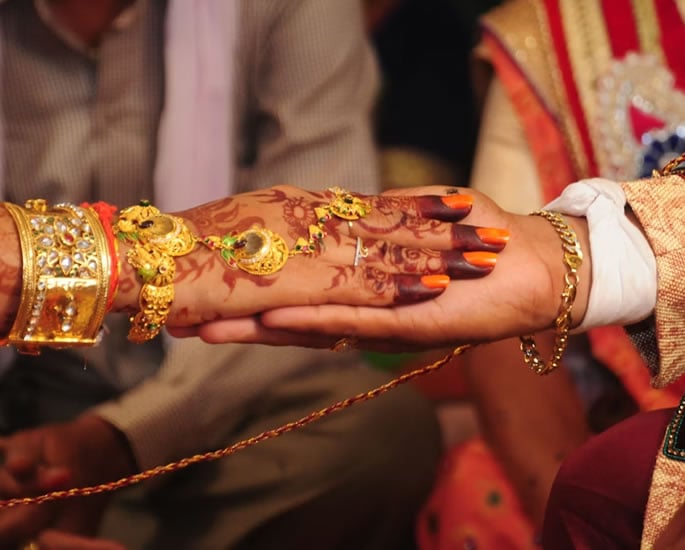
The traditional “big fat Indian wedding” has long been associated with scale, rituals, and extended celebrations that span several days.
Destination weddings at locations such as Lake Como, Jaisalmer, and Lake Pichola became aspirational benchmarks, particularly after Bollywood celebrities shared pictures of their own celebrations.
These events often prioritised grandeur over personal comfort.
That approach is now being reconsidered by younger couples who are more focused on how the celebration feels rather than how it looks on paper.
Personalisation has become central to planning, with couples making decisions based on their own preferences instead of external expectations.
Gargi Datar described this shift in a straightforward way: “The idea was to have things at the wedding that we actually want. And not just because ‘that’s how it’s done’.”
She hired a dancing gorilla for her wedding:
“It started as a joke because when we were planning, my algorithm was all cute wedding stuff like outfits, decor, hacks, etc.
“And his algorithm was just an unhinged gorilla dancing at weddings video.”
The couple, despite coming from a Maharashtrian background where baraats are not traditionally part of the custom, chose to include one in their own way. The gorilla became part of that celebration.
Gargi added: “So we figured, why not actually have the gorilla?
“I needed no convincing… it was the highlight of the wedding. It’s the most fun people have had!”
“That’s how we are as people, we do stupid stuff on a daily basis, so even for our friends it was befitting that we had a gorilla dancing in the baraat.
“The guests, most of them didn’t know this was happening, so when he showed up in the full costume, people lost it!! Even my side of the family danced in the baraat!”
The reactions ranged widely, adding to the unpredictability of the experience.
Tanisha Malhotra, who attended a friend’s wedding featuring the bizarre trend, described how the energy shifted:
“It really uplifted the mood of everyone. The moment the gorilla came in and started dancing, the whole vibe became super fun and energetic.
“Everyone was laughing, cheering, and it just made the atmosphere crazy in a good way.”
Older guests responded positively as well.
Despite its impact, the gorilla remains one part of a broader celebration rather than the centre of attention, as Tanisha added:
“It was definitely one of the highlights, but it didn’t overshadow the other events. It just added another memorable moment.”
Viral Moment to Growing Wedding Business

As the dancing gorilla trend gains popularity, it is also creating demand for performers and event-based entertainment.
What was once an occasional novelty is now becoming a service offered by small businesses and independent groups.
Theatre artist Sudama launched a mascot group deploying performers as gorillas at weddings and parties:
“My friend gave me the idea to start my Gori Boy Events agency. I thought I should try it because such a business requires taking risks.”
His group operates under the Instagram handle ‘Gori Boy Events’, which quickly gained over 13,000 followers within two months.
Much of its growth has been driven by short-form videos and social media visibility, where wedding clips often circulate widely.
The operational side remains relatively simple, with prices around Rs. 8,000 (£63) per event and performers earning Rs. 1,000 (£8).
Sudama added: “The outfit runs on a battery. Our boy wears it, and the outfit begins moving.”
Ashu, who performs as a dancing gorilla at weddings, added:
“I enjoy being a gorilla, and this is why I joined this industry. Wedding guests enjoy a lot.”
The trend also highlights a gap in how different elements of wedding entertainment are valued.
Gargi noted the imbalance in compensation: “I think currently in the market, in Pune at least, they’re charging atrociously low rates for someone who is in a hot full-body suit, dancing and making others dance, while all the ‘Shagun’ ka money goes to the dhol valas.
Still, demand continues to grow, suggesting that couples are willing to invest in experiences that stand out and create lasting impressions.
Capturing the Moment

While the dancing gorilla appears spontaneous, its execution requires planning and coordination behind the scenes.
Timing, safety, and communication all play a role in ensuring the performance integrates smoothly into the event.
Naynesh Chainani, who runs a luxury destination wedding planning company, explained the preparation involved:
“Executing any such acts involves extensive planning and coordination. Rehearsals are typically conducted hours or a day before the celebration.
“Permissions, safety, and clear communication with all performers are equally important.”
Filmmakers also face challenges when documenting these moments.
Manvi Gandotra described the difficulty of maintaining consistency in unpredictable environments:
“They give us visually rich, high-energy content, which is exciting. But the challenge is to maintain aesthetic consistency amidst the chaos.
“Lighting changes, crowd movement, and spontaneous reactions can be unpredictable. Anyone can shoot something loud, but making it feel elevated and cinematic, that is where our work begins.”
Psychologically, such moments resonate because they break expected patterns.
Dr Munia Bhattacharya explained: “When something completely unexpected happens, like a gorilla dancing, it breaks the emotional pattern.
“That sudden break creates surprise, and, when it is safe, surprise often turns into laughter.
“Emotional contrast, mixing serious and playful elements, shifts the mind from tension to relaxation.”
Dr Deepika Sharma noted that even short-lived trends can influence behaviour over time:
“A gorilla dancing at a wedding is fun and unusual. Even if the trend does not last, it can still inspire people to celebrate in creative ways.
“It is not just about age; it is about changing social conditioning and emotional comfort levels. Our sense of humour and expression is shaped by the environment we grow up in, not just our age.”
The dancing gorilla trend captures a wider shift in how Indian weddings are being experienced today.
Couples are moving towards celebrations that reflect their personalities, while guests are engaging with events that feel more relaxed and interactive.
What once seemed unconventional is now becoming part of mainstream wedding culture, supported by a growing ecosystem of performers, planners, and creators.
While specific trends may come and go, the underlying direction is clear.
Weddings are becoming less about following a fixed format and more about creating moments that feel personal, memorable, and distinctly their own.