















































"I wanted to show them as heroes."
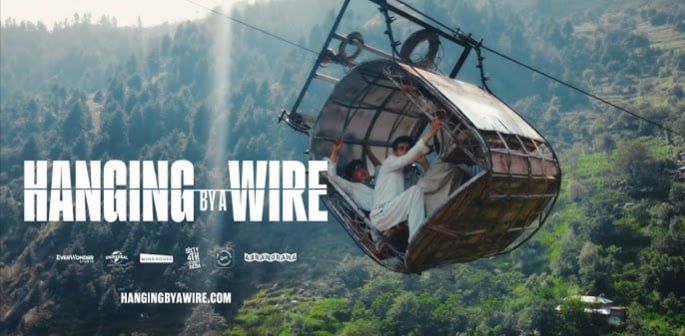
Pakistani documentary Hanging by a Wire is set to release officially on August 28, 2026, to audiences worldwide.
This follows a celebrated world premiere at the renowned Sundance Film Festival held earlier this year.
Directed by Mohammed Ali Naqvi, the documentary revisits one of Pakistan’s most gripping recent real-life crises.
The film centres on a dramatic 2023 cable car rescue operation that unfolded in the Allai valley near Battagram.
The valley is located in Khyber Pakhtunkhwa, where a transport cable car suddenly malfunctioned along its routine daily path.
Six minors and two adults found themselves suspended roughly 900 feet above a deep and terrifying ravine below.
The trapped passengers endured a gruelling 14-hour ordeal before rescuers were finally able to bring them down safely.
The incident triggered a high-stakes rescue operation that drew intense global media attention and widespread international concern.
What makes the story remarkable is how local individuals stepped up when conventional institutional responses fell critically short.
The documentary shines a powerful spotlight on local cable technician Sahib Khan, whom Naqvi proudly calls a “sky pirate.”
Zipline specialist Muhammad Ali Swati is also highlighted as one of the key figures behind the successful rescue.
Together, these individuals risked their own safety to construct a makeshift pulley apparatus under enormous and unrelenting pressure.
Local law enforcement officer Sonia Shamroz Khan also provided vital and unwavering support throughout the entire ordeal.
The documentary captures in striking detail how grassroots ingenuity and human courage triumphed where formal channels failed.
Naqvi himself crossed the cable car route during production, a personal experience he described as deeply unsettling and frightening:
“It’s petrifying. About halfway across, I thought, never again!”
Despite the personal fear, the filmmaker remained committed to telling the story from the ground level and with full authenticity.
He made a deliberate creative choice to centre the narrative entirely around the perspective of the rescuers themselves.
Naqvi said: “This story is told through the perspective of the rescuers, who only have a few hours, and they risk it all to try to save these kids.”
The filmmaker was also candid about the larger cinematic statement he wanted Hanging by a Wire to make globally.
He observed that “so many of the films that come from this region are framed through the lens of victimhood, of helplessness, of poverty.”
That familiar framing was precisely what Naqvi was determined to challenge and move away from with this particular project.
He stated: “I did not want to do that. I wanted to be deliberately subversive with this one.
“I wanted to show these people as resilient, as having agency. I wanted to show them as heroes.”
He intended to reframe how Pakistani communities are seen and portrayed through the lens of international documentary filmmaking.
The result is a film that places courage, resourcefulness and local heroism at the very heart of its storytelling.
Audiences at Sundance responded with considerable enthusiasm to Hanging by a Wire’s gripping narrative.