

















































"These kinds of questions didn't happen before"
Google is rolling out a new AI-powered search tool in the UK, marking a major change for the world’s most popular search engine.
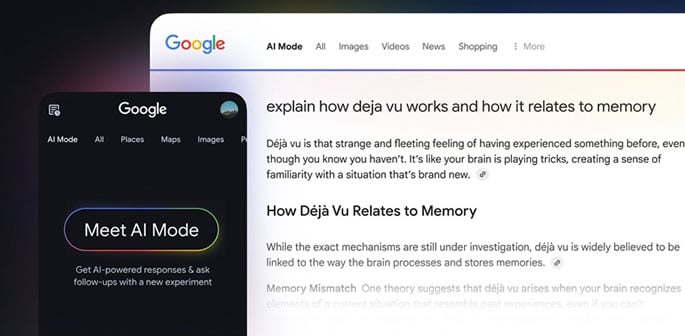
The tool offers an “AI Mode” that delivers answers in a conversational style, instead of the usual list of blue links to websites. Users choosing AI Mode will see fewer direct links to other pages.
This new feature will not replace Google’s existing search platform, which still processes billions of queries every day. But experts warn AI-driven responses could disrupt businesses that depend on web traffic from Google searches.
Retailers, news outlets, and other companies rely heavily on clicks generated by Google’s search results. Many also pay for prime advertising space on results pages.
A shift towards AI summaries with fewer links risks undermining this model.
The Daily Mail reported a roughly 50% drop in clicks from Google searches since the launch of Google’s AI Overview feature, which summarises content.
Hema Budaraju, Google’s product manager for search, said the company has not yet finalised how advertising revenue will work for AI Mode. It is also unclear if businesses can pay to feature in AI-generated answers.
Ms Budaraju disagreed with concerns about reduced web traffic:
“I would say that I think people are going to use these technologies to unlock newer information-seeking journeys.
“These kinds of questions didn’t happen before, and now you made it really possible for people to express anything a lot more naturally.”
People increasingly turn to AI chatbots like ChatGPT for quick answers, even if they are not always accurate.
Google’s new tool, powered by its Gemini AI platform, is already live in the US and India and is being rolled out in the UK over the next few days.
AI Mode will be optional and appear as a tab and an option within the search box.
Google said the new tool reflects changing user behaviour.
Ms Budaraju explained: “About two years ago, if you spilled coffee on your carpet, you would have [searched for] ‘clean carpet stain’. That’s how you would have probably keyworded your way through.
“Now, my query is likely to be, ‘I spilled coffee on my Berber carpet, I’m looking for a cleaner that is pet friendly’.”
A Pew Research Centre study found that when an AI summary appeared at the top of search results, users clicked a link only once in every 100 searches. Google disputed the study’s methodology.
Rosa Curling, director of campaign group Foxglove, which commissioned the research, warned about the impact on news organisations:
“What the AI summary now does is make sure that the readers’ eyes stay on the Google web page.
“And the advertising revenue of those news outlets is being massively impacted.”
Google generates more than two billion AI Overview boxes every day in over 40 languages, but not in the EU due to legislation.
There are also environmental concerns. AI systems require large data centres that consume significant power and clean water.
Ms Budaraju said Google remains committed to sustainability:
“We are constantly, as Google and as Search, evolving sustainable ways to serve technology.”