
















































"It’s not helpful for our current relationship with India"
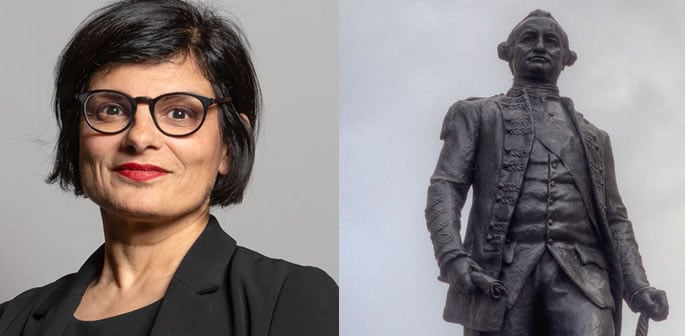
A Labour peer has called for the statue of Robert Clive to be removed from outside the Foreign Office in Whitehall.
Baroness Thangam Debbonaire claimed the Grade II-listed bronze sculpture’s depiction of “subservient Indians” in King Charles Street damages international relations.
She argued the monument’s portrayal of Clive’s role in India is historically inaccurate and harmful to Britain’s diplomacy.
Clive of India began as a clerk with the East India Company before becoming a wealthy military leader. He played a key role in British expansion on the subcontinent and has been blamed for the Bengal Famine of 1770, which killed up to ten million people.
Baroness Debbonaire, who served as shadow culture secretary and shadow leader of the House of Commons before losing her seat at the last general election, made her comments at the Edinburgh International Book Festival.
She told a panel: “I’m not sure that a statue of Clive should really have any place outside the Foreign Office.
“I walk past it and the frieze shows happy, smiling people really delighted to see him.
“And that’s just not historically accurate. It’s not helpful for our current relationship with India and it is deeply unhelpful to see India as a country that Britain civilised.
“India had a thriving engineering industry in the 17th century; it knew about mineral extraction, there had been incredible technological advances, it knew about free trade before free trade rules were ever written.
“That was closed down by an extractive colonising force.
“But what is pictured on that statue is tiny, tiny little Indians who are subservient and incidental to their own national story, and then a great big Clive.”
The Grade II-listed statue, unveiled in 1912 and moved to its current location in 1916, features artwork depicting the Mughal emperor granting Clive the right to collect revenue for the East India Company in 1765.
Downing Street distanced itself from Baroness Debbonaire’s remarks.
When asked about her call for removal, the Prime Minister’s official spokesman said:
“I’m not sure I’ve seen that. I’m not sure you achieve very much by going round taking statues down, but I haven’t seen that.”
Baroness Debbonaire had called the monument a “shocking piece of sculpture”.
Clive’s victory at the Battle of Plassey in 1757 enabled the East India Company to expand its influence in Bengal. He amassed a large fortune but was accused of mismanagement during the Bengal famine.
He is believed to have taken his own life when he was 49.

Statues of historical figures linked to the empire have faced increased scrutiny since the Black Lives Matter protests following the 2020 murder of George Floyd in the United States.
That year, a 125-year-old statue of slave trader Edward Colston was toppled by activists in Bristol and dumped into the city’s harbour. Lady Debbonaire, then an MP in the city, had called for its removal in 2018.
Speaking at a Black History Month event that year, she said:
“Having statues of people who oppressed us is not a good thing to be saying to black people in this city.”
“Edward Colston did many things, but he was not completely defined by that, and it’s an important part of saying to black people in the city ‘you are welcome’.”
At the time, Sir Keir Starmer said the statue “should have been brought down properly, with consent, and put, I would say, in a museum”.
He added: “This was a man who was responsible for 100,000 people being moved from Africa to the Caribbean as slaves, including women and children, who were branded on their chests with the name of the company that he ran.
“Of the 100,000, 20,000 died en route and they were chucked in the sea. He should not be on a statue in Bristol, or anywhere else.”