

















































"The country would reduce the number of low-wage, foreign workers"
Indian students in Canada are becoming more anxious after Prime Minister Justin Trudeau’s remarks on reducing the number of low-wage foreign workers in the country.
According to Immigration Refugees and Citizenship Canada (IRCC), Indian nationals represent the largest group among international students.
As of November 2023, they hold 37% of the 579,075 study permits that have been issued.
This is a huge increase from 2018 when 107,070 Indian students received permits.
Many believed their study permits would lead to permanent residency (PR) and eventually citizenship. However, recent policy changes have led to uncertainty among them.
The United Nations (UN) special rapporteur recently highlighted concerns about Canada’s reliance on temporary foreign workers, labelling it as a potential “breeding ground for contemporary forms of slavery”.
This highlights the exploitation and underpayment that temporary workers endure, particularly in low-wage jobs across industries like agriculture, hospitality, and retail.
The UN’s caution has fuelled the ongoing debate over immigration policies and added to the rising concerns among international students.
In response to growing domestic pressure, the PM announced plans to reduce the number of low-wage foreign workers.
Mr Trudeau said: “The country would reduce the number of low-wage, foreign workers so that Canadian businesses invest in their own workers and youth.”
This plan is part of a wider effort to address criticism about unchecked immigration and to improve job opportunities for Canadian nationals, especially young people.
It comes amid a rising unemployment rate for temporary residents.
Reportedly, the figure has reached 11%, compared to a 6.2% rate for the overall workforce.
Many Indian students had seen their study permits as a pathway to PR.
Thousands of Indian students, particularly from Punjab, have been enrolling in what are known as “degree mills” to earn diplomas in various trades.
These institutions were seen as a pathway to obtaining work permits, which could eventually lead to permanent residency and citizenship in Canada.
Therefore, the potential plans are a cause of concern for them.
In Prince Edward Island (PEI), the provincial government has cut the number of nominees for PR through the Provincial Nominee Program (PNP) by 25% for 2024, citing strain on healthcare and housing systems.
This has exacerbated fears of deportation among immigrants in various sectors.
While Trudeau’s government has maintained that study permits should not guarantee PR, the policy changes have caused significant distress among international students and temporary foreign workers.
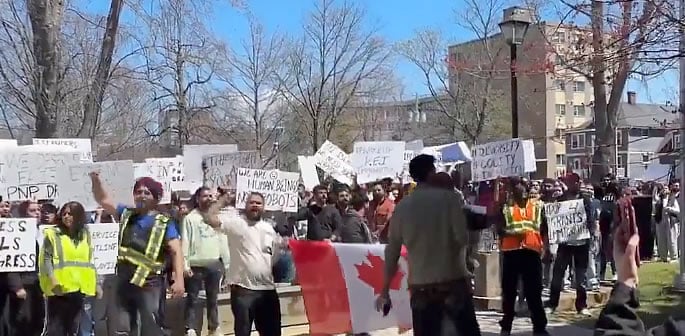
Some have protested the potential plans.
These protests not only reflect concerns about their current status but also seek support from the sizable Indian-origin Canadian voter base.
As Canada navigates its immigration policy adjustments, the outcome of these protests will be crucial for many Indian students and foreign workers in the country.