

















































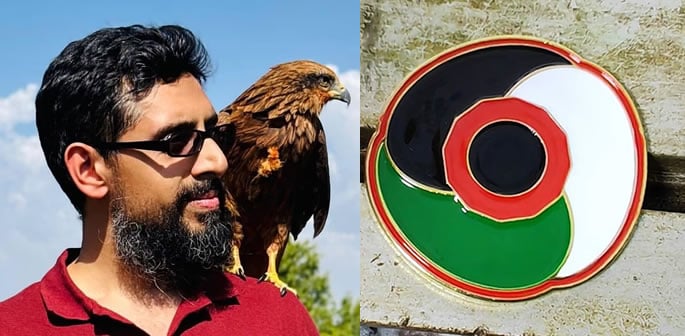
the badge has drawn criticism from veterans
The creator of a controversial ‘Palestine poppy’ is revealed to be an NHS doctor who wrote a children’s book that justifies stoning.
Abdul Qader Ismail, from Birmingham, is the creator of the Palestine Poppy, an enamel badge featuring a 12-sided poppy surrounded by the colours of the Palestinian flag.
He describes the design as a symbol of solidarity with Palestinians, with proceeds from sales reportedly donated to charities supporting the Palestinian cause.
However, the badge has drawn criticism from veterans who accuse its creator of appropriating Britain’s remembrance symbol and potentially diverting funds from the Royal British Legion (RBL), which owns the rights to the official two-petal poppy design.
Stuart Fawcett, a former Royal Navy officer turned Labour councillor, said the Palestine poppies were an attempt to “hijack our national symbol of resistance”.
The controversy has brought attention to Ismail’s views, as he previously shared an image that appeared to suggest Israel was a cancer.
He has also self-published books, which address subjects including capital punishment, homosexuality and gender dysphoria.
In the first volume, Ismail discusses punishments prescribed under Shariah law, arguing that they can act as a deterrent against forbidden acts.
The book recounts an account of a man who was stoned to death after asking to be “purified” for the sin of fornication. Following his death, the man was said to be “swimming in the rivers of paradise”.
The second volume encourages readers who are experiencing homosexual feelings and gender dysphoria to pray for guidance.
However, Ismail also writes that gay and transgender people should not be persecuted.
Ismail, who describes himself as a “middle-aged, cake-baking, horror movie-watching, British-Pakistani, Muslim” father of two, trained in medicine at the University of Oxford, graduating in 2010.
He subsequently completed a PhD at the University of Leicester and is listed as a co-author of numerous articles on neonatal medicine.
He has worked at hospitals across the East Midlands as a trainee paediatrician.
On the Palestine Poppy website, Ismail describes the poppy as the “national flower of Palestine” and highlights claims that 12,000 Palestinians fought against Nazi Germany during the Second World War.
He said he envisaged the badge becoming an “anti-apartheid symbol… to be worn until the people of Palestine have their freedom”.
Ismail maintains that the badges are sold on a non-profit basis, with all proceeds going to charities working to “end the occupation” of Palestinian territories.
The Palestine Poppy website was established towards the end of 2023, while the badges appeared for sale on eBay by the end of summer 2024.
The dispute has prompted criticism from veterans concerned about the use of the poppy, a longstanding symbol of remembrance for British service personnel killed in conflict.
The RBL describes itself as “non-partisan and non-sectarian” and says the poppy serves as a “unifier of people and communities”.
Decorated Iraq veteran Trevor Coult MC said he believed the alternative design “adds no value” and was “just there, in my opinion, to cause hatred”.
He added: “You’ve got people out there that just want to cause division and cause hurt.
“There’s no money from this poppy sale going towards helping any veterans.”
The row follows a separate controversy involving pro-Palestine protesters who allegedly trampled on poppy wreaths while climbing London’s Battle of Britain monument.
The incident took place days after the third anniversary of Hamas’ October 7 attacks in Israel.
The Palestine Poppy controversy comes amid wider debate over the use of remembrance symbols and their relationship with contemporary political causes.
The RBL has previously faced criticism from veterans and campaigners over its own designs, including a poppy badge featuring a Pride flag released in 2024.
However, the organisation said that “people are free to choose to wear different poppies”, leaving individuals to decide which design best reflects their views and how they wish to commemorate those who have served.