
















































"The sound was what caught me straight away."
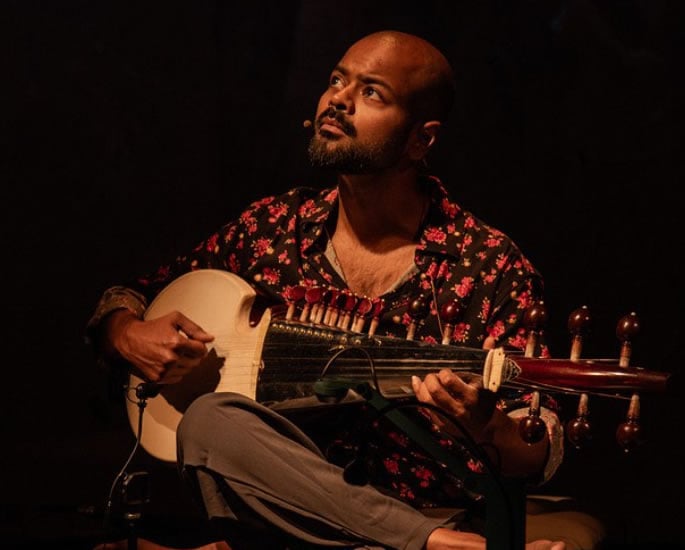
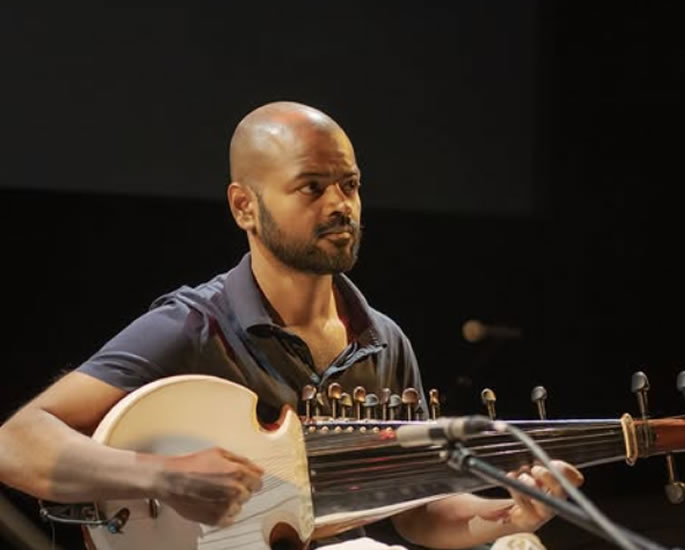
Soumik Datta is not your average sarod player.
Hailed as one of the most exciting musicians of his generation, his work cuts across boundaries – cultural, musical and political.
From performing with Beyoncé and Jay-Z to composing film scores and collaborating with choreographers like Sidi Larbi Cherkaoui, Soumik Datta’s musical universe is as expansive as it is fearless.
The artist brings his bold vision to Tapestry, a brand-new free festival in Southampton that takes place on July 19-20, 2025.
At Tapestry, Soumik will premiere music that explores themes of migration, identity and belonging.
Ahead of the performance, he opened up about his creative journey and inspirations in an exclusive interview with DESIblitz.
What drew you to the sarod and how has your relationship with it evolved over time?
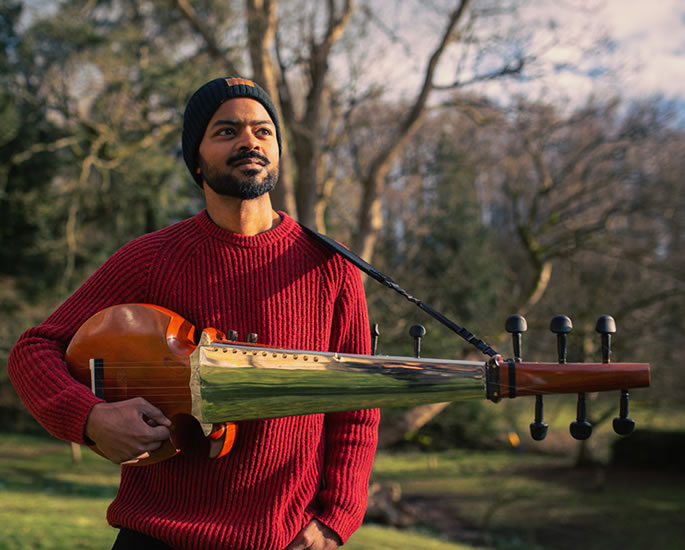
I discovered my grandmother’s sarod among the packing boxes that arrived from Mumbai when my family immigrated to London.
The sound was what caught me straight away. And it still does.
Something about how a plucked note can then glide with such clarity and beauty.
Listening to my guru play the sarod with such majesty inspired me as a young boy. And I’m still striving to manifest that sound.
You’ve collaborated with the likes of Beyoncé, Jay-Z and Bill Bailey. What do you take away from working across such a wide spectrum of music genres and personalities?
It’s wonderful to see artists hear the appeal of the sarod, especially those who are unfamiliar with Indian music.
You can see their faces lighting up.
It also challenges me to engage differently to try and create a sound together with them, inspired by jazz, hip-hop or electronic music.
You blend Indian classical music with contemporary themes. How do you approach merging tradition with innovation in your compositions?
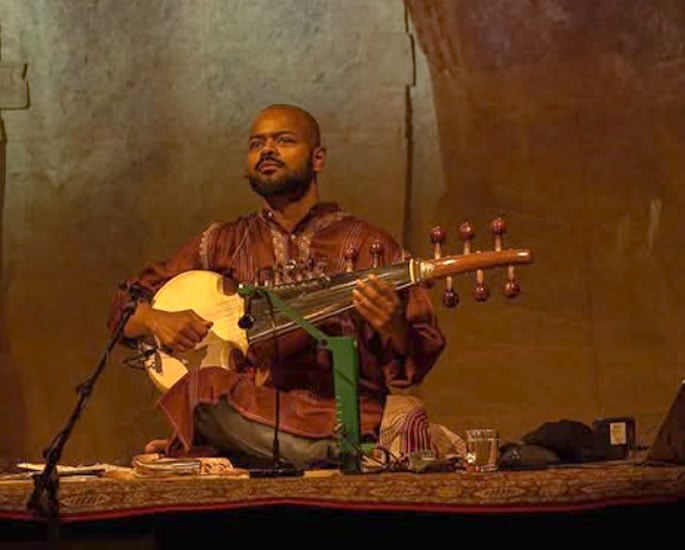
Indian music is a living tradition. And it’s alive today.
Any new phrases or compositions I make on the sarod now are connected to generations of sarod players and Indian music practitioners over decades and centuries.
So for me, there is no tradition without innovation. They are one and the same, connected by the same thread of time.
“And the world that we live in now is fractured, filled with contradictions, difficult to negotiate.”
So my music explores that tension between the paradise we have inherited and the ugliness we bring to it.
As both a composer and musician, what does your creative process look like when developing a new body of work?
Place and people are central to my practice. Understanding the plight of communities is key too.
Often, I will spend time with marginalised people experiencing both my privilege in that space as well as the helplessness of displaced groups.
I’m currently making a large-scale piece about air pollution in Mumbai. So I’ve been spending time there working with local flautists who are finding it hard to breathe and practice in the city.
We’re also learning a lot from the Warli tribal group, whose homes in the forest are being destroyed to create skyscrapers.
Often, music is born from the injustice of the system.
And in a city that is literally out of breath, we are discovering the sonic frequencies in the air that both connect us across class and caste but also fills our lungs with toxic pollutants caused by seemingly unstoppable industries.
You’ve scored films and worked with choreographers like Sidi Larbi Cherkaoui. How does composing for visual or movement-based art compare to a standalone musical performance?
I love making music for dance and movement.
Working with Sidi Larbi Cherkaoui and the Eastman team was an incredible learning experience. I got to use my sarod in unusual ways and compose music with artists from Korea and Japan.
Last week, I was working with a group of aerial artists in Mumbai to explore the verticality of the city.
“It’s interesting to play with vertical melodic lines, filled only with ascending notes.”
The visual dimension helps me to imagine the shape of music in unusual ways.
You received the Aga Khan Music Award and an Honorary Fellowship from Trinity Laban. What do those honours mean to you personally and professionally?
I’m very honoured to have received the Aga Khan Music Award as well as the Fellowship from Trinity Laban.
Earlier this year, I was grateful to receive the Eastern Eye ACTA award for Music.
But I think what these awards also recognise are the invisible support structures we as artists have in our lives, our parents, our mentors, our gurus, people who have invested time and energy to help sculpt a young person and their aesthetics.
At Tapestry, you’re unveiling new music centred on migration, identity and belonging. Can you tell us more about the themes and inspirations behind this performance?
The music I’m bringing to Tapestry tells the story of our home on this planet here and now.
It’s about the doors that open for some and remain closed for others.
The songs and tracks explore access, marginalisation and the political decisions that ripple across the ages.
“It’s deeply inspired by the events in the USA now, the failure of humanity in Gaza and also the shape of post-colonial India.”
Through the music, I am trying to understand my place as a British artist, an immigrant, an Indian musician and a human being trying to find hope in an increasingly complex world.
Soumik Datta’s performance at Tapestry promises to be a powerful exploration of displacement, identity and belonging, delivered through the evocative voice of the sarod.
With his unique ability to bridge classical Indian music and contemporary themes, he offers audiences a rare chance to reflect on the world around them through sound.
As he brings this bold new work to Southampton, Soumik continues to redefine what it means to be an artist rooted in tradition yet unafraid to challenge it.
On both days, the festival takes place at Westquay from 2 pm to 8 pm and Soumik Datta performs on July 19. For more information about Tapestry, visit the website.