


































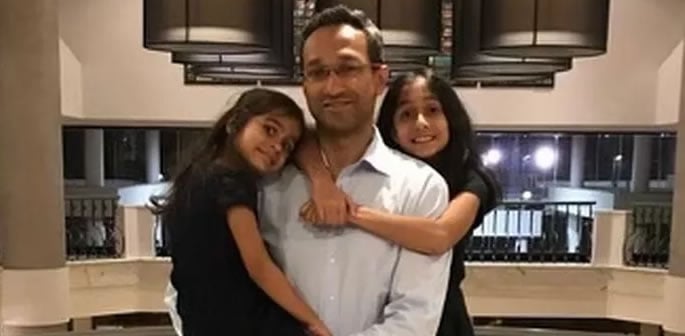
"He kept himself alive on the wards because he was a doctor."
A professor died aged just 43 after doctors botched treatment for a rare condition on which he was a national expert, his GP widow told an inquest.
A hearing was told Professor Amit Patel was one of the brightest doctors of his generation and a pioneer of stem cell transplantation.
But in August 2021, he was admitted to Wythenshawe Hospital in Manchester with flu-like symptoms suspected to be linked to a throat infection.
Despite being given antibiotics, his condition failed to improve.
Doctors were making a “working diagnosis” that Still’s disease – a rare inflammatory condition – was causing a potentially deadly immune disorder called HLH.
His wife Dr Shivani Tanna said it was “terrifying” for him to realise that doctors there did not “understand” HLH, for which he sat on a national panel.
Due to this, Professor Patel had to help advise doctors on how to treat him despite being unwell and feeling “foggy in the brain”.
Although he was a haematologist, he struggled to persuade nurses to show him his blood test results.
Dr Tanna told Manchester Coroner’s Court:
“He kept himself alive on the wards because he was a doctor.”
She said if he had been “Joe Bloggs”, he would have been dead within three days of being admitted, “just by sheer negligence”.
Professor Patel believed he needed to be treated urgently with immunosuppressants and that “time was of the essence”.
Instead, they treated him with steroids, causing a brief improvement.
Discussions began about discharging him for outpatient treatment for the debilitating effects of Still’s disease.
But when Dr Tanna visited her husband on August 27, she found him “barely conscious”.
She said: “I broke down.”
Professor Patel was transferred to intensive care but Dr Tanna said nurses were so short-staffed she had to check his observations and fluids herself.
She said it was “almost like we were being laughed at” by consultants, who expressed “irritation” at being given treatment advice.
On September 2, the father-of-two underwent a lung biopsy but he ended up “coughing up blood”, with doctors telling him to lie back.
Dr Tanna said her husband told them: “If you do, you’ll never get the blood out of my lungs, it’s clotting.”
According to Dr Tanna, doctors said they needed to “take back control” and gave him an injection. His eyes then “rolled back” and he was laid flat.
Professor Patel was “left for hours” as blood filled his lungs.
Dr Tanna said:
“He looked like a corpse. He was freezing cold.”
Professor Patel was placed under sedation on a specialist ECMO machine to oxygenate his blood, with his chances of recovering put at no more than one in ten.
He tragically died on October 28.
Dr Tanna said: “He was exceptionally brilliant as a doctor, and an amazing human being.
“He was probably one of the most knowledgeable and best doctors that the UK had.”
She had wanted him transferred to a top London hospital, however, Professor Patel did not want to be moved because of the disruption it would cause his family, who had just relocated to Cheshire.
Dr Tanna said: “Had I been able to move him, he would be here today.”
Representing the hospital, Paul Spencer had no questions for Dr Tanna but said “there are things we disagree with”.
Dr Simon Watts, a haematologist who treated Professor Patel, later told the hearing that while he had heard of HLH, he had never previously treated anyone with the condition.
When asked why the lung ultrasound was carried out, Dr Watts said national experts in HLH wanted to check there wasn’t an undetected issue causing the condition.
He accepted there was no record that they had been informed of a condition causing abnormal blood clotting.
But Dr Watts insisted he believed the issue “would have been raised” at a multi-disciplinary team meeting to discuss Professor Patel’s treatment.
After his death, senior doctors at Imperial College London said he was “an intellectually daring clinician, researcher and teacher”.
They added: “His untimely death has deprived British haematology of one of his young leaders in clinical research in the fields of stem cell transplantation and cell therapy.”
The hearing continues.