

















































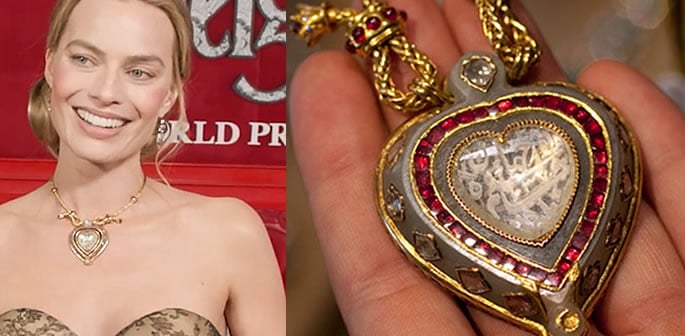
“The nickname ‘Taj Mahal’ reflects the Mughal romance"
Worldwide online searches for “Margot Robbie Taj Mahal necklace” have surged by 5,000% since the actress wore it at a film premiere.
Margot turned heads at the Los Angeles premiere of Wuthering Heights on January 28, 2026.
She wore the famous heart-shaped Taj Mahal diamond set in a Cartier necklace.
The diamond is more than 400 years old and dates back to the Mughal Empire.
It has an inscription in Parsi that reads: “Love is Everlasting”, along with the name of Nur Jahan, who was the first woman to receive the jewellery as a gift from her husband, the Mughal Emperor, Shah Jahangir.
The jewel was passed down to their son, Shah Jahan, who gave it as a gift to his own wife, Mumtaz Mahal.
When she passed away four years later, the then-emperor commissioned the Taj Mahal mausoleum as a tribute. The monument, then, inspired the diamond’s name.
It was later acquired by Cartier.
In Hollywood, it was famously gifted to Elizabeth Taylor by her two-time husband Richard Burton for her 40th birthday.
The Taj Mahal necklace received renewed visibility and online searches surged when Margot Robbie wore it for the premiere.
Jewellery specialists at Dawsons Auctioneers say the moment reflects how historic jewels continue to gain relevance through modern celebrity exposure, particularly on global red carpets.
Jonathan Pratt, Managing Director at Dawsons Auctioneers, said:
“At the Los Angeles premiere of Wuthering Heights on 28 January 2026, Margot Robbie wore Elizabeth Taylor’s celebrated Cartier ‘Taj Mahal’ pendant necklace – a piece that encapsulates history and glamour over centuries.
“The pendant’s heart-shaped diamond is inscribed with the Islamic date 1037 (1627–1628), and the ruby-and-diamond neck chain is described as circa 1972 and attributed to Cartier.
“This modern setting was designed to present an older, historically charged stone as a jewel that could be worn again, bridging centuries of history with contemporary red-carpet style.
“The nickname ‘Taj Mahal’ reflects the Mughal romance associated with the pendant.
“The stone is inscribed in Parsi with the words ‘Love is Everlasting’ and also bears the name of Nur Jahan.
“A key part of the necklace’s modern identity is Cartier’s reimagining of the piece.
“Originally worn on a traditional Indian silk cord, Cartier created the ruby-and-gold chain – often credited to house designer Alfred Durante – with rondelles and tassel details, effectively turning a symbolic, historic stone into a piece of high jewellery designed for modern public life.”
View this post on Instagram
On its Hollywood ties, Mr Pratt added:
“What we can trace clearly is the pendant’s association with modern celebrity.”
“Richard Burton gave the necklace to Elizabeth Taylor for her 40th birthday in 1972 during a trip to Budapest, a moment that transformed the jewel into a modern icon.
“Reported figures for the gift range from £350,000 to £380,000. Later, at Christie’s New York in 2011, it realised $8,818,500 (approximately £5.70 million).”
Since that sale, the necklace has largely remained out of public view. Its appearance on Margot Robbie marked a rare return to the spotlight.
“When a celebrity borrows an archive piece like this, the jewel becomes a short-lived exhibition: watched by millions, replayed endlessly, then returned to controlled storage.
“In that sense, Robbie didn’t just wear a necklace; she staged a micro-retrospective of one of the best-known provenance stories in 20th-century jewellery culture.
“One reason that Cartier keeps turning up in these ‘historic jewel’ moments is the house’s long habit of translating culturally specific motifs into high jewellery, from drawing room to gala, from private collection to public myth.
“This strategy is undeniably effective as the pieces photograph brilliantly.”