


















































It is a comedic moment that carries a sharp sting of tragedy
Prime Video’s Bait introduces Shah Latif as a man standing at the precipice of a career-defining breakthrough that feels out of reach.
Portrayed by Riz Ahmed with a restless, frantic energy, Shah is a struggling actor whose life is a stark juxtaposition of high-fashion tuxedoes and overdue utility bills.
The six-episode series, set to debut globally on March 25, 2026, tracks a chaotic four-day period following a disastrous James Bond screen test.
When a stray paparazzi photo ignites a media firestorm suggesting he is the next 007, Shah’s reality begins to fracture under the weight of public expectation and personal insecurity.
This narrative serves as a sophisticated dissection of the modern thirst for relevance, shifting gears from a comedy into a psychological drama.
Fame, Pressure and a Slow Descent

The series, which is also written by Riz Ahmed, effectively establishes Shah’s desperation in the opening episode, where a failed audition becomes the catalyst for what follows.
The opening scene highlights Shah’s struggles and evokes parallels with Marvel’s Wonder Man, which also follows a struggling actor.
Shah’s confidence is also low, emphasised when a fan mistakes him for Dev Patel and he goes along with it until an elderly bystander chimes in.
It is a comedic moment that carries a sharp sting of tragedy as he returns to a cluttered apartment.
As the story progresses into the second episode, it incorporates a surreal, podcast-like segment that mirrors his deteriorating mental state and features a surprise that viewers will love.
These scenes are cleverly intertwined with the domestic chaos of his family members, who are frantically increasing home security measures in their own ways.
Shah’s sudden Bond rumours prompt excitement but it also sparks the protagonist’s existential crisis.
By the third episode, the narrative undergoes a significant tonal shift during the family’s Eid celebrations, discarding rapid-fire quips for a more sombre atmosphere.
While the pacing in this middle chapter is notably slow, it allows for a deliberate build-up of the consequences trailing Shah’s increasingly erratic behaviour.
The humour throughout these early stages is crude and occasionally dark, reminiscent of the chaotic comedic energy found in Riz Ahmed’s breakthrough performance in 2010’s Four Lions.
However, as the series progresses, the satire falls away to reveal a man in the throes of a downward spiral.
This transition reflects the messy reality of a life spiralling out of control, where the pursuit of fame begins to alienate everyone within the protagonist’s inner circle.
Characters That Define the Series
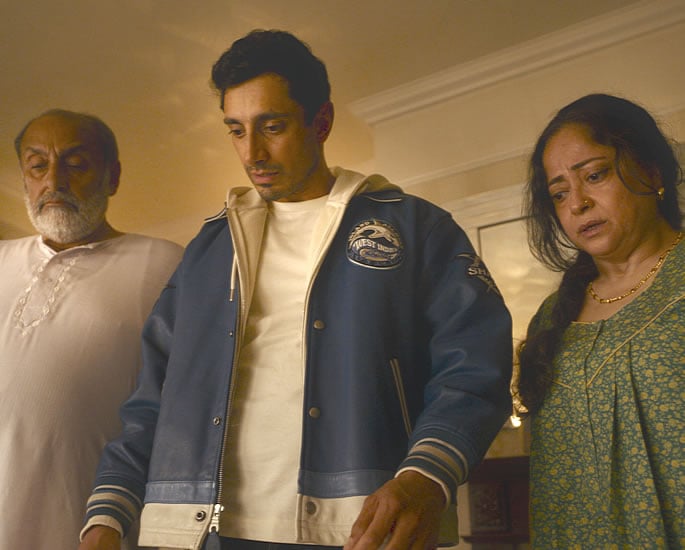
While Riz Ahmed anchors Bait, the supporting cast brings the series to life, each with their own stories incorporated into the central narrative.
Guz Khan is a standout as Zulfi, Shah’s entrepreneurial cousin whose M-Uber budget cab service provides much of the show’s levity.
The exchanges between the two capture the authentic, often childish vitriol of family dynamics, though their constant insults occasionally border on the excessive.
Aasiya Shah’s Q adds a necessary layer of quick-witted pragmatism to the household, while Shah’s parents, Tahira and Parvez, ground the narrative in the quiet dignity of parental support.
Weruche Opia rounds out the professional sphere as Felicia, Shah’s agent, who must navigate the fallout of her client’s growing narcissism.
The emotional core of the series is found in the fourth episode, a tense and impactful two-hander.
Ritu Arya’s Yasmin, Shah’s ex-girlfriend, serves as a formidable foil to his unravelling psyche, challenging his arrogance with no-nonsense confidence.
Their chemistry is palpable, moving through a range of emotions that expose Shah’s vulnerability, even as his later behaviour at a neon party leaves the audience questioning his sincerity.
A minor disappointment lies in the limited use of Himesh Patel as Raj, a fellow actor whose craftiness is masked by his suave persona.
Although it would have been interesting to see this part of his character fleshed out more, his presence in his sole episode highlights the professional jealousies that fuel Shah’s descent.
The Price of the Spotlight

As Bait approaches its conclusion, the narrative moves firmly into the territory of psychological drama, addressing themes of British Asian identity, racism, and the heavy burden of cultural expectations.
The final episode utilises a surreal dream sequence to interrogate the ethics of Shah’s desperate pursuit of fame, effectively tying up the loose ends of his four-day spiral.
This closing chapter succeeds in making the audience root for Shah again, following a pivotal turning point in the fifth episode where he is forced to confront the wreckage of his own making.
Flashbacks to his family’s unwavering support reinforce the idea that his identity was never truly found in the roles he auditioned for, but in the people he attempted to leave behind.
Ultimately, the series functions as a cohesive and satisfying stand-alone narrative that avoids the modern habit of teasing future instalments at the expense of a solid ending.
The shift in genre from madcap comedy to a psychological drama reflects the internal discord of the protagonist, creating a viewing experience that is as visceral as it is thought-provoking.
While Shah Latif begins as a sympathetic underdog and evolves into a deeply unlikeable narcissist, his eventual journey toward self-reflection provides a rewarding emotional payoff.
For viewers seeking a show that prioritises character depth and authentic cultural exploration over formulaic tropes, Bait is a solid addition to your watchlist.
All six episodes will be available to stream on Prime Video starting March 25, 2026.