















































"That became one of the biggest reasons I wanted to build Kayva Care.”
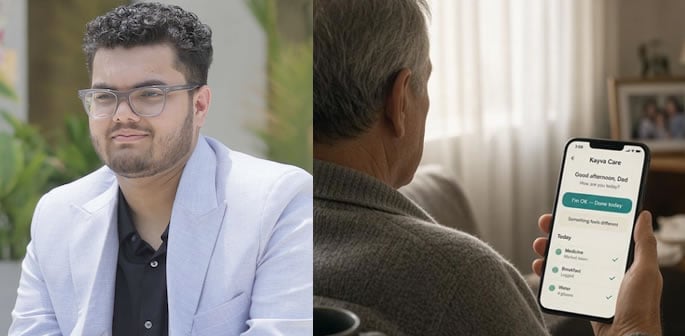
Abhinav Rana founded Kayva Health after seeing how difficult it can be for families to know how an ageing parent is really doing between phone calls, especially if they live abroad.
His own family had lived across different countries, and staying in touch with his grandparents did not always give him a clear picture of their day-to-day lives.
That experience stayed with him, particularly after he encountered similar concerns among families during his medical school placements.
Kayva began as a wearable health data platform before Rana shifted its focus towards helping families understand changes in a loved one’s health and routine over time.
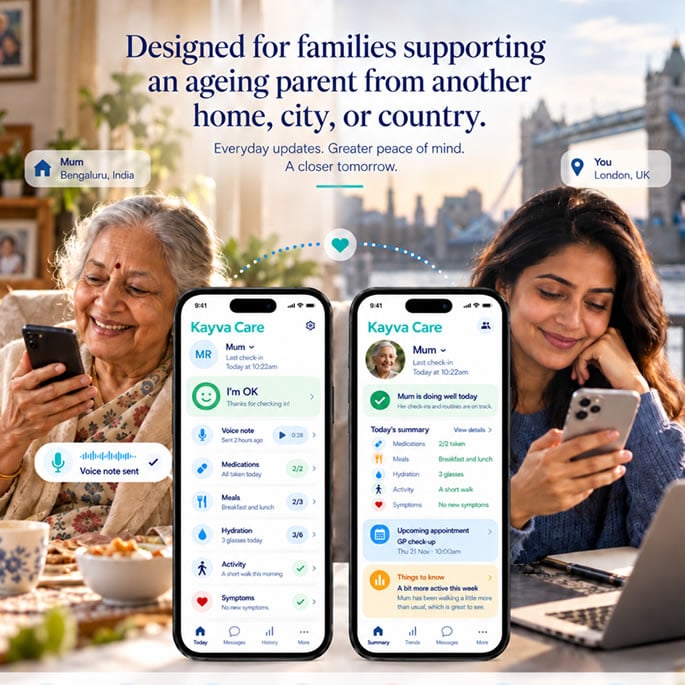
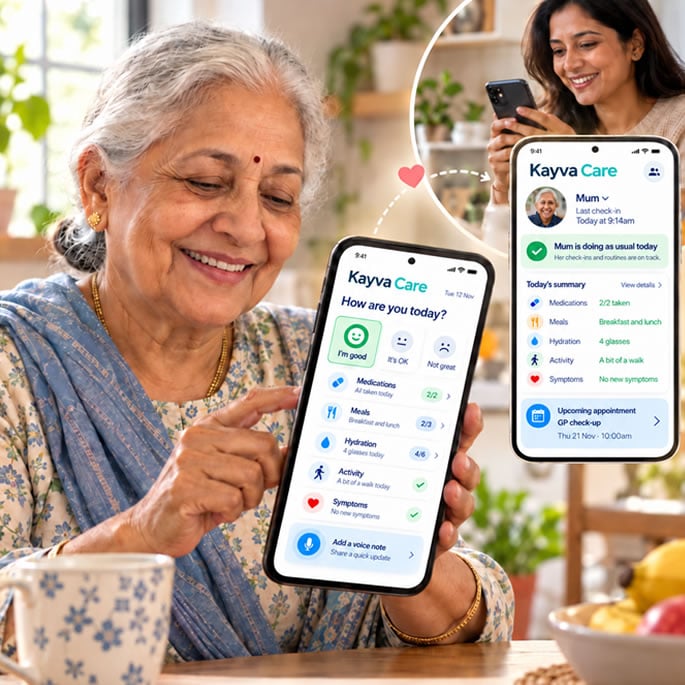
The platform brings together check-ins, medicines, symptoms, routines and supported health measurements, while allowing parents to decide what they share.
In an interview with DESIblitz, Abhinav Rana discusses what led him to build Kayva, the challenges of developing it alone and his plans for its future.
A Personal Need became Family Care
Abhinav Rana’s motivation for building Kayva came partly from his family’s experience of living across different countries.
When his grandparents were alive, staying informed often depended on conversations that offered only a snapshot of how they were doing.
His medical school placements gave him another perspective on the issue, as he explains:
“It was not always fear that something was seriously wrong.
“It was often much simpler questions: Are they happy today? Have they eaten properly? Did they take their medication? Has anything changed? Should I call and check in?”
This led Rana to explore a broader problem affecting families who remain connected across distance but lack an ongoing picture of a loved one’s wellbeing.
He says: “The more people I spoke to, the more I realised this was a pattern: families are more globally connected than ever, but that does not necessarily mean they have a clearer understanding of how the people they care about are actually doing.
“That became one of the biggest reasons I wanted to build Kayva Care.”
However, Kayva’s development began with a different application of health technology.
From Wearables to Family Health
Abhinav Rana started building Kayva in 2026 around wearable health data.
Devices could already collect information such as sleep, resting heart rate, HRV, activity and recovery, but interpreting those measurements remained difficult for many users.
The original product focused on helping people understand changes against their own baseline and consider what might be connected to those changes.
User conversations gradually exposed another need, particularly among people thinking about ageing parents.
Rana says: “The most emotionally important question was often not, ‘How am I doing?’
“It was, ‘How is someone I care about doing?'”
Investors and other people he spoke to also identified the potential in applying the underlying technology to family care. That feedback contributed to Kayva’s shift towards its current focus.
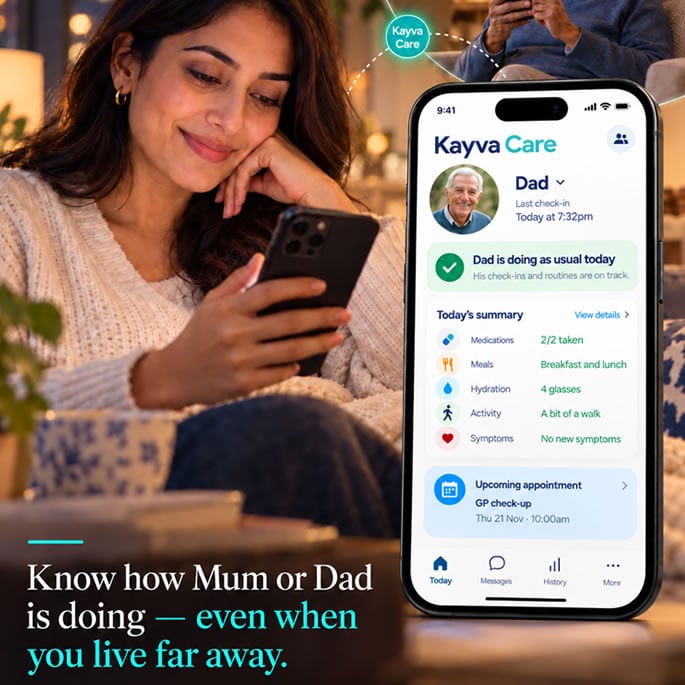
Kayva now centres on the period between conversations with an ageing parent, bringing together selected information over time rather than relying on individual check-ins.
Abhinav Rana says: “Today, the problem we are focused on is the gap between calling Mum or Dad and actually understanding how they have been doing over time.
“A phone call gives you a moment. We are trying to give families continuity.”
Privacy is Built into the Product
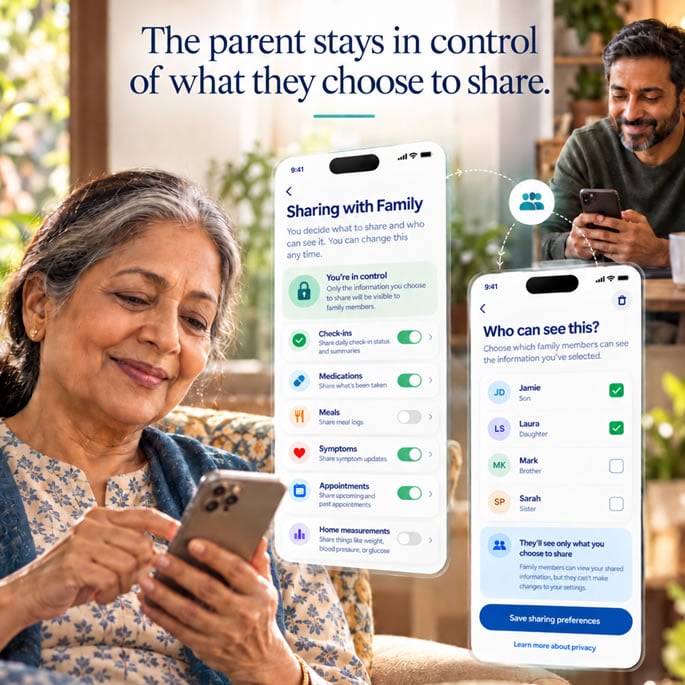
Kayva is designed around the idea that family involvement should not automatically mean unrestricted access to a parent’s information.
Parents and family members have separate identities, with sharing controlled by the parent.
Rana states: “That has been one of the most important design principles from the beginning.
“I never wanted Kayva to feel like a surveillance product.”
Parents can choose to share check-ins, medication records, symptoms, routines, appointments, home measurements and supported wearable information.
Permissions can also be changed if their preferences change.
Rana continues: “The parent and the family member have separate identities within Kayva, and the parent remains in control of what information is shared between them.
“The family member does not simply get unrestricted access to everything.”
“And a wearable is not required. If someone already uses a supported device and wants that information included, it can add useful context, but Kayva should still work for someone who does not want to wear anything at all.”
For family members, the aim is to provide useful context without turning the platform into a continuous monitoring dashboard.
Rana says: “For example, the useful thing is not necessarily seeing every individual activity or health reading.
“It is being able to understand that Mum checked in today, took her morning medication, ate, went for her usual walk and things appear broadly consistent with her normal routine.
“And if nothing important has changed, Kayva should be comfortable saying that. We do not want to manufacture alerts or create anxiety simply to make the product feel active.”
Building Kayva as a Solo Founder
Abhinav Rana developed Kayva by himself, with the first usable version taking around six weeks to build.
He says: “It has been intense because I have built Kayva completely on my own so far.”
Rana was studying medicine when he decided to take a year out to focus fully on the company.
Alongside development, Rana spoke to users and adapted the product according to where they were finding value. That process also influenced how much information Kayva should present.
Early versions included greater complexity, with features such as blood glucose monitoring. Some may return in the future, while others were removed because they did not fit the product’s purpose.
He admits: “The more I worked on it, the more I realised that adding another feature is easy. Removing one is much harder.”
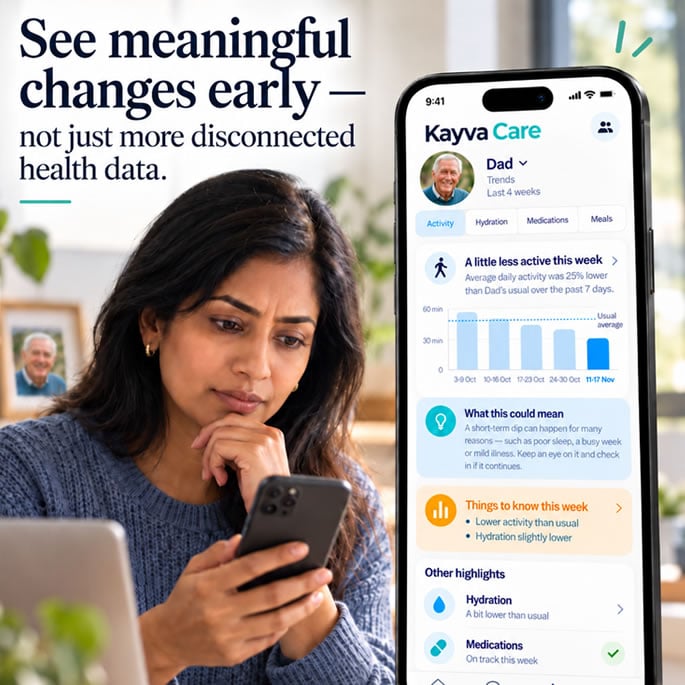
The resulting product puts greater emphasis on interpreting information than displaying it. Rana wants families to be able to identify meaningful changes without having to work through large amounts of data.
He details: “If a family opens Kayva and sees twenty different measurements, charts and alerts, we have probably failed.
“They should not need a medical degree to understand what they are looking at.”
This has meant reducing the product to a smaller set of questions around changes, individual patterns and relevant context.
He elaborates: “The product increasingly became less about showing everything we technically could and more about answering a few useful questions:
“What changed?
“Is this actually unusual for this person?
“Is it something worth knowing about?
“What context helps explain it?”
AI and the Future of Healthcare
Throughout the development process, AI was used, with Kessa serving as the intelligence layer.
Abhinav Rana explains: “Kessa is the intelligence layer within Kayva.
“Its role is not simply to generate text. It helps turn health and wellbeing information into something a person can actually understand.”
Rana has also used AI to accelerate coding, debugging, prototyping and testing while building the product.
“As a solo founder, AI has allowed me to move at a speed that would have been almost impossible for one person a few years ago.
“But I think there is an important distinction between using AI to move faster and outsourcing the thinking to AI.”
Kayva is intended to support understanding rather than replace medical professionals or create unwarranted certainty.
Rana says: “In healthcare especially, AI also needs boundaries.
“I do not want Kayva pretending to be a doctor or creating certainty where certainty does not exist.”
The current focus on ageing parents forms the starting point for a much broader ambition, as he reveals:
“My ambition for Kayva is much bigger than elderly care.”
His proposed progression begins with the relationship between a parent and family member before potentially extending to carers, nurses and clinicians.
Rana’s longer-term goal is to address the large amount of information generated between healthcare appointments, when changes can occur without being captured by traditional healthcare interactions.
Hardware could also be explored as the company develops, particularly where existing devices cannot provide the information required. It is not currently necessary for Kayva to operate.
Rana ultimately wants the platform to support earlier understanding and better care while helping families remain connected, with the current product representing the starting point for that wider vision.
Kayva Health is currently focused on a problem that many families face when an ageing parent lives at a distance: staying connected does not always mean knowing how they are doing.
Abhinav Rana’s approach is to give families more context without taking control away from the parent, with privacy and permission built into the way the platform works.
His longer-term plans would see Kayva move beyond the parent-family relationship and potentially involve carers, nurses and clinicians.
For now, the focus remains on making the time between phone calls more visible and useful for families.