

















































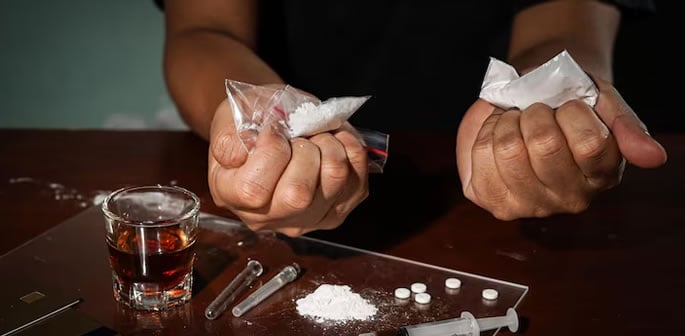
“in the Asian community we are the first generation of Class A drug users.”
Drugs and alcohol use affect South Asians in Britain, with research documenting alcohol dependency, cannabis and other substance use across different communities.
Studies show that cultural expectations, family relationships and stigma can influence how substance use is experienced and discussed.
Young people are also part of the conversation, with cannabis and nitrous oxide among the substances examined in UK research.
Women can face particular stigma, while men may experience pressures around masculinity, family expectations and seeking treatment.
So, what does the evidence tell us about drugs and alcohol among South Asians in Britain?
Substance Use is Not Absent from South Asian Communities
South Asian communities have historically reported lower levels of some alcohol and illicit drug use than the wider UK population.
However, lower reported use does not mean substance use is absent from South Asian communities.
Research has documented alcohol and drug use among British Bangladeshi, Pakistani, Indian and other South Asian populations.
Studies have also examined how social disadvantage, family circumstances and local environments can influence people’s experiences with substance use.
Research involving British Bangladeshis in London explored the experiences of people accessing treatment for problematic drug use.
One participant described the changing reality within his community, saying:
“I think, in the Asian community we are the first generation of Class A drug users.”
The participant, identified as Danish, connected drug use among young people with limited opportunities and the availability of drugs in his local area.
Earlier research also examined heroin use and drug dealing within an English Asian community.
The findings showed how drug markets could operate through particular local and social networks.
Together, these studies challenge the perception that drug use is separate from South Asian communities.
Instead, they show that substance use can affect South Asians in Britain, even when it receives limited public attention.
Cannabis and South Asian Young People

Cannabis has featured in research examining substance use among South Asian young people in Britain.
A 2017 study examined Bangladeshi and Pakistani adolescents accessing a drug service in Northern England.
Researchers interviewed 43 adolescents and professionals working with young people.
Participants reported extensive experience of smoking skunk cannabis, while professionals also reported cannabis use among young Asians.
The researchers concluded that cannabis appeared to be becoming normalised within some Asian communities.
However, this does not mean South Asian teenagers generally have higher cannabis use.
An earlier East London study of 2,789 pupils found lifetime cannabis use was actually lower among Bangladeshi, Indian and Pakistani adolescents than White British pupils.
The findings show that cannabis use varies between communities and individuals.
They also demonstrate why South Asian young people should not be treated as one group when discussing substance use.
The “Balloons” Conversation

Nitrous oxide, commonly known as “balloons”, has become part of Britain’s wider conversation around youth substance use.
National data shows that use among young people has fallen, rather than increased.
The Office for National Statistics found that 1.3% of 16 to 24-year-olds used nitrous oxide in the year ending March 2025.
This was down from 3.3% in the previous year.
However, nitrous oxide remains significant among young people receiving drug treatment.
Government figures show that 15% of young people in treatment during 2024/25 reported problems with nitrous oxide.
This compares with 16% during 2023/24.
The Advisory Council on the Misuse of Drugs has also highlighted health concerns associated with nitrous oxide use.
These include neurological problems linked to repeated or heavy use.
There is currently no reliable national evidence showing that South Asian teenagers use nitrous oxide at higher rates.
However, South Asian young people remain part of Britain’s wider youth substance-use landscape.
The available evidence therefore supports discussing “balloons” as a youth issue without attributing higher use to South Asian teenagers.
Women and Alcohol

South Asian women can face particular stigma around alcohol dependency, with family expectations making substance use difficult to discuss.
A 2024 study examined 18 South Asian women in England with personal experience of alcohol dependency.
Participants described shame, stigma and concerns about family dishonour connected to izzat, or family reputation.
Family relationships could have different effects.
Some women experienced misunderstanding or judgement, while others received support after their families understood their experiences.
One woman in recovery described how hidden substance use can be among South Asian women:
“Asian women drinking or taking whatever substances is such a hidden part of addiction.”
The findings show that family should not simply be viewed as a barrier to recovery.
For some women, relatives can become an important source of support.
However, fear of judgement can make disclosure more difficult.
The 2026 ACMD review found that izzat and family honour can affect South Asian women’s treatment engagement, potentially “pushing their use into hiding”.
Government guidance also recognises additional stigma around alcohol among some ethnic minority women.
It recommends culturally inclusive services without making assumptions about ethnicity or religion.
The Pressure on South Asian Men

The conversation around South Asian substance use should not overlook men.
While discussions often focus on women and cultural stigma, research has also examined substance use among South Asian men.
A 2026 study explored substance-use disorder among Panjabi men and examined how cultural identity shaped their experiences of treatment and recovery.
The researchers found that expectations around masculinity, family responsibility and providing financially could influence how men understood their substance use.
One participant described these expectations, saying:
“A good man is somebody who can provide for his children, his family, and his wife.”
Such expectations can create pressure to appear strong, responsible and capable of managing difficulties independently.
For some men, this may make acknowledging dependency or seeking support more difficult.
The findings show why substance use among South Asians should not be framed solely around women’s experiences.
Men can also face cultural expectations that influence how they understand addiction, recovery, and asking for help.
Breaking the Silence

Drugs and alcohol are not issues that exist outside South Asian communities.
Evidence has documented substance use among British Bangladeshis, Pakistanis, Indians and other South Asian groups.
Research has explored cannabis among young people, heroin use, alcohol dependency and treatment experiences.
National figures also show that nitrous oxide remains part of the wider youth substance-use picture, despite falling use among 16 to 24-year-olds.
There is no single South Asian experience of drugs and alcohol.
The evidence shows the importance of discussing substance use without stereotypes or assumptions.
Breaking the silence does not mean normalising harmful drug or alcohol use.
It means creating space for honest conversations, early support and greater understanding.
For South Asians, that conversation must include young people, men, women, families and people experiencing dependency.
Substance use exists within South Asian communities.
The challenge is ensuring stigma does not prevent people from seeking help.