

















































"I screamed non-stop for 45 minutes."
Naga Munchetty revealed how her agonising womb disorder was dismissed by doctors for over three decades.
At times, the BBC Breakfast presenter’s battle with adenomyosis has left her screaming in agony, in pain so severe she would lose consciousness and with no option but to call an ambulance.
Ms Munchetty has suffered with the symptoms since the age of 15.
However, she told MPs she was not taken seriously, gaslit and urged to “suck it up”.
She revealed how adenomyosis has left her “paranoid” about bleeding through clothes while on her period.
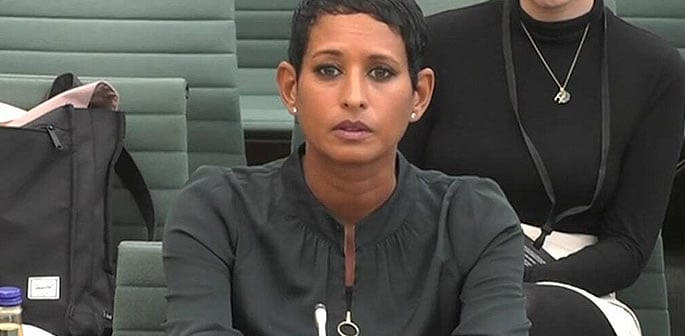
At the Commons Women and Equalities Committee, Naga Munchetty said:
“I started my period at 15. It would last for 11 or 12 days.
“Eight or nine of them were very heavy. I’d throw up on the first day, pass out once or twice during the cycle. I’d be wrapped around a toilet.
“I’d still go to school. I still went to work. Whenever I went to the doctor I was told it was normal.”
This was “especially” prevalent in “male doctors who’ve never experienced a period and then by female doctors who hadn’t experienced period pain”.
Ms Munchetty continued: “For work, I wouldn’t sleep because I’d set an alarm at 2 am to change the towel and super heavy tampon.
“It made relationships difficult, I’ve have had very understanding partners.
“My adenomyosis wasn’t diagnosed until 47.”
Ms Munchetty first revealed she was suffering from the condition in May 2023, saying that her husband had been forced to call an ambulance.
She said: “The pain was so terrible I couldn’t move, turn over, sit up.
“I screamed non-stop for 45 minutes.
“And then it happened again in the middle of the night and we had to call an ambulance because I couldn’t be moved. And I was just screaming.”
Addressing the committee, Ms Munchetty also revealed how she “never said anything at school”.
She added: “I worried about bleeding through my uniform, it happened. I wore shorts and two pairs of tights.
“I never said anything to my employers, I would be dosed up on painkillers. Sometimes still am. You learn to take two paracetamol then two Nurofen. I tend to exceed what you should take.
“You time your painkillers, you become almost paranoid about when you take the toilet break.
“I’m on air for four hours, in the regional ops – the two or three-minute break – I will make sure to flag half an hour before when I need to go.
“No one can be in that toilet, I will be grumpy if someone is in. I have to go. There’s an immense pressure on your bladder too, from a swollen uterus.”
Naga Munchetty also acknowledged she was “fortunate enough to be able to have private healthcare” and said accessing it was the “only time I felt I could sit there and take time and force an issue, force understanding, force explanations from my gynaecologist”.
She added it was the only time she could “not feel bad that I was taking up more than 10 minutes of my GP’s time because there was a queue of people in the waiting room”.
Ms Munchetty said: “No woman says she’s in pain unless she is in real pain.
“No woman says she is anxious unless she is really anxious.”
“No woman wants to appear weak or appear incapable until she really is, until she can’t cope anymore. And it shouldn’t be that way.”
But she acknowledged that is “really easy to dismiss men as not caring”.
After sharing her experience on her Radio 5 Live Show, one listener got in touch and said his partner has adenomyosis and endometriosis.
Ms Munchetty explained: “He said it’s really hard on partners to have to witness their loved ones in agony and powerless to do anything about it.
“That was typical, I had lots of men get in touch after 5 Live.
“They’re not given the information. They’re expected often to just sit there and be quiet while their partner or female loved one says they’re experiencing this.
“Because they’re not experiencing it, they’re almost not allowed to say it.
“What they witness, the pain, the anxiety, the sleepless nights, the stress, the physical discomfort, it’s almost like that’s not important.
“They do want to be involved. They certainly don’t have the tools or information to help.”
It is estimated that 10% of women suffer from adenomyosis, which can remain undiagnosed for years.
Adenomyosis occurs when the lining of the womb — the endometrium — buries deep in the muscular wall of the uterus.
The displaced tissue continues to act normally — thickening, breaking down and bleeding — during each menstrual cycle. This can result in an enlarged uterus and painful, heavy periods.