

















































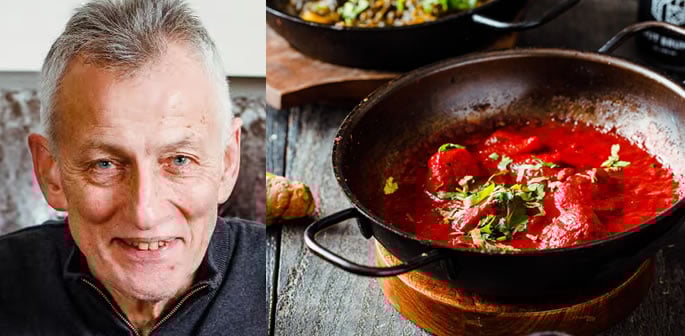
“It was me who coined this name."
A Birmingham resident is leading a one-man campaign to save the city’s most iconic dish – the Balti.
Andy Munro is a food writer, former bureaucrat and lifelong Brummie.
He’s on a mission to protect the famous curry, which is cooked and served in thin, steel-pressed woks that resemble the good-old sub-continental kadhai but are shallower and called Balti, a bucket.
Andy said: “This autumn I am going to put a bid to the British government as they have a department for the protection of cultural heritage.
“I would like Balti to have a UNESCO-approved mark. I have sent them a video of Balti being cooked.
“Despite the large-scale shut-downs, there are close to 40 to 50 genuine Balti houses in Britain so I am not worried about the numbers.”
The dish, which rose to fame in the 1970s, once defined Birmingham’s food scene.
But where there were once bustling Balti houses across the city, only a few now remain. Andy still lives in the city’s Balti Triangle, a name he coined to replace what was previously called the Balti Belt.
He revealed: “It was me who coined this name.
“Earlier, this was called Balti Belt and it didn’t sound right. So I took some creative liberty and called it the Balti Triangle, inspired by the Bermuda Triangle.
“I had come up with this line – Balti Triangle, where you get in the sea of spices. But with time, what has remained is just Balti Triangle.”
Ladypool Road was once a Balti house hotspot for Brummies and tourists alike, but it now features Thai, Turkish and Lebanese restaurants.
Andy Munro credits the creation of Balti to a restaurateur from Pakistan-occupied Kashmir who came to Birmingham during the 1970s.
Eager to appeal to a broader, more affluent clientele, he developed a dish that could be cooked quickly, using lean meat off the bone and fresh vegetables.
Andy recalled: “They were very rough and ready eating places. Glass-topped tables and basin in the corner to wash your hands. They were very basic.”

The new dish had to be fast, something suited to busy British diners. Traditional Indian cooking methods didn’t fit the bill.
He continued: “They used ghee and that heavy-duty Indian kadhai was more suited for slow-cooking.
“So instead of ghee, he used vegetable oil since it has a higher smoke point. And he also thought about Balti, a thin flat-bottomed, shallow vessel with handles that was suited to sizzle on high flame.
“And it was made by Sikhs working in furnaces and factories around Birmingham.”
Unlike butter chicken or tikka masala, Balti is a British-born dish. And it can be cooked in under 10 minutes.
Balti can be made with chicken, lamb, vegetables and even daal but it is the cooking style which sets it apart. Because of the high flame, the bubbling sauce around the edges caramelises.
Traditionally, Balti is meant to be eaten straight from the vessel it’s cooked in, like a fondue.
But many restaurants today serve it in silver bowls, something Andy calls an insult to the dish.
He said: “That worries me, since I am a passionate Birmingham resident.
“When people come to Birmingham, they have heard about the famous Balti and they sit down to have it.
“If they are served in silver bowls, it is pseudo-Balti. That way, all the properties are lost. Then people would say ‘What’s the big deal about Balti? It’s just any other curry’. That’s what makes me determined.”
Andy Munro is now seeking official cultural recognition for the Balti from UNESCO and the UK government.
He hopes this will protect the dish from disappearing entirely and inspire a new generation to take pride in this spicy slice of British culinary heritage.