

















































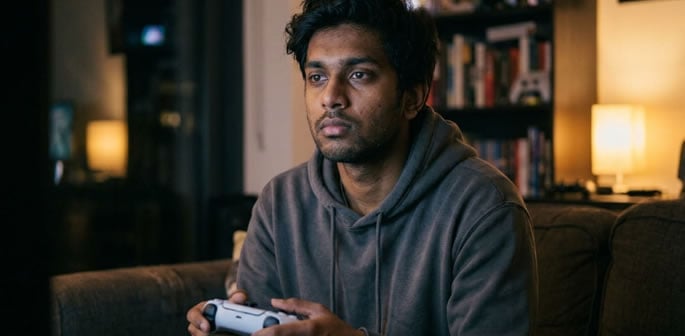
"Many of them described a feeling of emptiness"
Finishing a video game may leave players feeling empty but researchers say post-game depression is a real phenomenon.
A study published in Current Psychology suggests that this post-game emotional crash can be measured, tracked, and linked to wider psychological patterns.
The research focuses on the emptiness, sadness and sense of loss some players feel after finishing highly immersive video games.
It argues that these reactions are part of a broader emotional response tied to narrative depth and player investment.
Crucially, the study also connects these feelings to traits like rumination and existing mental health challenges, suggesting a more complex picture than the term first implies.
Building a Way to Measure Post-Game Emotions

The study, led by psychologist Kamil Janowicz and narrative designer Piotr Klimczyk of Orion Belt Games, set out to turn an anecdotal gaming experience into something measurable.
The pair developed the first quantitative tool designed to capture post-game depression and assess how widely it occurs across players.
Janowicz said the idea came directly from observing online communities:
“The idea came from experiences shared by video game players on social media, Discord, and Reddit.
“Many of them described a feeling of emptiness and a range of various emotions after finishing an engaging video game.
“First, my colleague, Dr Piotr Klimczyk, explored it in his qualitative study. Then, based on his findings, we developed a quantitative measure of post-game depression and conducted our research.”
To build the scale, researchers recruited active gamers who had recently finished a title they considered personally significant.
After filtering responses, the final sample included 210 adults with an average age of around 28. Most reported playing daily or almost daily.
Participants completed a draft 20-item questionnaire alongside established psychological assessments measuring depressive symptoms, rumination and reflection.
The team also recorded the genres of games played, allowing comparisons between different types of gaming experiences.
What the Data Reveals

The results point to a consistent pattern of emotional after-effects.
The final scale was refined to 17 questions across four categories: game-related ruminations, post-completion sadness or emptiness, the urge to replay the game, and media anhedonia, which describes a reduced ability to enjoy other media after finishing a game.
Janowicz said the findings confirmed what players had long described informally:
“We found empirical confirmation of a range of experiences after finishing the video game, as reported by video game players in recent years.
“Thus, post-game depression is real and could be measured in a reliable way with our questionnaire.
“We found that players spending more time on RPGs are more prone to experience more intense symptoms of post-game depression.
“As well as those who have a stronger tendency to ruminate and more problems with processing their emotions.”
Role-playing games appeared to be particularly linked to these effects.
These titles often demand long-term emotional investment, complex decision-making and sustained attachment to characters and narrative worlds.
That level of immersion may help explain why the emotional drop is sharper when the experience ends.
Klimczyk frames the findings within a wider emotional framework:
“I would add here that our research shows how video games can be a source of very complex and emotional experiences.
“We see our research fitting the overarching theme of eudaimonic experiences in video games, area of study that, we believe, will gain bigger traction in the future.
“Our study is but a small stepping stone towards that.”
A eudaimonic experience refers to media that offers meaning, reflection or personal growth rather than simple entertainment.
Limits, Risks and What Comes Next

Despite the scale of the findings, the researchers are careful not to overstate the clinical meaning of post-game depression, stressing that it should not be confused with a diagnosable depressive episode, even if it can overlap with certain emotional traits.
Klimczyk clarified:
“In some cases, people implied that by ‘post-game depression’ we mean a clinical case of depressive episode.”
“This is not the case, although, as Dr Janowicz wrote, the link with lower mental health exists.
“The term was coined by the gamers. Googling ‘post-game depression’ before our research gained traction, one would find a vast amount of Reddit posts about that specific feeling that they described by using such a term. We decided to keep it that way.”
The study’s biggest limitation is its cross-sectional design, which captures only a single moment in time. That makes it impossible to prove causation.
Janowicz acknowledged this clearly: “Our study was cross-sectional, so it is not possible to determine causal relationships between observed variables.
“For example, it is possible that players with lower mental health are more prone to experience post-game depression after finishing the game, but it is also possible that post-game depression may lead to a decline in their mental health.”
Future research will need to follow players over longer periods to understand directionality.
Janowicz said: “Longitudinal research will be a huge step toward overcoming the limitations of our research.
“It would allow us to determine causal relationships and assess what are antecedents and consequences of post-game depression.
“Moreover, comparing players from various countries will be very interesting.”
Even with its limitations, the study offers one of the clearest attempts yet to define a widely recognised but under-researched gaming experience.
It suggests that emotional responses to video games can extend well beyond playtime, shaped by narrative depth, player investment and psychological traits.
For some, finishing a game may resemble the end of a meaningful chapter rather than simple entertainment.
Researchers say the next step is expanding the evidence base and refining how these experiences are understood across different cultures and gaming styles.
Janowicz summed up the broader reception: “We got a lot of interest and attention on our findings around the world.
“Many people contacted us to discuss our findings.
“That’s very nice to see this work inspire many people and be interesting to video game players, who found it valid and described their real feelings.”