

















































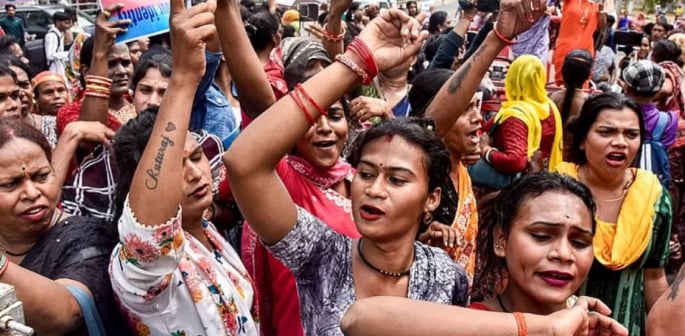
The debate has quickly escalated into a broader political issue.
India’s proposed Transgender Persons Amendment Bill, 2026, has triggered widespread concern among activists, legal experts, and opposition leaders.
Introduced in the Lok Sabha, the Bill seeks to amend the 2019 Transgender Persons Act.
While the government frames it as a clarification, critics argue it represents a significant rollback of rights.
The proposed changes have reignited debates around gender identity, autonomy, and constitutional protections.
Many within the queer community fear the legislation could reshape legal recognition in restrictive ways.
The Bill was introduced around March 12 to 13, 2026, by Union Minister for Social Justice and Empowerment Dr Virendra Kumar.
It aims to modify provisions related to recognition, protection, and definitions under the existing 2019 law.
Officials claim the amendments are intended to streamline procedures and prevent misuse of identity recognition.
However, this framing has been strongly challenged by advocacy groups and legal commentators.
Concerns centre on whether the Bill undermines principles established by earlier legal frameworks.
One of the most contentious changes involves redefining who qualifies as a transgender person under the law.
The 2019 Act included individuals whose gender identity did not match their assigned sex at birth, including trans men, trans women, and genderqueer individuals.
The amendment removes this broader definition and replaces it with a narrower, category-based approach.
It explicitly excludes people with different sexual orientations or self-perceived identities.
Critics argue this effectively erases large sections of the transgender and non-binary community from legal recognition.
The Bill also introduces new categories, including individuals identified as eunuchs and those forced into transgender identities through harmful practices.
While the inclusion of protections against forced identity is welcomed in principle, activists say the broader implications remain troubling.
They argue the focus shifts away from lived realities and towards rigid classifications.
This, they believe, risks further marginalising already vulnerable groups.
Many fear it could institutionalise exclusion rather than expand protections.
Another major change is the removal of self-identification as a legal principle.
The 2019 Act recognised a person’s self-perceived gender identity as central to their rights.
The amendment replaces this with a system requiring medical and administrative verification.
This includes certification by a District Magistrate based on recommendations from a medical board.
Critics argue this contradicts the Supreme Court’s 2014 NALSA judgment, which affirmed self-identification under the right to dignity and privacy.
Under the proposed framework, individuals seeking legal recognition must undergo evaluation by medical authorities.
The Bill also mandates that gender-affirming surgeries be reported to the District Magistrate.
A revised certificate becomes compulsory following such procedures.
Activists describe these measures as intrusive and pathologising.
They warn that it could lead to increased surveillance and gatekeeping in access to legal documentation and healthcare.
The amendment retains existing penalties for offences such as abuse or denial of services.
However, it introduces stricter punishments for forcing someone into a transgender identity through violence or coercion.
These include prison terms ranging from ten years to life imprisonment, along with substantial fines.
While these provisions are intended to address serious harm, critics argue they do not reflect the realities of violence faced by transgender individuals.
Instead, they say the Bill prioritises control over protection.
Opposition parties and rights groups have strongly condemned the proposed changes.
Many have called for the Bill to be withdrawn, describing it as regressive and unconstitutional.
They argue that replacing self-identification with medical certification violates bodily autonomy and personal dignity.
View this post on Instagram
Legal experts have also raised concerns about potential challenges under constitutional rights to equality and privacy.
The debate has quickly escalated into a broader political issue.
Within the transgender and queer community, the reaction has been particularly intense.
Activists have described the Bill as an erasure of identities and a setback for hard-won rights.
Concerns include exclusion from welfare schemes and increased barriers to accessing essential services.
Advocacy groups warn that the amendments could weaken community support structures.
They argue it recentres authority in the hands of the state and medical institutions.
The controversy also highlights wider tensions around LGBTQ+ rights in India.
While the NALSA judgment marked a progressive step in recognising gender identity, subsequent developments have remained uneven.
Ongoing debates around marriage equality and discrimination continue to shape the legal landscape.
Many see the 2026 amendment as part of a broader shift towards more restrictive interpretations of identity.
This has raised fears about its long-term implications.
As discussions continue in Parliament, the future of the Bill remains uncertain.
However, the intensity of the backlash signals deep concerns about its impact.
For many, the issue goes beyond legal definitions and touches on fundamental questions of dignity and self-determination.
The coming weeks are likely to see further debate, both within political circles and across civil society.
The outcome could significantly influence the direction of transgender rights in India.