













































"It can actually set the country on fire."
India’s elections are ongoing, however, the rise of AI and deepfakes are influencing it.
However, this is not a new thing.
In November 2023, Muralikrishnan Chinnadurai was watching a livestream of a Tamil-language event in the UK when he noticed something strange.
A woman introduced as Duwaraka, daughter of Tamil Tigers chief Velupillai Prabhakaran, gave a speech.
But the issue was that Duwaraka had died in 2009.
Mr Chinnadurai, a fact-checker in Tamil Nadu, watched the video closely and spotted glitches. He soon pinned it down to being an AI-generated figure.
Mr Chinnadurai said: “This is an emotive issue in the state [Tamil Nadu] and with elections around the corner, the misinformation could quickly spread.”
AI Content being Created

As India’s elections continue, it is impossible to ignore the amount of AI-generated content being created.
From campaign videos to personalised audio messages and even automated calls made to voters in a candidate’s voice, there is a variety of content being created.
Content creators like Shahid Sheikh have even used AI tools to show Indian politicians in never-before-seen avatars – wearing athleisure, playing music and dancing.
But as AI tools become more sophisticated, there is concern about misinformation.
Former Chief Election Commissioner SY Qureshi said:
“Rumours have always been a part of electioneering. [But] in the age of social media, it can spread like wildfire.
“It can actually set the country on fire.”
What has Narendra Modi said about the Issue?

It is not just India’s political parties that are taking advantage of AI technology.
In Pakistan, it allowed the imprisoned Imran Khan to address a rally.
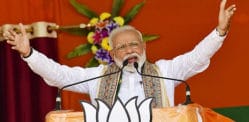
And in India, Prime Minister Narendra Modi has also already made the best of the emerging technology to campaign effectively.
Using the government-created AI tool Bhashini, he addressed an audience in Hindi and it was translated into Tamil in real time.
But it can also be used to manipulate messages.
In April 2024, videos of Ranveer Singh and Aamir Khan appeared to show them campaigning for the Congress Party.
Both actors filed police complaints, saying they were deepfakes made without their consent.
On April 29, Modi voiced concerns about AI being utilised to manipulate speeches by senior leaders of the ruling party, including himself.
The following day, police apprehended two individuals – one from the opposition Aam Aadmi Party (AAP) and another from the Congress party – linked to a doctored video of Home Minister Amit Shah.
Modi’s Bharatiya Janata Party (BJP) has also encountered similar allegations from opposition leaders.
Experts point out that, despite these arrests, there is still a lack of comprehensive regulation to address the issue.
According to data and security researcher Srinivas Kodali, this means that “if you’re caught doing something wrong, then there might be a slap on your wrist at best”.
Without regulation, creators have said they have to rely on personal ethics to decide the type of work they choose to do or not do.
Deepfake Issues

Among the requests from politicians were pornographic imagery and the morphing of videos and audio of their rivals to damage their reputation.
Divyendra Singh Jadoun revealed: “I was once asked to make an original look like a deepfake because the original video, if shared widely, would make the politician look bad.
“So his team wanted me to create a deepfake that they could pass off as the original.”
Mr Jadoun is the founder of The Indian Deepfaker (TID), which created tools to help people use open-source AI software to create campaign material for Indian politicians.
He insisted on having disclaimers on his creations so it is clear it is not real. However, it is still hard to control.
Shahid Sheikh has seen his work shared without permission or credit by politicians or political pages on social media.
He said:
“One politician used an image I created of Mr Modi without context and without mentioning it was created using AI.”
It has become so easy to create a deepfake that anyone can do it.
Mr Jadoun explained: “What used to take us seven or eight days to create can now be done in three minutes.
“You just need to have a computer.”
Despite the concerns, India initially said it was not thinking about an AI law.
However, in March 2024, the government took action after controversy was sparked over Google’s Gemini chatbot response to a query asking: “Is Modi a fascist?”
Rajeev Chandrasekhar, the junior information technology minister, stated that this violated the country’s IT laws.
In response, the Indian government has mandated that tech companies obtain explicit permission before publicly launching “unreliable” or “under-tested” generative AI models or tools.
Additionally, it has cautioned against responses from these tools that could “threaten the integrity of the electoral process”.
However, fact-checkers argue that these measures are not enough.
They emphasise that debunking such content is a daunting task, especially during elections when misinformation surges.
Mr Chinnadurai said: “Information travels at the speed of 100km per hour.
“The debunked information we disseminate will go at 20km per hour.”
Mr Kodali says that these fakes are making their way into the mainstream media. Despite this, the “election commission is publicly silent on AI”.
Mr Kodali said: “There are no rules at large. They’re letting the tech industry self-regulate instead of coming up with actual regulations.”
Experts admit there is not a foolproof solution in sight.
Mr Qureshi added: “But [for now] if action is taken against people forwarding fakes, it might scare others against sharing unverified information.”