












































"I had enormous empathy for Merle Oberon’s struggle."
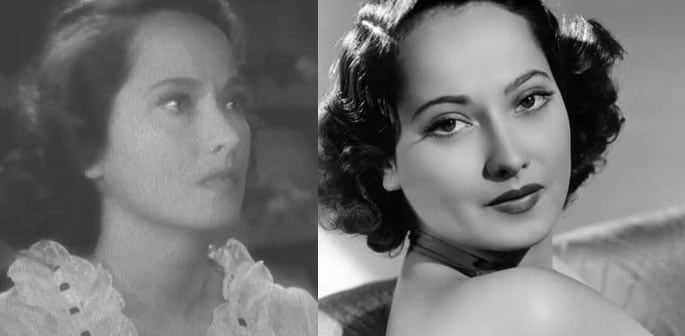
Merle Oberon is a star of Hollywood’s Golden Age and she is the subject of a new biography that brings her hidden Indian heritage into focus.
For decades, Merle concealed her mixed-race background, a secret that only gained mainstream attention in 2023.
When Michelle Yeoh was nominated for the Best Actress Oscar for Everything Everywhere All at Once, reports initially said she was the first Asian woman to achieve the honour.
That claim was soon corrected—Merle Oberon had received the same nomination in 1935 for The Dark Angel.
Michelle Yeoh won her Oscar while Merle Oberon lost to Bette Davis.
The truth about Oberon’s heritage had been uncovered in the 1980s but was largely overlooked. Now, Mayukh Sen’s upcoming book Love, Queenie seeks to reclaim her story with nuance and energy.
Mayukh writes: “As a teenager, I had enormous empathy for Merle Oberon’s struggle.”
Unlike others who idolised Golden Age stars, Mayukh was drawn to Merle, recognising both her desire to hide a secret and traces of her South Asian accent.
His biography aims to inspire audiences to revisit her work.

For much of her life, Merle Oberon lived behind a fabricated identity.
Fans heard she was a British actress born in Tasmania, raised by her British officer father and his wife in India until adolescence and then brought to England.
In actual fact, she was born Estelle Merle Thompson in 1911 in what is now Mumbai.
Her mother’s family was of Sri Lankan descent, while her father was an unidentified British soldier.
Raised in poverty, she faced discrimination as a mixed-race woman in colonial India.
Even her family history was shrouded in secrecy. The woman she believed to be her mother was actually her grandmother. Her real mother posed as her older sister.
This type of hidden lineage was not unique—Jack Nicholson’s family had a similar story. Dubbed “Queenie” by her grandmother, she sought an escape.
A wealthy admirer paid for her journey to London in 1929, where she pursued acting despite early struggles.
Her big break came when director Alexander Korda took her under his wing, rebranding her as Merle Oberon.
She trained to erase her Indian accent while Alexander’s team crafted a background story claiming she was from Tasmania.
Reinventing one’s identity was common in Hollywood, but for Merle Oberon, the stakes were higher.
With South Asians barred from entering the United States under racist immigration laws, her career would have been impossible without this deception.
Merle Oberon gained Hollywood contracts, balancing work in England and America.
By 1939, she was at her peak, starring as Cathy in Wuthering Heights alongside Laurence Olivier.
However, behind the scenes, she suffered.
Laurence Olivier, resentful that his wife, Vivien Leigh, was passed over for the role, mistreated her. Stress and illness led to her hospitalisation.
At the same time, she lived lavishly with Alexander, though she was not as devoted to him as he was to her, having at least one public affair.
Alexander returned to England to support the war effort and Merle did the same in the United States.
Merle’s complexion became another challenge.
Unlike other stars, she tanned easily, which led to difficulties on set.
Directors demanded she use skin lightening creams, some of which contained toxins.
Her worsening skin condition later inspired the invention of a high-intensity beauty light, which remains a staple in film today. She married its creator, cinematographer Lucien Ballard.
In his book, Mayukh Sen states Merle’s true identity put her in peril.

Hollywood’s Hays Code prohibited interracial relationships on screen, meaning Merle’s career relied on her perceived whiteness.
The lie, once a strategic decision, became a burden that dictated her life.
As she aged, opportunities dwindled.
Hollywood had little space for women over 40, even those as striking as Merle Oberon.
In the 1950s, she married Italian industrialist Bruno Pagliai and settled in Mexico, where they built a glamorous life in Acapulco. They adopted two Italian orphans, as Merle had undergone a medical procedure in India that left her unable to have children.
By the 1960s, social norms had shifted, but Merle refused to acknowledge her past.
She supported Republican politics and Governor Ronald Reagan.
In 1973, she produced and starred in Interval, a film widely dismissed as outdated.
Yet she remained modern in some ways—she left Bruno Pagliai and married her co-star Robert Wolders, 25 years her junior.
Merle Oberon’s life was filled with contradictions—romances, reinventions, and missed opportunities.
In Love, Queenie, Mayukh Sen argues that instead of condemning her silence, we should understand the racism she endured and the impossible choices she faced.
Her legacy remains complex, but her impact on film history endures.