

















































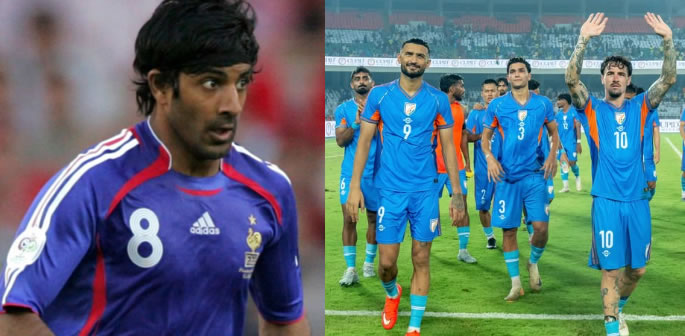
"Indian football's ranking just does not make sense."
India has no shortage of football supporters, but it continues to lack the international results that such passion might suggest.
That contradiction was on full display in Kolkata, where more than 50,000 supporters watched India face five-time world champions Brazil on October 3.
The 4-0 defeat ultimately reflected the enormous gap between the two nations, but the occasion also provided a reminder of the appetite for top-level football in India.
For former France international Vikash Dhorasoo, however, the bigger question is why a country of more than 1.4 billion people has yet to consistently produce players capable of competing at that level.
Dhorasoo, who played in a World Cup final and played for AC Milan, believes his own career proves that players of Indian descent can reach the summit of the sport.
He argues that India’s challenge is not a lack of potential, but creating the structures capable of turning that potential into elite footballers.
India’s Football Paradox
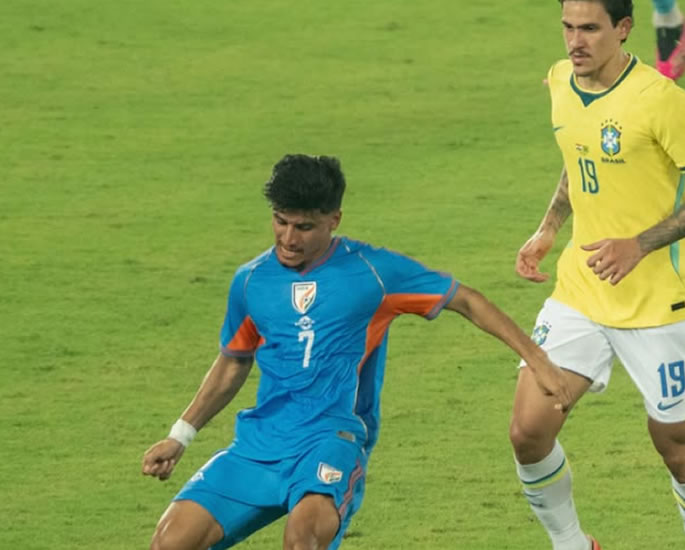
India is currently 138th in the FIFA rankings, a position that sits uncomfortably alongside the scale of the country’s population and the passion for football in traditional strongholds such as Kolkata.
That ranking is not simply an abstract number.
India also failed to qualify for the 2027 AFC Asian Cup after finishing bottom of their qualifying group, despite ending the campaign with a 2-1 victory over Hong Kong. Singapore topped the group with 14 points, while India finished on five.
Dhorasoo said: “Indian football’s ranking just does not make sense. There is such a vibrant football culture in places, for example, like Kolkata.”
Kolkata provides perhaps the clearest example of that passion.
Football has long been embedded in the city’s sporting culture, with large and committed followings for its major clubs and a strong connection to international football.
Brazil’s visit only reinforced that relationship, with the national team’s arrival generating significant excitement among supporters before the match.
But passion alone does not produce international-level footballers.
That is where Dhorasoo believes India needs to look beyond the size of its potential talent pool and examine how young players are developed.
From Potential to Elite Players
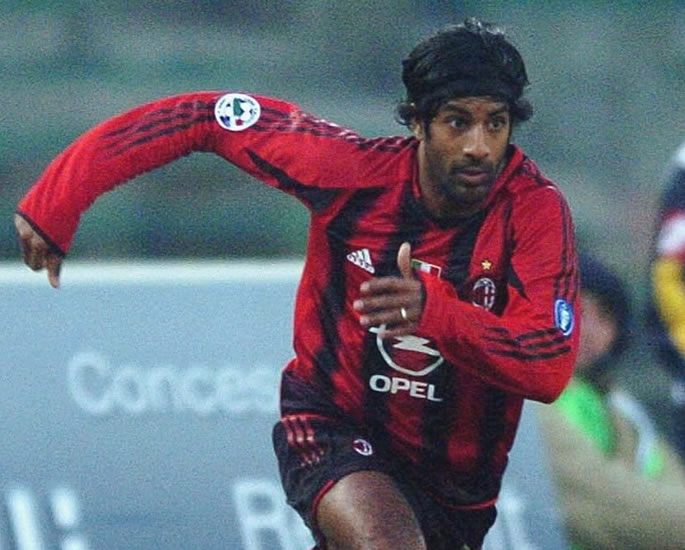
Vikash Dhorasoo drew on his own career.
Born in France to parents of Indo-Mauritian descent with ancestral roots in Andhra Pradesh, he developed through the French football system before playing for clubs including Lyon and AC Milan.
He also represented France at the 2006 World Cup, coming on as a substitute in the final against Italy.
He therefore understands first-hand what is required to move from a talented young player to someone capable of competing at the highest level of international football.
Dhorasoo said: “I’m living proof that Indian-origin players can reach the highest level of this sport.
“I don’t have any doubts that for a population of 1.4 billion, you can find gems who will be able to do what I did.
“Of course, performance depends on a lot of factors. It requires long-term planning, new methods and vision.
“I also believe it’s not always about the player; it’s also the coaches who need to play a significant role.”
Identifying talented children is only the beginning of player development. They also need access to quality coaching, appropriate competition and a clear pathway into senior football.
Dhorasoo’s visit to Kolkata was partly focused on examining those structures.
Invited by the All India Football Federation (AIFF) before the Brazil fixture, he planned to meet federation officials and visit academies to discuss how Indian football can develop its next generation.
He said: “I’m meeting Carlo Ancelotti tomorrow. I will meet the federation officials too and have an open conversation about developing Indian football.
“I’d like to see a few academies because my strongest belief is that it’s the youth who will take the country forward.”
“It would be awesome as well to be able to meet the women’s football team because this is where my journey started as a coach.”
The emphasis on youth is central. A stronger senior national team cannot be built overnight; its foundations have to be established years earlier through the development of young players.
That also makes coaching a critical part of the equation.
The most promising players can only progress if they are taught within an environment that develops their technical ability, tactical understanding and decision-making.
For India, improving that pathway is arguably more important than finding a quick solution to its senior team’s ranking.
Brazil exposed the Gap, and Opportunity
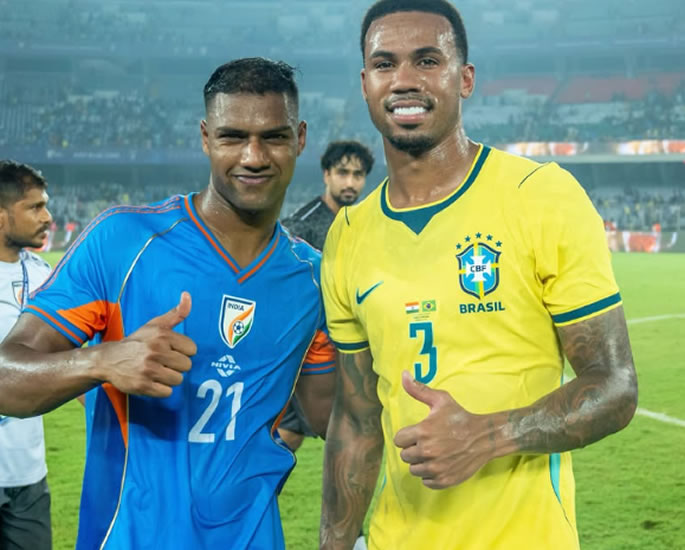
The Brazil fixture offered an unusually clear measure of where India currently stands.
Brazil arrived in Kolkata ranked fifth in the world and as five-time World Cup winners, while India were ranked 138th.
The match was also the first senior men’s international meeting between the two countries and represented the highest-ranked opposition India had faced since the FIFA World Ranking was introduced.
India initially showed enough organisation to frustrate Brazil, but the gap in quality soon became clear.
Estêvão opened the scoring before Pedro doubled Brazil’s advantage, while Samuel Lino added two further goals to complete a 4-0 victory.
The result was not unexpected. More significant for Indian football was the experience of competing against players operating within one of the world’s most developed football environments.
That was precisely the opportunity Dhorasoo wanted India’s players to embrace:
“My advice to the players is simple: enjoy the game to the fullest because it will be a moment to remember. These 90 minutes will teach you what it takes to play at the level Brazil are performing.
“Football is such a beautiful game that you can be a small team yet find solutions to create some problems to the giants.”
Before the match, Dhorasoo said the game ” should be a celebration of football”.
Although India could not cause an upset, the fixture still carried significance beyond the scoreline.
Brazil coach Carlo Ancelotti acknowledged that India made it difficult for his side to open the scoring, while India’s early defensive organisation demonstrated that the team could compete in spells even against vastly superior opposition.
However, the greater value lies in what happens after the spotlight moves elsewhere.
A high-profile friendly cannot fix India’s player-development system, improve coaching standards or change the national team’s fortunes on its own.
What it can do is expose players and coaches to a level of football that remains relatively unfamiliar to them while giving supporters and young players a tangible reference point for what the highest level looks like.
The ambition should be to create an environment in which reaching that level becomes increasingly realistic.
The Long Road Ahead
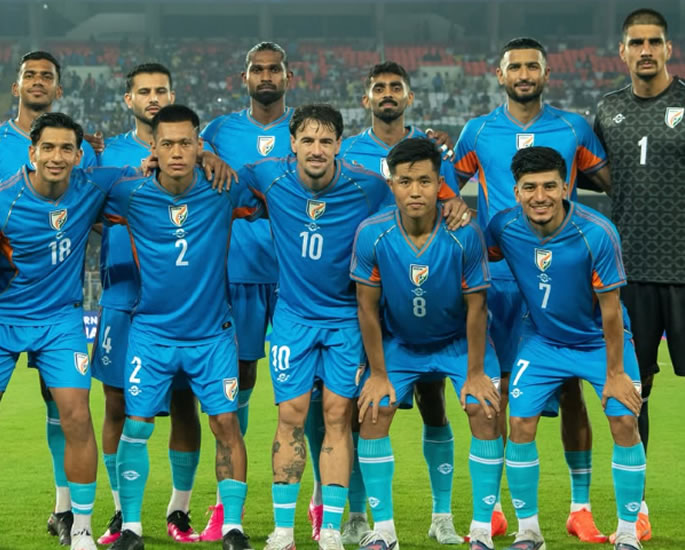
India’s football challenge is far bigger than its FIFA ranking, following a subsequent 6-1 loss to Uruguay.
The country already has many of the ingredients required to build a stronger football culture: a huge population, established pockets of passionate support, an expanding interest in the international game and a growing number of young players entering organised football.
The missing piece is turning those ingredients into a consistent development pathway.
Dhorasoo’s career demonstrates that Indian heritage does not place a ceiling on what a footballer can achieve.
But there is no suggestion that ancestry or population size alone can produce elite players. Planning, methods, coaching and youth development recognise that world-class footballers emerge from systems designed to help talent flourish.
That is particularly relevant after India’s failure to qualify for the 2027 Asian Cup.
The team’s final qualifying campaign produced only one win, two draws and three defeats, leaving it five points from six matches.
Those results underline why structural improvements matter.
If India wants to compete more consistently in Asia and eventually challenge stronger teams internationally, it needs more players capable of operating at a higher level.
That process begins long before a player pulls on the senior national shirt.
For Dhorasoo, the answer lies in giving young players better opportunities and ensuring coaches have the expertise to develop them.
The Brazil match has now come and gone, but its importance should not be measured by the 4-0 scoreline alone.
It gave India a glimpse of the standard it ultimately wants to reach and, equally importantly, highlighted the distance still to travel.
Indian football does not lack ambition, supporters or potential.
What remains uncertain is whether those ingredients can be converted into a system capable of consistently producing elite players and a stronger national team.
The recent defeats were a reminder of the gulf that remains, but they can also serve as a reference point.
If India’s football authorities, coaches, academies and clubs can use occasions like this to build better pathways for young players, the next generation may be better equipped to compete on the international stage.
The challenge now is ensuring that the excitement surrounding the high-profile friendlies contribute to a longer-term story about where Indian football can go.