






































"I felt this was a story that needed to be told."
The Model is set to screen at the UK Asian Film Festival, bringing a story that feels both personal and widely relatable to British South Asian audiences.
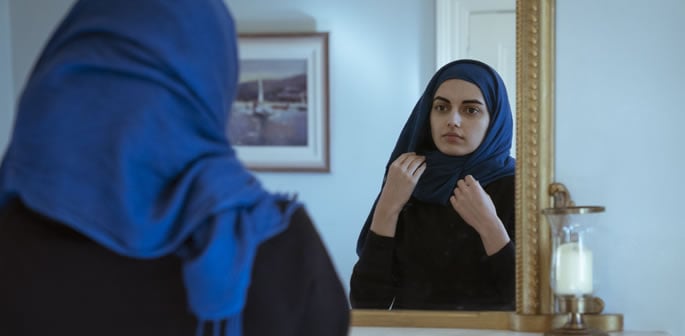
The film follows Daisy, a young South Asian woman caught between a modelling career she chose and a family narrative she didn’t, shaped by expectation, culture and faith.
It looks closely at the pressure to live up to certain standards, and the quiet ways people adjust themselves to fit what others want.
Directed, written and produced by Marcus Flemmings, the film is led by Sasha Vadher, who also co-produces and draws on her own lived experience to shape the character.
After premiering at Manchester Film Festival and the South Asian Chicago Film Festival, it now arrives at one of the UK’s key platforms for South Asian cinema.
In an exclusive interview with DESIblitz, Marcus Flemmings and Sasha Vadher break down the thinking behind the film and the experiences that shaped it.
A Story Shaped by Lived Experience
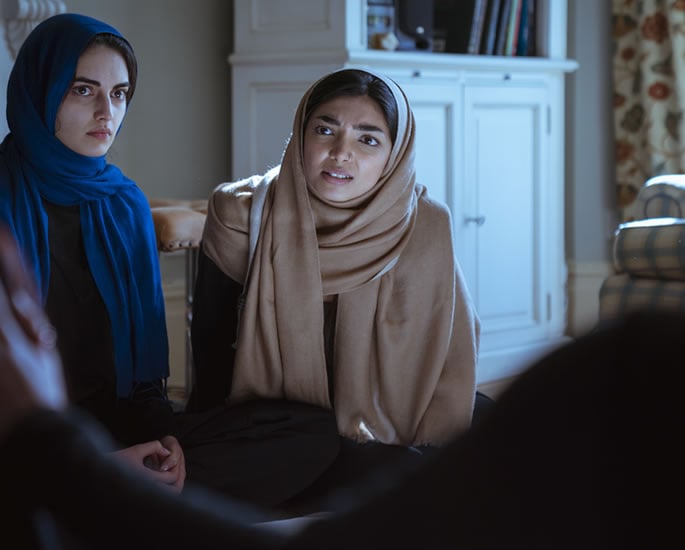
From its earliest conception, The Model was built to challenge what audiences assume a story like this should be.
For Marcus Flemmings, the title signals something far broader than the surface narrative:
“Working in the industry, I felt this was a story that needed to be told.
“The title itself refers to more than a fashion model; it’s society, and the model we’re all held to, whether that’s family, religious or cultural expectation.”
That idea reframes the film immediately, shifting focus from industry commentary to something more embedded in everyday life.
Marcus’ upbringing plays into that perspective. Growing up around different cultures, with a family shaped by varied backgrounds, meant seeing firsthand how identity is never fixed.
Meanwhile, that complexity was part of Sasha’s appeal:
“It’s a powerful, thought-provoking piece, the kind of story I knew would resonate.
“As an actress, it’s a privilege to go on such a journey with a character who is so multifaceted.”
That sense of multiplicity runs through the film’s foundation. It avoids simplifying identity into a single lens, instead allowing contradictions to sit side by side.
Those contradictions begin to take sharper form when the focus shifts to family, belonging and the pressures that come with both.
Navigating Culture, Ambition and Belonging
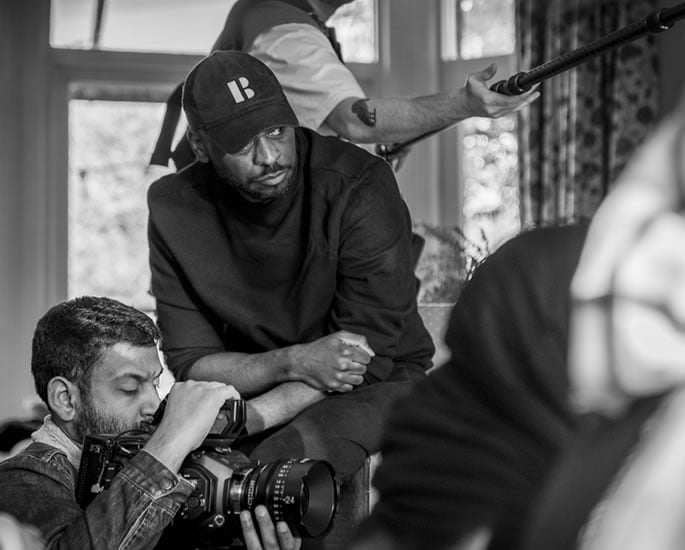
The Model‘s emotional weight sits within a familiar tension: the gap between what you want and what you are expected to be.
Marcus’ approach is shaped by his own background:
“Every culture comes with its own set of ambitions and expectations.
My family are Jamaican, and there’s a clear cultural expectation that comes with that – who you bring home as a friend or partner, what kind of job you do.
“That frequently sits in conflict with the values of British culture.”
For Daisy, that conflict is intensified by her dual heritage.
Resonating with that experience, Sasha says:
“Because the character has dual heritage, I was able to draw on my own real-life and lived experiences.”
“Daisy has to navigate belonging to two very contrasting cultures.
“She also has a sister she’s close to, which mirrors my own relationship with my sister and, much like Daisy, I’ve had to find my way through those two worlds myself.”
That navigation extends into career choices, where cultural expectations often carry more weight.
Sasha explains: “In South Asian culture, the academic route is encouraged far more than the creative one, and I’ve seen firsthand how people from South Asian backgrounds feel a pressure to fulfil those expectations.
“Having witnessed that so closely definitely informed my performance.”
These pressures are not isolated to background context. They shape how the character moves, reacts and makes decisions, which feeds directly into how the performance was built on set.
Emotional Truth through Collaboration
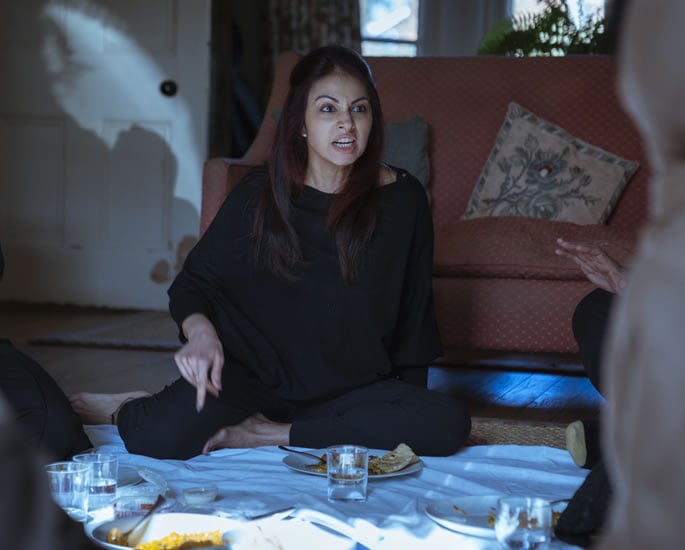
Rather than locking the character of Daisy into a fixed structure, Marcus Flemmings aimed to let the character evolve in real time, guided by instinct rather than strict adherence to script.
He explains: “I like finding the character off the page. On this film, I leaned heavily into Sasha’s instincts as an actor, what she felt was right in the moment, and then I’d guide the story based on what she did on set, rather than sticking rigidly to what was on paper.
“For the scenes in Morocco, I had no script at all. We went to Essaouira and improvised everything, with no other actors apart from Sasha. It’s a testament to her ability that the film still works.”
That approach allows moments to develop organically, particularly in scenes where emotional shifts are subtle or unpredictable.
For Sasha, maintaining authenticity within that freedom required a clear internal framework:
“My acting training drilled into me that intention and the given circumstances are crucial.
“So I was constantly questioning what Daisy was experiencing in any given moment, to be as authentic as possible. It helps you know the character better – even keeping a diary entry in her voice can work.”
Her involvement as co-producer also shaped how the character was realised.
This collaborative process becomes particularly important in how the film handles grief. Rather than presenting it as a defined arc, it remains inconsistent and unresolved.
Marcus reflects: “Like most people, I’ve experienced grief. How we process it varies from person to person.
“Sasha’s character, Daisy, chooses avoidance.
“Sasha’s performance is extraordinary. Honestly, there’s maybe 0.01% of actors in the UK, possibly the world, who could have pulled off the complexities of this character the way she has. She’s an enormous talent.”
That unpredictability in emotion carries through into the film’s visual language and wider storytelling choices.
Representation and Challenging Industry Norms
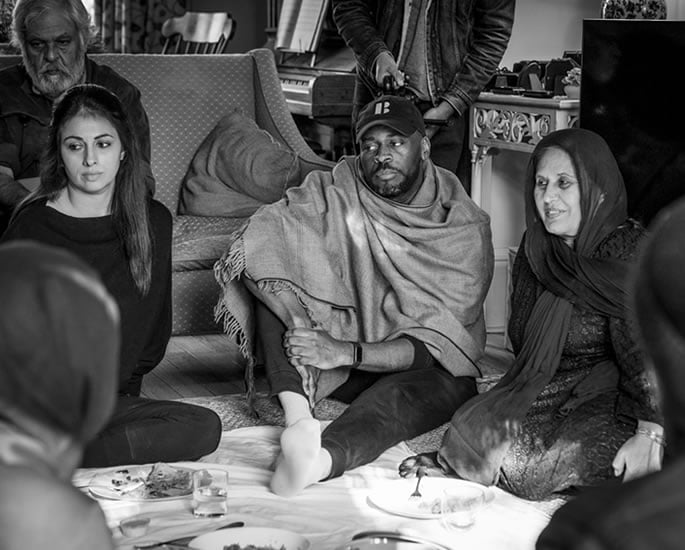
The Model‘s visual and casting decisions sit within a broader response to how British stories are typically framed, as Marcus admits:
“I’m tired of British dramas that are either period pieces, council estate stories, or films that lean into cultural stereotypes like Top Boy.
“I didn’t grow up identifying with gang culture, and a lot of British South Asians didn’t grow up seeing themselves in how TV and streaming services have typically portrayed them either.
“Haider Zafar, my long-time collaborator and, by a distance, the best Director of Photography in the UK, comes from a Pakistani background, and we’ve spoken for years about making films that don’t lean on those stereotypes.”
That intent feeds directly into casting, with actors coming from different backgrounds.
Marcus continues: “It was important to me to have characters of all races in the film.
“We have incredible South Asian actors, Supreet Bedi, Ainy Jaffri, Shazia Mirza, alongside an incredible up-and-coming actress called Malyka Khan. The Model was her first role and she is extraordinary in it.
“We also have Black actors, mixed-race actors, Albanian, Moroccan – the lot. I’m a massive advocate for diversity in film when it’s appropriate to the story; it adds to the realism of the narrative.”
On how this translated on set, Sasha adds:
“There was such a talented group of actors, and they all brought so much to every scene. We were able to share ideas and collaborate openly – it was inspiring to be around.”
Highlighting Haider Zafar’s contribution, Marcus says:
“As I said, Haider Zafar is the best cinematographer in the UK, and his work on this film surpasses anything he’s done before.
“From a purely technical standpoint, he had no camera assistant and no focus puller on any day on set.
“Not only has he pulled off some of the most beautiful cinematography you’re likely to see, he’s focus-pulled shots by himself that look absolutely jaw-dropping. The film is stunning to look at, and that’s entirely down to him.”
Sasha Vadher connects that directly to Daisy’s journey: “The first part of the film is very intense, and Haider Zafar’s cinematography reflected Daisy’s chaotic mindset.
“The second part juxtaposes that with the serene setting of Morocco.”
That shift in tone ties back to the idea of performing identity across different spaces.
Marcus notes: “As I touched on earlier, navigating two cultures, whether that’s being South Asian, Black, or Asian and also being British, is tough.
“The expectations of both can sit at odds with one another. In this film specifically, our lead is both South Asian and Caucasian through mixed parentage, so the story touches on her struggle with that duality, and with her faith.”
Sasha frames that pressure in both personal and professional terms:
“From a personal standpoint, there’s a lot you feel you have to adhere to. Career-wise, the pressure to be perfect was something I wanted to come through in the story as well.”
Those overlapping pressures continue to shape how The Model engages with its audience, particularly as conversations around representation and authenticity remain ongoing.
The Model does not try to offer easy answers. Instead, it stays with the tension its central character faces, whether that’s around identity, family pressure or the need to meet expectations that don’t always feel like your own.
Those ideas run through every part of the film, from the performances to the way it’s shot, keeping the focus on experiences many viewers will recognise.
As conversations around representation and authenticity continue to grow, films like this push that discussion forward without simplifying it.
The Model will be screened at the UK Asian Film Festival on May 8 at 8 pm.
Watch the Trailer