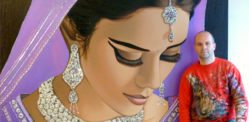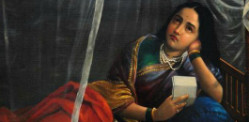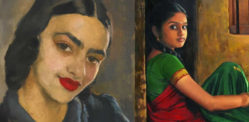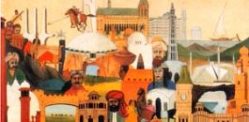














































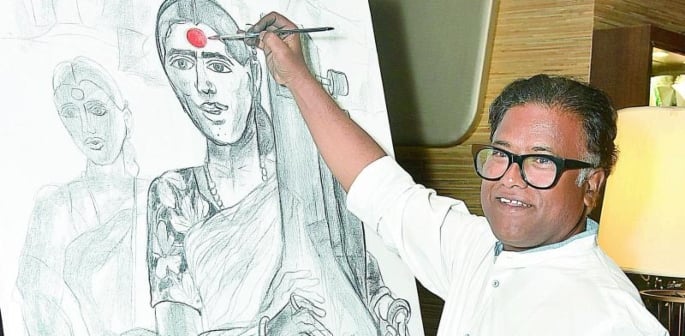
There is beauty in the simplicity of Laxman’s paintings.
Laxman Aelay’s art is symbolic and rich in the culture of his birth town, Telangana.
His works are mostly in acrylic and ink on canvas.
In his work, he commonly uses a thin line technique and strategically utilises the canvas space to position elements within his paintings.
There is much symbolism in his work, as he depicts women engaging with each other through the expressions on their faces and body language.
Laxman captures singular moments and yet is very dynamic to the degree where his work suggests a larger context and interpretation.
We delve into his life, his inspirations, and interpretations of his stunning paintings.
Life
Laxman Aelay is an artist born in the Nalgonda district in Telangana.
His art offers contemporary interpretations of the imagery of Telangana and has many Indian influences.
He has created a name for himself as he has dabbled in various mediums such as book illustrations, and production design in films.
However, he is most known for his paintings that mark the culture of Telangana’s culture and its politics.
Regarding his background, he belonged to the Padmashali caste of traditional performers and was raised by his father, a professional weaver.
Henceforth, Laxman has used certain inspirations to incorporate texture, colour, design and motifs into his work.
In his early years, he depicted rural areas that he grew up in.
Moreover, his take on art is influenced by realism and somewhat nostalgic depictions of his rural life in poverty and his native village Kadirenigudem.
His paintings were animations of dark men in traditional clothing, shepherds, and women in sarees with their conventional red dot on their foreheads.
He depicted the women going about their daily chores, capturing them conversing in the bylanes, carrying on their heads floral bathukammas, and chatting in markets.
The women would be depicted with a gaze steering ahead and were embellished in heavy ornaments.
Laxman has experimented with shades of white, black and grey to depict a certain mood or message.
His more vivid paintings created an animated quality. As a result of these colours, the women signify energy, and the jewellery appears more striking. This could be done to highlight wealth and importance.
In his work, he uses mostly acrylic and graphite.
Later in life, Laxman was influenced by the music and instruments traditionally played in Telangana.
He wanted to keep the culture relevant and popularise it to some extent as some of these art forms were dying forms in Telangana.
Hence, through his artwork featuring musicians, he portrays their evolution over time by depicting them in various environments and contexts.
Laxman did not want to depict them as frozen stills as a snapshot or a slice of the culture.
Moreover, he wanted to depict the politics of labour through abstract realism.
Work
 Some of Laxman’s work has a colour pattern of earth tones, such as green, red and yellow.
In terms of this monochromatic painting, Laxman paints the entire background in rustic red.
It captures the stunning characteristics of women chatting and going about their lives.
He draws designs on women’s sarees such as flowers and polka dots as well as others.
There is beauty in the simplicity of Laxman’s paintings.
Laxman draws various designs on the women’s sarees, such as flowers, polka dots and other patterns.
Interestingly, the eye lines of the women look in different directions. Perhaps this represents a certain disconnect despite dressing up in uniform and a similar manner.
The colour red evokes importance, juxtaposing with the rustic light brown of the drawings.
This may symbolise external power that the women are oblivious to. It may portray that women are less alert thus alluding to ideas of women’s role in society.
The drawing of the house in the top corner is associated with the women, it is a reminder that their household is important and their involvement is always prevalent in their lives.
The posture of the women suggests a certain class. In comparison, the upper class who may be portrayed in livelier colours or their body language suggests etiquette and social standing.
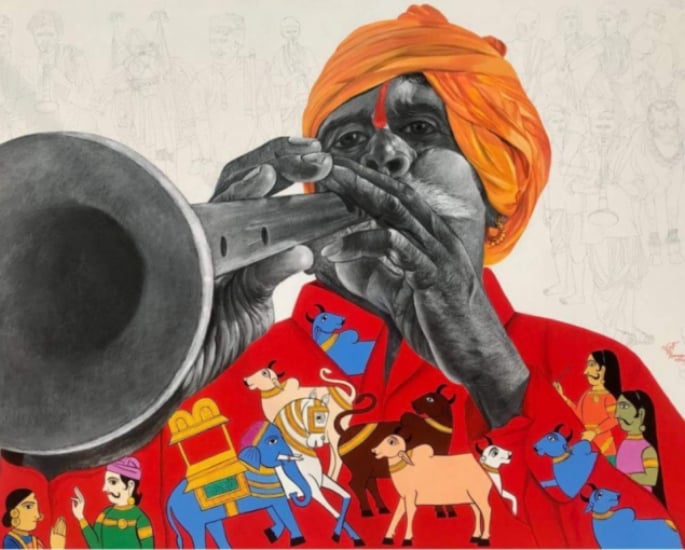 This piece uses several mediums such as a pop art style in the clothing, graphite and charcoal for the face and instrument, and in the background, there are light graphite pencil drawings.
This artwork acts as a celebration of the instruments in Telangana.
He is the main performer and there are background performers that are of less significance.
This can be interpreted as so because of the contrast in vividness.
The clothing celebrates culture and the importance of animals as a part of life for these villagers.
Some of the animals are in blue, which suggests an influence from Lord Krishna who is typically adorned in blue and jewellery.
There is a contrast between the youth of the villagers and the musician.
Perhaps this represents wisdom, a wealth of knowledge and the aspect of the dying tradition of performing.
The men in the background are looking directly ahead, whereas the musician is looking to the left, and the villagers are looking around.
Moreover, the female villagers strangely have moustaches. Whereas, the two villagers in the bottom left corner are looking directly at each other, and the woman doesn’t have a moustache.
Her hands are in a prayer position perhaps to suggest her gratitude, and the man is gesturing with his hand.
The woman is also notably wearing more jewellery and a vivid blue saree. This represents a difference in class.
The women on the right seem like spectators.
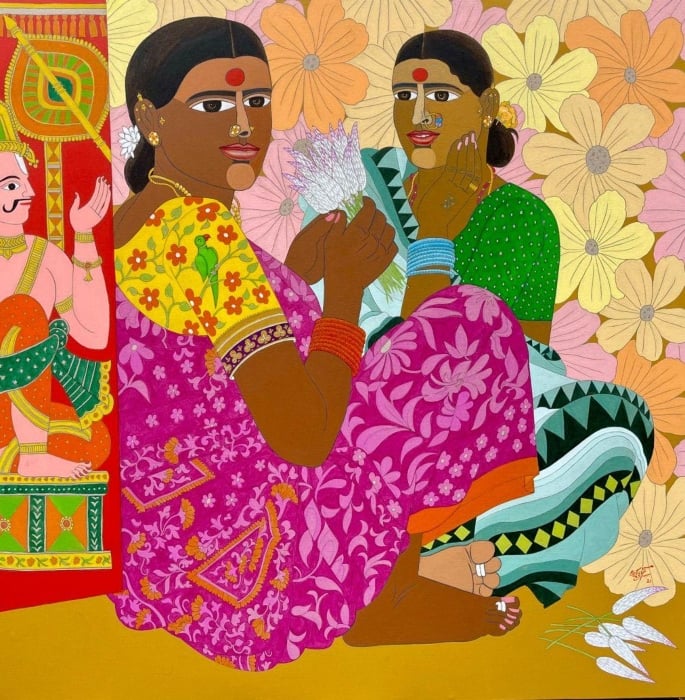 This piece is visibly more vivid than some of his other works.
There is a shrine in the background and the women wear red dots on their heads.
This celebrates the religion and culture these women belong to.
In this painting, there is use of a cartoon-style portrayal of the women.
Moreover, they have large eyes and small noses; to some this represents beauty.
The women are modernised, as they have painted nails but wear a traditional saree outfit.
This signifies the culture adapting from the West.
The flowers in the background suggest a sense of femininity.
The woman on the left is looking at the other woman with adoring eyes, perhaps to show a dynamic in their assumed friendship.
On the left, the woman has a parrot on the embroidery of her clothing, and her outfit has beautiful florals in a striking colour, compared to the other woman wearing an outfit less glaring.
This could suggest the differences in power between the friends.
Nevertheless, they are sitting near each other, which can suggest a closeness in the community of villagers in Telangana.
In some cultures, having a fair complexion is a sign of beauty. The women have dark skin, but their foreheads are of a lighter colour.
Perhaps the painter is suggesting a lack of desirability of the women.
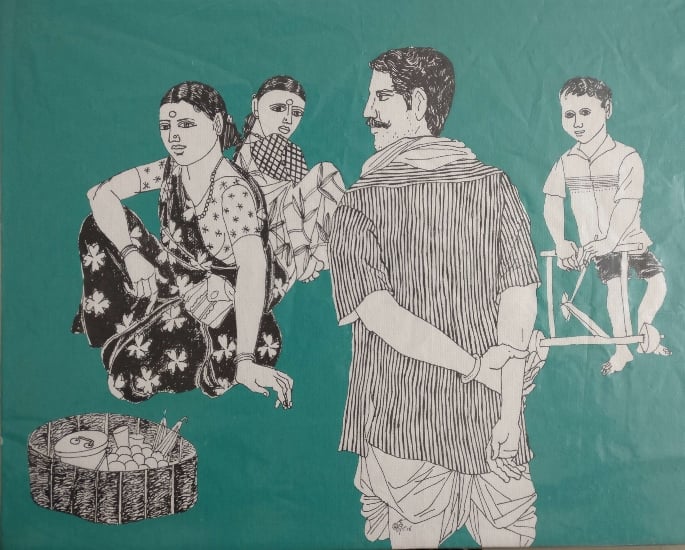 The mediums used here are acrylic paint and ink on a canvas.
Along with other works, the line technique of the ink drawing is thin and isn’t always perfectly straight or curved.
This creates an abstract feel as well as has certain connotations of uncertainty.
This painting shows a dynamic in a family. There is the son, head of the family and two girls.
The direction of the eyes of the girl behind and the boy is on the man.
Whereas, the man is looking at the woman to his left. The woman is looking ahead towards us.
Moreover, the woman in front has an alluring and slightly seductive graze.
The women wear traditional outfits whereas the boys are dressed in modern Western clothing.
Concerning the expression in the eyes, the woman in the back has a worried expression, whereas the others seem fairly content.
She is positioned with her back facing the man, but her head is directed at the man.
Perhaps this shows she is upset by her body language yet wants to be engaged with everyone.
The detail in the clothing of the woman behind is not as pretty as the woman in front as she has beautiful flowers and notably wears a satchel.
Her hand is also very poised and feminine.
The blue background may suggest a more solemn and melancholy mood.
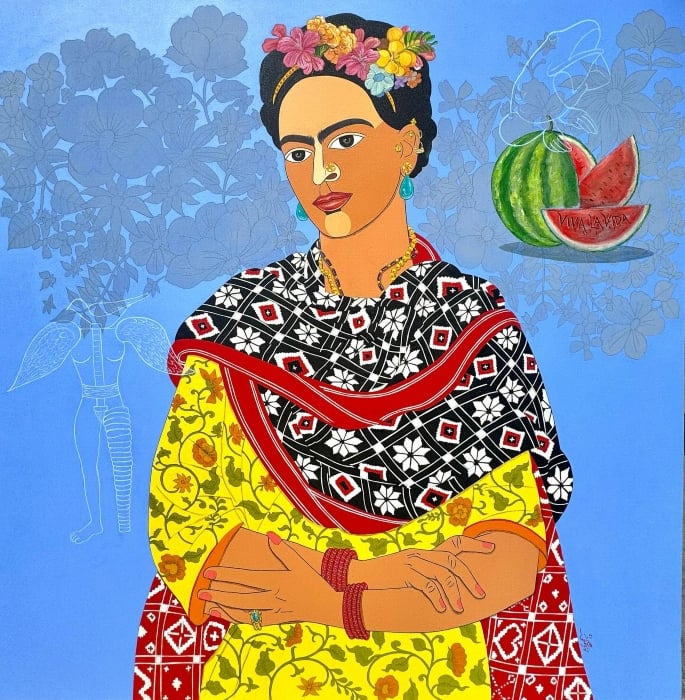 The woman depicted in this painting has a manly hand position and body language.
Moreover, her eyebrows are thick and close together, she has a pointed nose and her expression seems stern, slightly angry but focused.
However, her hair is adorned with beautiful flowers which acts as a juxtaposition with the other elements of the painting.
She is modestly dressed, as her scarf covers her chest. Moreover, she wears regal colours such as red and gold; this signifies wealth and authority.
There is a contrast of her scarf with rigid firm lines on the embroidery with the fluidity and softness of the dress.
Perhaps this represents an internal battle, as well as celebrating the multifaceted nature of a woman.
There is a faded drawing of a woman, with wings, a bird for its head and what appears to be some sort of a chastity belt.
Moreover, it is missing a right foot.
Notably in the right corner, there is a cut watermelon. In some works the watermelon signifies a power struggle and a protest against injustices.
The woman is striking in the contrast of her bright clothing against a blue background.
There are faded flowers in the background, which may suggest an attempt to be feminine but for this woman, it’s not a high priority.
Furthermore, her earrings and ring are the same colour as the background which suggests an effort to be aware of one’s surroundings.
Perhaps this woman acts as an advocate for women’s rights and acts as a political statement to encourage equality in a male-dominated society.
Laxman Aelay’s work depicts an insight into the society in which he grew up, i.e. a village in Telangana.
Throughout his work, he uses common motifs in terms of the village women and a consistent technique of his artwork.
His work is symbolic and interesting to contemplate.