















































"Listeners are taking this episode more personally"
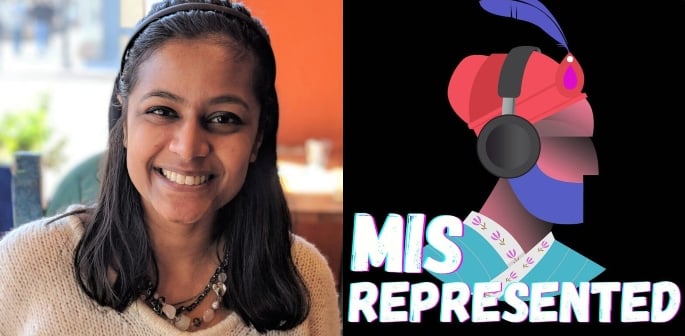
MISREPRESENTED is a global hit podcast created by the innovative creatives at Kahaani.
Kahaani itself is a media project, aiming to put the “world back in world history”. Indian American and founder of Kahaani, Niki Aggarwal, hosts the independently run podcast.
The shows shed a light on South Asia’s role in world history, revealing on their website:
“We don’t just unravel the true story – we also tell the story of how the history got twisted in the first place.”
MISREPRESENTED covers many areas. From involvement in the Atlantic Slave Trade to the 2.5 million South Asians who fought in WW2.
The popular show debuted in November 2021 and has been on an uphill trajectory since.
The podcast has become a staple for many Desis around the world. The forgotten issues reveal an insightful and at times terrifying scope of South Asia’s history.
Therefore, it comes as no surprise that it holds impressive rankings in the historical charts of Apple Podcasts.
From Pakistan to Kenya to Singapore, MISREPRESENTED has a terrifically diverse audience.
In February 2022, the season finale discussed the history of chai. It specifically touched upon how this symbol of cultural pride has a forgotten past.
Titled ‘Chai Lies’, the episode talks about the politics and propaganda of chai, covering 300 years in just 35 minutes.
‘Chai Lies’ encompasses everything that MISREPRESENTED stands for.
Not only do they cover the relationship between this commodity and South Asia, but hone in on the controversial aspects that similar mediums try to avoid.
It’s this daring and unapologetic manner of the podcast which has made it so prominent and loved.
DESIblitz caught up with Niki to discuss the vision behind MISREPRESENTED, ‘Chai Lies’ and the burning desire to address certain issues.
Can you tell us a bit about yourself?

I’m an Indian American who grew up in Europe. So, maybe it’s not that big of a surprise that I ended up in a career that explores the interconnectedness of our world!
But growing up, I didn’t know that would be my path. I was always very interested in pursuing a career in social justice.
Very early on, I understood how privileged I was. This was perhaps from going on trips to India to visit family.
And yet I also was keenly aware of race and gender and the disadvantages I faced as a brown girl.
So, I spent the first part of my career in the social sector, learning how to advocate for underrepresented voices and bring about systemic change.
That path happened to land me in San Francisco. Thrusting into the fast-paced world of Silicon Valley, I quickly fell in love with startups and their ability to make a huge impact.
I entered the startup world in order to learn as much as I could about entrepreneurship.
I loved my job and that company, and only left because I had my own company I wanted to pursue (spoiler alert, it was Kahaani).
What motivated you to create the podcast ‘MISREPRESENTED’?
Growing up, I always felt uncomfortable in my history classes. My teachers often used ‘we’ when discussing Europe and America, but I knew that word didn’t include me.
India was rarely mentioned and, when it was, it was usually in the context of religion.
South Asia’s absence in the historical narrative led me to believe South Asians were irrelevant. It took me two decades and a move to India to fully understand how wrong I was.
South Asians have played a key role in all major eras of history, from the Roman Empire to the American Civil War.
We just don’t learn it that way because when the subcontinent lost economic power, it also lost power over the narrative. My prior ignorance is not unique.
Many others, both in the diaspora and on the subcontinent, believe that our absence in the historical narrative is justified. Because South Asian history wasn’t relevant to other Americans or Europeans.
And this issue extends beyond the Desi community.
“People of colour across the board are misrepresented in western historical narratives.”
So, diaspora and immigrant communities are especially likely to experience resulting struggles with identity and belonging.
These flawed narratives perpetuate white supremacy and systemic racism.
In 2012, researchers at the University of Kansas and Texas A&M found a strong correlation between understanding of history and present-day views of racism.
These are systemic issues that will not be solved by one person, one organisation, or one podcast.
I created MISREPRESENTED as a way to introduce listeners to stories that would widen their perspective. This is when it comes to South Asia and historiography.
What kind of issues/stories do you talk about on the show?

The premise of each episode is that we are sharing a history about South Asia that has been forgotten or misremembered in the mainstream narrative.
After we share the true, full story, we divulge how and why that history got twisted in the first place.
For example, the second episode is about the Jaipur Royal Family.
We learn how the dynasty relied on mythmaking to contend with global changes. This includes the onset of the Mughal Empire to the decline of the British Raj.
But the episode is also about how fiction slowly, over decades, becomes fact.
And how a history that was written to maintain one system of power may be co-opted by a different system centuries later to perpetuate a new narrative.
Why did you feel a podcast was the ideal medium to discuss these issues?
Most people would not call themselves history buffs. I think a lot of us consider a history buff to be a person who spends their weekends reading historical nonfiction or listening to history lectures on YouTube for fun.
And yet, history podcasts are the second-fastest-growing type of podcast, following fiction.
That says to me that most people are actually very into history if it’s presented in an accessible format.
“What’s great about audio is that it allows listeners to multitask.”
If listeners can run or clean or drive while consuming your stories, they can pay attention for much longer than if they have to sit and watch a 30-minute video.
So, by creating a podcast, we have the ability to dive into a great deal of nuance. This is so necessary when tackling lesser-known histories.
But the backlash is inevitable when you’re disrupting narratives. We’re in the business of telling people that their understanding of the world may have some serious flaws. That can make folks uncomfortable.
Can you tell us about ‘Chai Lies’ and the importance of such a topic?

In the episode, we take listeners through the British East India Company’s centuries-long quest for control over tea.
This involved drug wars, slavery, corporate espionage and the conversion of South Asia into a subcontinent of chai-drinkers.
This episode is really about looking inwards as a community.
It’s easy for many of us in the Desi diaspora to look at the history of South Asia that we’re presented and see ourselves as the ‘good guys’ who suffered at the hand of others.
‘Chai Lies’ will hopefully shed some light on where we, as South Asians, are distorting our own history and the consequences of doing so.
What surprised you the most when researching chai?
A lot of the episode’s content surprised me when I first came across it.
In the intro of the episode, I share that I had grown up with the sense that chai was an ancient tradition, when, in reality, it’s younger than Coca-Cola!
But the most shocking thing was probably the intense propaganda campaign that was waged to convert South Asians into avid chai-drinkers.
The tea industry co-opted the language of the progressive independence movement.
It was very reminiscent of companies today trying to align themselves with the BLM movement, while actually being part of the problem.
Whether that’s through discriminatory hiring or predatory lending practices. This episode was special since it was about a topic so many Desis feel strongly about.”
Listeners are taking this episode more personally than previous ones. They are also applying the deeper themes to their own understanding of the historical narrative.
Furthermore, we tend to draw in a younger audience. However, this episode definitely resonated with older folks as well.
“Chai really is a unifying topic for Desis!”
Has there been an issue/story that has affected you the most?

It didn’t get to air this season, but a history that I’m still grappling with is South Asia’s many roles in the Atlantic Slave Trade.
Having lived in Mumbai, my jaw truly dropped when I learned that the streets of Bombay were built during and because of the American Civil War.
That Indian cotton was required to enslave human beings from Africa. That the very same ships used to transport those slaves were employed to take South Asians to far off places.
I grew up learning about the slave trade, and never once did I learn or see or feel that my people had anything to do with it.
It’s critical to me that Kahaani shows how interconnected our histories are. So, I think this history will play a big role in season 2 of the podcast.
What more can be done to shed a light on such prevalent topics?
At Kahaani, we believe that our historical narrative is formed primarily through schools and on screens.
We need popular media – whether that’s a Netflix series or a podcast. This is to reflect diverse narratives as well as curriculum in schools.
“When it comes to the latter, Kahaani is working with teachers to develop a supplementary curriculum.”
Our materials encourage students to think critically about the perspectives they are presented with and to apply their learning from history to current events.
We are also working with schools to train teachers on how to diversify the history curriculum in small, but significant, ways.
What is the most rewarding thing about ‘MISREPRESENTED’?

My absolute favourite thing is when we receive messages from listeners across the world who share what the podcast has meant to them.
One listener said that our balanced approach to history enabled her to feel comfortable enough to interrogate some of her own biases when it came to our episode ‘The Last* Hindu Empire’.
Someone also shared that the podcast has become a bonding activity for her and her mum. They have really enjoyed discussing and connecting over these stories.
I am so grateful that people are finding this podcast and that we are able to strike an emotional chord.
What would be the ultimate goal with the podcast?
I’m going to get really high-level here – our ultimate goal is that the next generation of the South Asian diaspora grows up vividly aware of how interconnected the world is.
I hope that the podcast can help ensure that South Asians see their homeland’s influence in today’s world. My goal is that no future brown person has to wonder if our ancestors mattered on a global scale.
That understanding would allow us all to acknowledge our multifaceted roles as both oppressor and victim.
We’d understand why and how systems of power led to the current twisted tales around our own history and reckon with their influence on the present.
“That said, this series isn’t just about making Desis feel seen.”
Academics and activists have long argued that better history-telling is required for us to reduce racism, both at an individual and systemic level.
We hope that MISREPRESENTED can serve as a model in the future as to how to turn marginalised histories into common knowledge.
Niki’s awareness of her heritage, history and culture is so immersive. The way her passion seeps through her words is the same vigour that listeners hear on the podcast.
Many South Asians have infiltrated the podcast space, shining a light on pressing issues and problems within communities.
However, MISREPRESENTED is certainly refreshing in its stories.
The engaging aura of each episode beautifully captures the twists, tragedies and characters of South Asian history.
But there is an urgency in the podcast’s tone to make sure people fully absorb the extent of certain events.
The show has received mass praise from the likes of New York Times bestselling author Aru Shah and fellow author Sanjena Sathian who stated:
“[The podcast has] amazing storytelling with just enough political anti-colonial snark and context.”
As Niki and Kahaani gear up for more triumphs in the future, their success so far has been inspiring and dynamic.
MISREPRESENTED is available to listen to on streaming platforms, including Apple Podcasts and Spotify.