

















































If things go to plan, the mission will happen sometime in 2025.
India conducted its first-ever “analog mission”, which is a simulation of space conditions to prepare astronauts for real space missions.
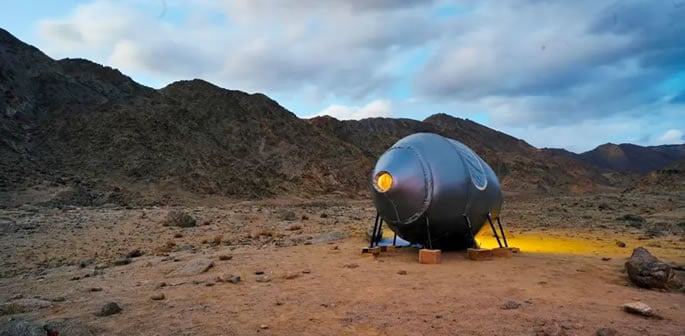
Hab-1, short for Habitat-1, was tested for three weeks in the Himalayan mountains of Ladakh.
Space architect Aastha Kacha-Jhala, of Gujarat-based firm Aaka, said these simulations could help identify and address issues astronauts and equipment might face before space missions.
Hab-1 is built with space-grade Teflon and insulated with industrial-use foam. It has a bed, a stowaway tray which can be pulled out and used as a workstation, storage space to keep supplies and emergency kits, a kitchenette for heating meals and a toilet.
Ms Kacha-Jhala said: “Hab-1 is designed keeping in mind that space is going to be very limited on the Moon or Mars.
“The astronaut will also have very limited water so we designed a dry toilet.
“We also put in place a system for a proper disposal of waste and ensured that the habitat remained odour-free.”
She is now speaking to Isro about building India’s first permanent simulation space facility in Ladakh.
The mission comes as India prepares to send its first astronauts into space.
Isro’s Gaganyaan mission plans to place three astronauts into low-Earth orbit at an altitude of 248 miles for three days.
If things go to plan, the mission will happen sometime in 2025.
India also plans to set up its first space station by 2035 and send a man to the Moon by 2040.
Professor Subrat Sharma, Dean of Research Studies at Ladakh University, said:
“Once we have our own simulation mission, we won’t have to depend on foreign space agencies to train our astronauts.”
He said Ladakh was chosen for the experiment because “from a geographical perspective, its rocky, barren landscape and soil have similarities with the material and rocks found on Mars and some parts of the lunar terrain which make it ideal for space research”.

Soil samples collected are being tested by the university to see if astronauts will be able to use locally sourced materials to build homes in space.
In a day, the Himalayan region’s temperature can range from -18°C to 20°C.
It’s no match for Mars (where temperatures can go below -153°C) or Moon (where -250°C is the norm in some deep craters), but still, it’s a test of human endurance.
Professor Sharma added: “Since you can’t go to space to test every time, you need these facilities where space-like conditions can be created.”
Ladakh is one region where barren land stretches for miles, simulating the isolated feeling.
That is how the simulation astronaut felt as they said the initial few days “were great” but admitted that it began to “feel repetitive”.
The astronaut wore biometric devices to monitor his sleep pattern, heart rate and stress levels.
Scientists say simulating psychological factors to see how they would impact humans in space is one of the mission’s most important parts.
With other space agencies aiming to send astronauts to the Moon and set up permanent bases, simulation missions are expected to play a crucial role in research and training.
In April 2024, scientists and engineers began trials in Oregon to prepare NASA’s robot dog – Lassie – to walk on the Moon’s surface.
NASA hopes to 3D-print a base using only materials found on the Moon’s surface while China and Russia are working together on their own plans.
India doesn’t want to be left behind.
Professor Sharma explained that once the data gathered in Ladakh is analysed, it “will help us develop medical technology to deal with the needs of our astronauts when they face a problem in space”.
He added: “We need to know how our bodies will function on the Moon where days and nights are a lot longer than on Earth. Or in space where there’s not enough oxygen.”