

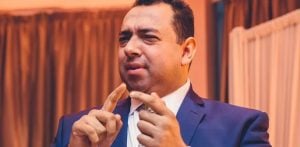



























“It was a very suffocating existence."
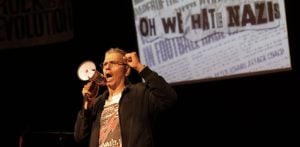
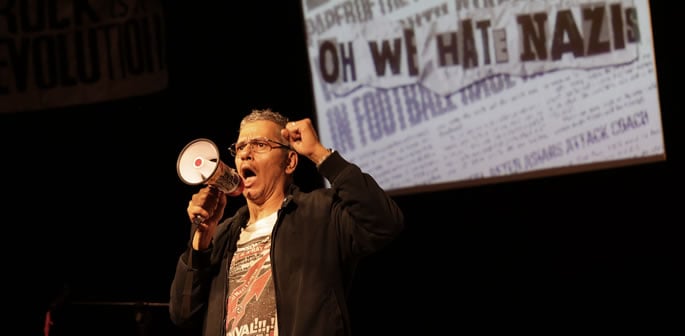
PUNK DAYS brings Hassan Mahamdallie’s teenage years in 1970s London to the stage, combining autobiography, live music and political history.
Written and performed by Mahamdallie and directed by Stef O’Driscoll, the play follows a mixed-race, working-class teenager growing up amid racism, rising unemployment and the growing influence of the National Front.
At the same time, he discovers punk and its potential to challenge social and political attitudes, while the production explores the relationship between music, identity and resistance.
It also revisits the emergence of Rock Against Racism and the role music played in bringing different communities together.
PUNK DAYS comes to Birmingham’s Midlands Arts Centre from October 2 to 3, 2026, alongside free events exploring punk, archives, politics and anti-racist activism.
In an interview with DESIblitz, Hassan Mahamdallie discusses the experiences behind the play, punk’s political influence and why its story remains relevant.
Finding a Voice Through Punk
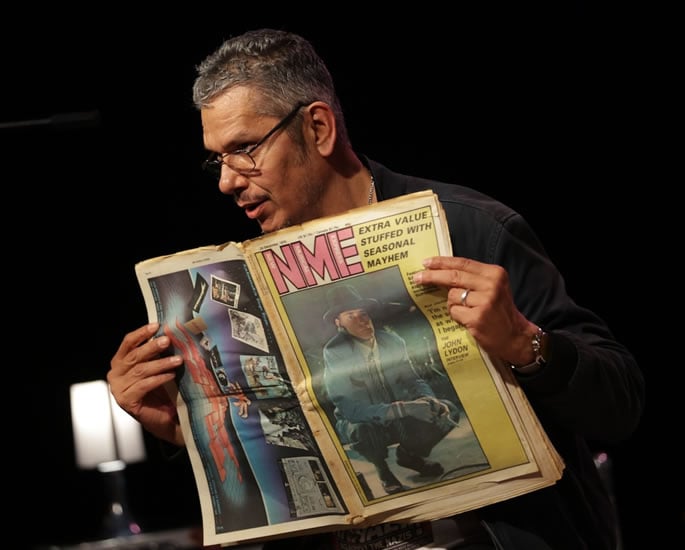
PUNK DAYS draws heavily on Hassan Mahamdallie’s teenage years in 1970s London, placing his personal experiences within a wider period of social and political upheaval.
The decade saw major economic and political changes in Britain, while debates around immigration, race and national identity became increasingly prominent.
Mahamdallie recalls: “Like a lot of young people from working-class and marginalised backgrounds growing up in the 1970s, Black kids, South Asian kids, mixed-race kids like me, I felt very alienated and angry at society.
“Youth unemployment was very high; it was difficult to see a future in front of you, society was run by an upper-class male establishment, some of whom had fought in the First World War, and in ‘the colonies’ and had no idea at all about our lives, our needs and our problems.”
Punk’s appeal was tied to that wider generational experience, with its direct songs giving young people a way to articulate dissatisfaction without relying on the established institutions that had failed to speak to them:
“It was a very suffocating existence. And that feeling of hopelessness and frustration was really the rocket fuel of Punk. It was a youth revolution really.
“All the bored, angst-ridden, p****d off kids like me, all the oddballs and rejects who nobody seemed to care about or want, found their place in Punk Rock.”
The music also gave Mahamdallie specific points of connection.
Tracks including ‘Anarchy in the UK’, ‘No Time to be 21’, ‘Bored Teenagers’, ‘In A Rut’ and ‘I Wanna Be Free’ reflected the dissatisfaction he was already feeling.
The Battle over Punk’s Politics
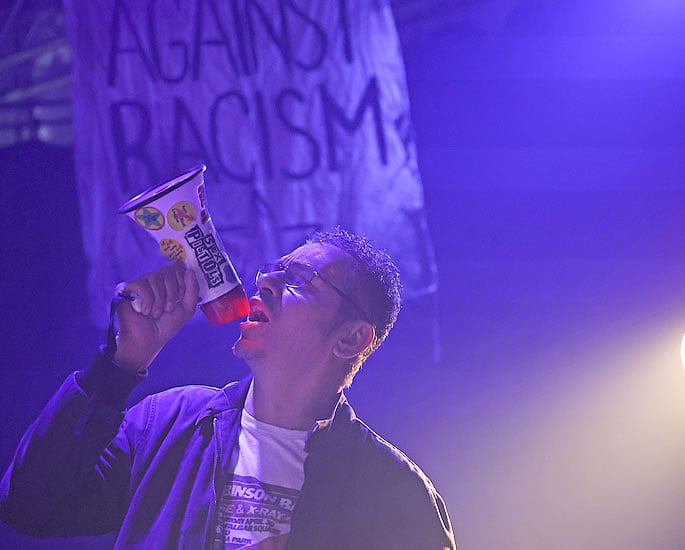
Punk’s relationship with politics was complicated from the beginning but it was important to Hassan Mahamdallie, as he explains:
“The political side of Punk was tremendously important to me.
“I grew up into a Labour-supporting family – that’s how my parents always voted, but I saw that you had to go beyond that.
“We had Labour governments back then that attacked their own voters and that paved the way for the election of Margaret Thatcher in 1979. That was a disaster.
“But with Punk you have to understand that it didn’t start out as a political movement.
“It was an explosion of anger, but like any explosion it could go in any direction.”
“So we had to have a fight inside the Punk Rock scene to make sure that the fascists, exemplified by the National Front skinhead movement, didn’t win the battle of ideas inside Punk.”
The distinction between opposition to authority and hostility towards ethnic minorities was central to that struggle.
He continues: “That all that anger would be channelled upwards against the establishment, not downwards against Black or brown people, or migrants and refugees from places like Kenya, Malawi and Uganda.
“Punk had to become an anti-racist space, and we tried very hard to make that happen.
“For me, that fight was the start of a lifelong commitment to fighting against racism and for all kinds of human liberation – that really is what I have dedicated my life to. And continue to in any way I can.
“So Punk made me political! I’m thankful for that.”
From 1970s Activism to PUNK DAYS
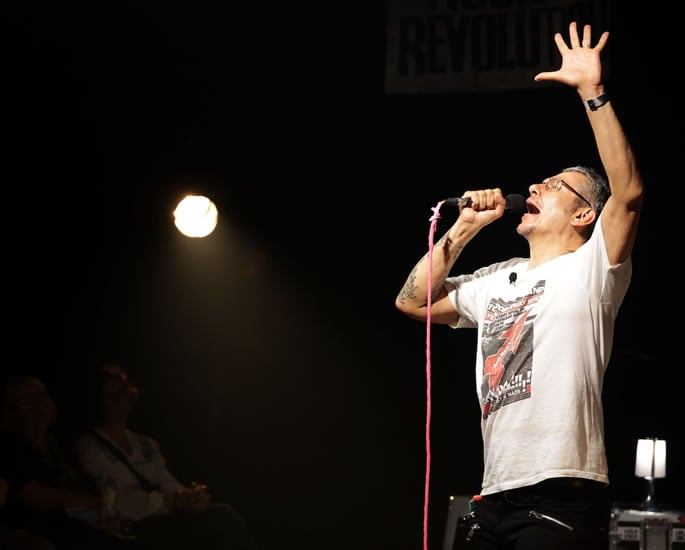
PUNK DAYS revisits these experiences at a time when debates about the far right, racism and multiculturalism remain part of public life.
Mahamdallie says: “The main idea I try to put across in PUNK DAYS is that we have faced the rise of the far right before, and we managed to beat them and change the course of history for the better – for a while at least. Change is possible.”
Two of the most significant organisations associated with the period were Rock Against Racism and the Anti-Nazi League.
Rock Against Racism was founded in 1976, while the Anti-Nazi League launched the following year, bringing together anti-racist campaigners and political activists.
“We pride ourselves in the multicultural society that we came out of the defeat of the far right in the 1970s but that is now all under threat.
“As I say in the play, ‘history doesn’t repeat itself, but sometimes it rhymes’.”
Mahamdallie also places questions of identity within that history.
“Having a positive identity is important – British Asian, Black British, Muslim, Hindu, being proud of yourself and your heritage is enormously important.
“It gives you confidence and a sense of belonging, but it’s only the start of a much bigger journey to change the world around us.”
The 1970s campaigns demonstrated how music could provide a meeting point for people from different communities, as Mahamdallie says:
“We have to come together, and find ways to unite and take on the far right.
“We did that through music in the 1970s with the founding of Rock Against Racism and the Anti-Nazi League, using the power of Punk Rock and Reggae to bring everyone together who oppose racism and hatred, to prove we are the majority, and we won’t allow the clock to be turned back.
“We need the same kind of movement today that we had in the 1970s but with different music genres. Everybody needs to feel welcome in that space.”
Bringing his Story to the Stage
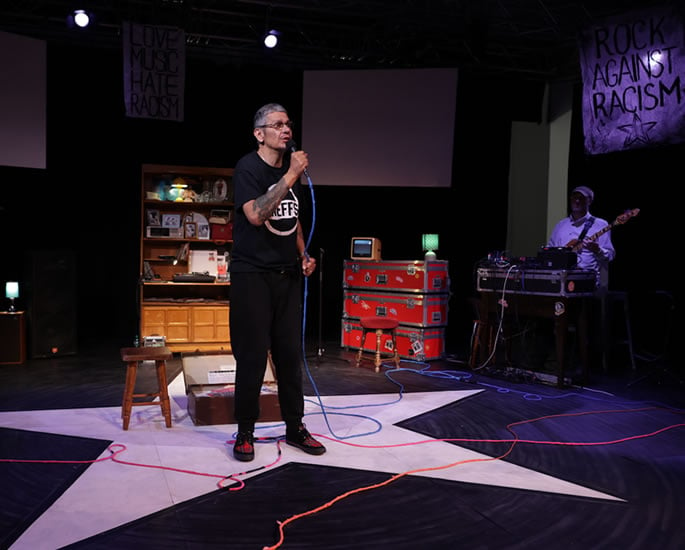
Hassan Mahamdallie’s decision to create PUNK DAYS came from wanting to revisit this period through his own experience.
He details: “I thought now was exactly the right time to tell that story. To add my voice to today’s fight against the far right.
“Although it’s my personal story, what I hope is that everyone, especially those whose heritage extends beyond the borders of this country, can see a little bit of themselves in me.”
On his heritage, he says: “I’m tremendously proud of my heritage, white working-class mum, and Indo-Trinidadian dad.
“But I’m aware that my background is not ‘special’, that there are many of us who have those diasporic roots, and are always struggling to find our place in a society where often we feel not wanted, or are seen as outsiders.
“As though we’re only here under sufferance.”
PUNK DAYS combines theatre and live music. Mahamdallie performs with his collection of 7” punk singles, while his friend Dom Kennedy joins him on stage with guitar and a mixing desk.
“I had some friends who came and saw PUNK DAYS in London, who told me, ‘I’ve never listened to Punk before, but I’m going to go away and listen to your Spotify playlist!’
“When you come and see the show, you’ll see me playing some of my 7” vinyl Punk singles collection, some of which you might have heard, like the songs of The Clash, but many you won’t know.”
Mahamdallie describes the music as an important part of recreating the energy of the period:
“For me the best Punk tunes are perfect 3-minute songs delivered with a special kind of energy that gets you going!
“PUNK DAYS is both a play and a live gig – my friend Dom Kennedy is on stage with me with his guitar and his mixing desk delivering a terrific soundtrack to my retelling of my teenage years.”
The show also addresses events that shaped Britain’s anti-racist politics, including Enoch Powell’s ‘Rivers of Blood’ speech and Eric Clapton’s racist comments during a 1976 Birmingham concert.
Mahamdallie says: “You’ll hear some of the hard and uncomfortable moments in history, some of which are particular to Birmingham – Enoch Powell’s racist ‘Rivers of Blood Speech’ and Blues guitarist Eric Clapton’s racist rant from the stage at a Birmingham concert in 1976 that kick-started Rock Against Racism mass movement.”
The Birmingham references are particularly relevant to the production, bringing a national political history back to events that took place in the city and its music scene.
Hassan Mahamdallie also wants the play to address the question of who has the right to feel that they belong in Britain, particularly for audiences with family histories extending beyond the country.
“I really want PUNK DAYS to give hope to those that come see the play – that we do belong, that no-one can erase our presence and all that we have done to make this country what it is, and continue to do so.
“As the slogans from the 1970s put it, ‘We are here because you were there!’ and ‘Here to stay, here to fight!’.”
“But I hope by the end of it you are uplifted and ready to play your role in the movement against today’s racists and fascists.
“That’s why PUNK DAYS is important to me. I want my kids to grow up in a world without these hatreds and that’s a world we still have to win.”
PUNK DAYS will give audiences the opportunity to experience Hassan Mahamdallie’s personal account alongside a live punk soundtrack and a programme of free wraparound events.
The additional activities extend the production’s themes beyond the stage, bringing together music, archives and conversations around racism, resistance and social change.
Free post-show and wraparound events:
- Friday, October 2, 9 pm: DJ Deesh performs a post-show set featuring Ska, Two Tone and Punk classics. He has been involved in music and club culture since the late 1980s and co-founded a major South Asian LGBTQ+ club night in the 1990s.
- Saturday, October 3, 11 am–12 pm: Looking Back to Step Forward: An Archive Touring Exhibition sees Mahamdallie joined by Mark Jay to explore early UK punk, 1970s politics, Rock Against Racism and the DIY approach to identity and creativity.
- Saturday, October 3, post-matinee: A post-show discussion brings Mahamdallie together with local social justice campaigners and organisations to explore the issues and themes raised by the play.
PUNK DAYS explores how music, culture and collective action shaped the period Mahamdallie experienced as a teenager.
To find out more information or to book tickets, visit the MAC website. Use the code PUNKDAYS995 for a discount – subject to availability, on a first-come, first-served basis.