
















































Semaglutide works by mimicking the hormone GLP-1
The Wegovy weight loss pill is now available to buy privately from the high street and online pharmacies across the UK, but is not yet on the NHS.
The tablet contains semaglutide, the same active ingredient used in Wegovy injections, and has been approved for private prescription following authorisation by the Medicines and Healthcare products Regulatory Agency (MHRA).
Like the injectable version, it is designed to be used alongside a healthy diet and increased physical activity rather than as a standalone treatment.
Patients must also meet strict eligibility criteria before it can be prescribed.
Those with a body mass index (BMI) of 30 or above, or a BMI between 27 and 30 with weight-related conditions such as type 2 diabetes or high blood pressure, may be eligible following an online or face-to-face consultation.
Healthcare professionals are also urging people to avoid purchasing semaglutide from unverified websites because of the growing threat of counterfeit medicines.
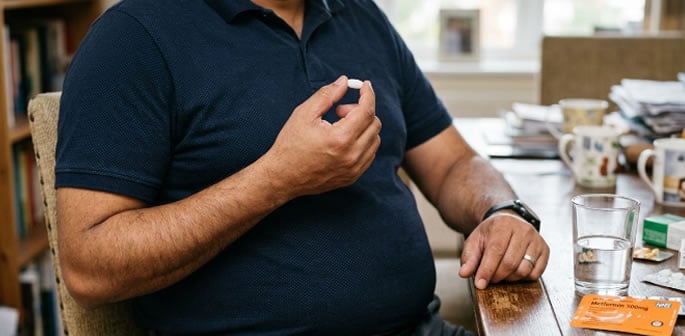
The tablet must be taken on an empty stomach after fasting for at least eight hours.
Patients should swallow it whole with no more than 120ml of plain water and wait at least 30 minutes before eating, drinking or taking any other medication.
Doctors recommend taking it at the same time every day to help establish a routine. If a dose is missed, patients should skip it and continue with the next scheduled dose.
Tablet or Injection?
Both the Wegovy tablet and injection contain semaglutide and clinical trials suggest they deliver similar levels of weight loss.
The main difference is convenience.
People who dislike injections may prefer the tablet, while those who find daily medication difficult or cannot easily fast each morning may favour the weekly injection.
Unlike the tablet, the injection can be taken at any time of day but must be stored in a refrigerator.
Side Effects and Dosage
Semaglutide works by mimicking the hormone GLP-1, which is naturally released after eating.
It acts on appetite centres in the brain, helping people feel fuller, reducing hunger and decreasing food cravings.
The most common side effects include nausea, vomiting, constipation and diarrhoea.
Some people also experience stomach pain, headaches or tiredness.
Injection users may notice mild redness, swelling or itching at the injection site.
More serious complications, although uncommon, include low blood sugar, pancreatitis and severe allergic reactions.
The medication should not be taken by anyone under 18, pregnant or breastfeeding. Patients are also advised to discuss existing medical conditions and medications with a healthcare professional before starting treatment.
Treatment begins with a 1.5mg tablet taken once daily for the first month.
Following medical review, the dose is usually increased each month until the recommended maximum of 25mg daily.
Patients already receiving a private 2.4mg semaglutide injection may be able to switch to the 25mg tablet under medical supervision.
Healthcare professionals stress that patients should never change treatments without clinical advice because the most appropriate dose varies between individuals.
How Much does it Cost?
Private prices currently vary between pharmacies.
Some providers are offering introductory discounts, while costs generally increase as the dosage rises.
Current prices range from around £99 for a month’s supply of the 1.5mg tablets to approximately £199 for the highest 25mg dose.
When the tablet launched in the United States, the manufacturer listed the starting dose at $149, which is roughly £110 per month.
Although there are expectations that tablets could eventually become cheaper than injections, prices are currently similar at many pharmacies.
NHS Availability remains Uncertain
Earlier in June 2026, the Wegovy tablet became the first weight-loss tablet of its kind to receive MHRA approval.
However, it has not yet been approved for NHS use.
The next stage is an assessment by the National Institute for Health and Care Excellence (NICE), which will examine clinical evidence and cost-effectiveness before deciding whether it should be funded.
Adam Burt, head of obesity for pharmaceutical company Novo Nordisk, said “we need to make sure the medicines are cost-effective for the NHS [and] the taxpayer”.
He added that the review normally takes 9 to 12 months.
Experts Warn against using it as a Quick Fix
Health experts continue to stress that GLP-1 medicines are intended for treating obesity and weight-related health conditions rather than cosmetic weight loss.
They advise against using them simply to achieve a “beach body”, despite evidence that some people misuse the medication.
Clinical trial data suggest the tablets can produce significant weight loss.
During a 64-week study, participants taking Wegovy tablets alongside a calorie-controlled diet and increased physical activity lost an average of 13.61% of their body weight.
Those taking a placebo lost 2.18% on average.
Professor of diet and population health at the University of Oxford, Susan Jebb, believes the medication could become a long-term treatment similar to drugs used for blood pressure or cholesterol.
However, she also believes medication alone cannot solve the wider obesity challenge.
“Pretty much everybody has a good intention to eat healthily today, but somehow that gets eroded when you walk down the high street and there are coffee shops and cafes and muffins… and chocolates on a three-for-two deal.”
Concern over Counterfeit Medicines
Novo Nordisk has also warned about the growing trade in fake weight-loss medication sold online.
Burt described counterfeit pills as a “massive concern” and said the company actively monitors illegal websites.
He said: “[This includes] monitoring of online spaces, particularly online where people can be exposed to fake drugs websites selling counterfeit medicines, fortified medicines.
“We have an operation where we take down sites directly.
“We had a successful High Court judgement a couple of weeks ago, that enables us to work directly with service providers to take down these sites.”
In April, pharmacies called for stronger action against counterfeit weight-loss medicines after Northamptonshire Police seized £250,000 worth of illegal drugs during a raid.
Burt said Novo Nordisk continues to work with the MHRA, regulators and police, with law enforcement carrying out “a number of sting operations”.
He also encouraged people to seek advice from official NHS and Novo Nordisk sources before purchasing any weight-loss medication.