















































she entered politics after his death in a military coup.
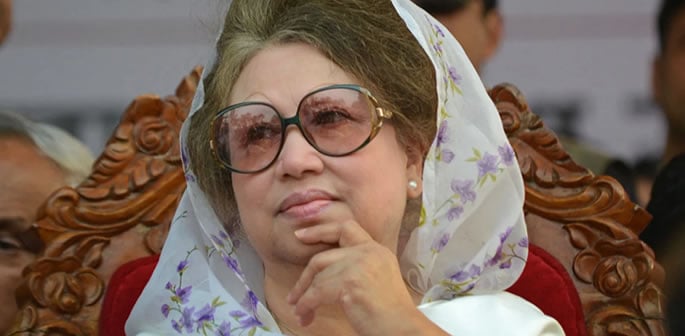
Khaleda Zia, Bangladesh’s first female Prime Minister and a long-time rival of ousted leader Sheikh Hasina, has died at the age of 80 after a prolonged illness.
Zia had planned to contest February’s parliamentary election. It will be the country’s first national vote since a popular revolution in late 2024 removed Hasina from power.
Her death was confirmed by her Bangladesh Nationalist Party (BNP).
Physicians had said Zia’s condition was “extremely critical”. She had been placed on life support.
Doctors added that it was not possible to provide multiple treatments at the same time due to her age and overall poor health.
Crowds gathered outside Evercare Hospital in Dhaka after news of her death broke.
Zia had been admitted there for the past month. She was receiving treatment for kidney damage, heart disease and pneumonia, among other conditions.
Zia was thrust into the political spotlight following the assassination of her husband, President Ziaur Rahman, in 1981.
Previously a reserved presence beside her husband, she entered politics after his death in a military coup.
She went on to lead the BNP and became Bangladesh’s first female Prime Minister in 1991, after the country’s first elections in 20 years.
Her political career was defined by a bitter rivalry with Sheikh Hasina, the Awami League leader and daughter of Bangladesh’s founding president.
Known as an “uncompromising leader”, Zia refused to take part in a controversial election under military ruler General Hussain Muhammad Ershad in the 1980s.
She broke through a male-dominated political system and became one of the country’s most formidable political figures.
Her first term was widely praised. It focused on improving women’s education and social development.
Her government also restored parliamentary democracy by amending the constitution with bipartisan support.
Zia’s second term in 1996 lasted only weeks. It drew criticism for staging a one-sided election amid opposition demands for a neutral caretaker authority.
Parliament later approved that system before dissolving.
She returned to power in 2001 and stepped down in October 2006 ahead of fresh elections.
That administration faced sharp criticism over allegations of corruption.
Over the past 16 years, under the Awami League government, Zia became the most prominent symbol of resistance to Hasina’s rule, which many viewed as increasingly autocratic.
She boycotted the 2014 election after Hasina scrapped the caretaker government system. The move was intended to ensure neutrality during national polls.
Zia was later convicted on corruption charges and jailed. She denied wrongdoing and said the cases were politically motivated.
She was acquitted of corruption and allowed to travel to London for medical treatment only after Hasina lost power.
Zia was released in January 2025, shortly after mass anti-government protests toppled Hasina and forced her into exile in India.
Hasina has since been convicted and sentenced to death for crimes against humanity over her crackdown on those protests.
Despite poor health and long absences from public life, Zia remained a figurehead for opposition forces.
The BNP is seeking a return to power. If successful, Zia’s son, Tarique Rahman, is expected to become the country’s new leader.
Rahman recently returned to Bangladesh after 17 years in self-imposed exile in London.
In a statement, interim leader Muhammad Yunus described Khaleda Zia as a “symbol of the democratic movement”.
He said: “The nation has lost a great guardian… Her role in the struggle to establish democracy, a multi-party political culture, and the rights of the people in Bangladesh will be remembered forever.”
India’s Prime Minister Narendra Modi said he was “deeply saddened” by Khaleda Zia’s death, writing on X:
“We hope that her vision and legacy will continue to guide our partnership.”
Pakistan’s Prime Minister Shehbaz Sharif called Zia “a committed friend of Pakistan” whose service would leave a lasting legacy.