

















































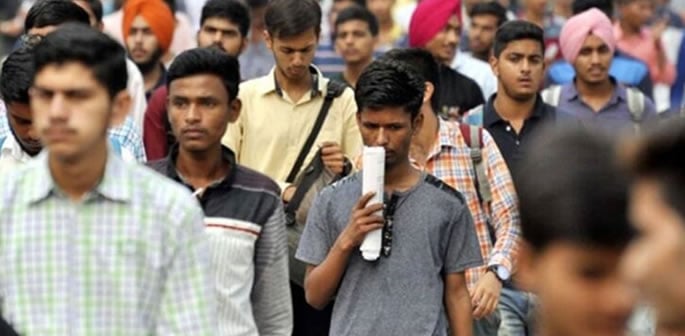
Around 40% of graduates aged 15 to 25 are unemployed
India’s youth population is vast, highly educated in parts, but many are unemployed.
With 367 million people aged 15 to 29, the country holds the world’s largest youth cohort, yet a significant share remains outside education and formal employment.
This gap between aspiration and opportunity sits at the centre of India’s economic story, shaping how young people study, work and move across regions.
The latest findings from Azim Premji University highlight how expanded access to education has not translated into equivalent job creation.
It leaves a generation navigating a labour market where progress in learning coexists with persistent barriers to meaningful employment.
As British economist Joan Robinson once observed, whatever “you can rightly say about India, the opposite is also true”.
That paradox is visible in the contrast between rising educational attainment and uneven labour outcomes.
Millions of graduates enter the workforce each year, yet many encounter delays, underemployment or roles that fall short of expectations.
Understanding this imbalance is key to making sense of India’s current labour dynamics and the pressures facing its young workforce.
A Growing Youth Base Entering an Uneven System

India’s youth population stands at 367 million people aged between 15 and 29, forming a third of the working-age population. Of these, 263 million are not in education and represent the potential workforce.
The numbers point to a significant demographic opportunity, often described as a demographic dividend.
However, the benefits depend on whether the economy can generate sufficient productive employment.
Educational access has improved steadily over the past four decades. Enrolment in schools and higher education has risen broadly in line with development trends.
Participation among students from poorer households has also increased, with their share in higher education rising from 8% in 2007 to 17% in 2017.
Gender gaps have narrowed, and caste barriers, while still present, have weakened over time.
The number of colleges and universities has grown from around 1,600 in 1991 to nearly 70,000 today. Around 80% are privately run, reflecting a major structural shift in provision.
This growth has widened access, but it has also introduced unevenness in quality, with differences across regions, institutions and disciplines.
A more educated and connected generation is emerging, yet outcomes in the labour market remain inconsistent.
The system has expanded in scale, but its ability to absorb graduates into suitable roles has not kept pace.
Transitioning from Education to Employment

The transition from education to employment remains the central bottleneck.
Graduate unemployment is notably high, particularly among younger cohorts. Around 40% of graduates aged 15 to 25 are unemployed, along with approximately 20% of those aged 25 to 29.
These figures exceed those seen among less educated groups, reflecting both expectations and structural limitations within the labour market.
Rosa Abraham, lead author of the report, told BBC:
“When you’re young, you wait – and report unemployment.”
Over time, individuals adjust their expectations and enter available roles.
She adds that many eventually transition into work as responsibilities increase, describing an “aspiration-availability mismatch” combined with the ability to wait during early career stages.
Mark Blaug documented similar patterns decades ago, noting that graduate unemployment in India has persisted since the mid-20th century.
While the underlying issue is longstanding, its scale has increased alongside the expansion of higher education.
India now produces around five million graduates annually, but only a portion secure stable salaried roles, with fewer still entering formal employment within a short timeframe.
The broader labour market reflects a similar imbalance.
In the two years following the pandemic, India added 83 million jobs, raising total employment from 490 million to 572 million.
This growth included gains for both men and women, indicating recovery across sectors.
However, nearly half of these jobs were in agriculture, a sector typically associated with low productivity and limited income growth.
This composition matters. While employment has expanded in numerical terms, the quality of jobs has not kept pace. Many roles remain informal or underproductive, limiting their impact on living standards.
The result is a labour market that is active, but uneven in its ability to generate upward mobility.
Shifting Participation

Women’s participation in the workforce reflects this duality.
At one end, a smaller but growing group of educated women is entering salaried employment in sectors such as information technology, automobile manufacturing and business services.
This trend is more visible in states with stronger industrial ecosystems, including Tamil Nadu and Gujarat.
At the other end, a larger share of women are engaged in self-employment or unpaid work within family-run enterprises. These roles often reflect economic necessity rather than expanded opportunity.
While participation rates appear to rise, the nature of work varies significantly, creating a divide between formal, salaried employment and informal, household-based labour.
Changes are also visible among young men.
Since 2017, the proportion of men participating in higher education has declined, from 38% to 34% by late 2024.
Financial pressures are a key factor, with many leaving education earlier to contribute to household income.
Some take up work in family farms or businesses, roles that were previously more commonly associated with women.
Abraham noted: “A growing share of these men – now including graduates – are supporting family incomes by working on family farms or businesses.
“This used to be largely women’s work. It’s a worrying shift.”
Migration continues to act as a balancing mechanism within the labour market.
Workers move from states such as Bihar and Uttar Pradesh to more industrialised regions like Tamil Nadu and Karnataka in search of better opportunities.
These flows help match labour supply with demand, but they also highlight disparities in regional development and job availability.
The structure of India’s economic growth plays a significant role in shaping these outcomes.
Expansion has been driven largely by skill-intensive services, particularly in IT and communications.
In contrast, export-oriented manufacturing, which has historically absorbed large numbers of low- and medium-skilled workers in other regions, has remained comparatively underdeveloped.
This has contributed to a labour market that offers opportunities for the educated while leaving gaps for those without advanced skills.
Vocational training has expanded through private providers, but its linkage to employment remains inconsistent.
Similarly, professional courses such as engineering and medicine remain costly, limiting access for some groups despite broader improvements in participation.
Time is an additional factor.
India’s median age is 28, and nearly 70% of its population is of working age. This demographic structure supports economic growth, but the advantage is temporary.
From around 2030, the share of working-age individuals is expected to decline as the population ages.
Artificial intelligence may introduce further disruption, particularly in entry-level white-collar roles that graduates typically pursue.
This could alter the pathways through which young people transition from education into stable employment, adding another layer of uncertainty to an already complex system.
India’s challenge lies in aligning its expanding educational base with the creation of productive, well-paying jobs at scale.
The policy direction is widely recognised, including increasing salaried employment, strengthening links between education and industry, and improving transitions from school to work.
Stronger social protection for informal and migrant workers is also part of the broader framework.
The underlying question is one of economic direction.
India has built a larger, more educated youth cohort than ever before.
The extent to which this cohort is absorbed into meaningful employment will determine whether demographic potential translates into sustained economic progress or remains partially unrealised.