

















































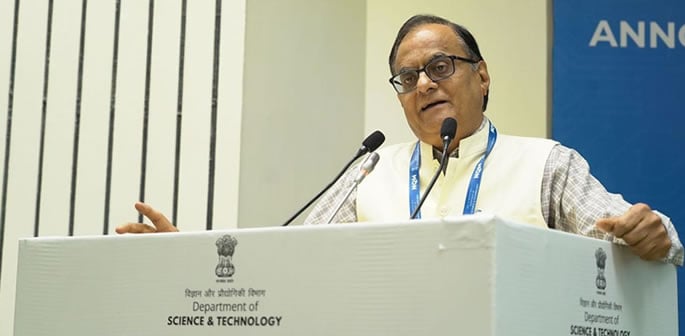
"The hubs will be at the forefront of research and innovation"
India launched BharatGen on September 30, 2024, with Science and Technology Minister Jitendra Singh saying it was the world’s first State-funded project of its kind.
He added: “BharatGen is a proud example of India’s commitment to advancing homegrown technologies.
“It positions India as a global leader in the field of Generative AI, much like our achievements with UPI and other innovations that have transformed various sectors.”
Led by IIT Bombay under the National Mission on Interdisciplinary Cyber-Physical Systems (NM-ICPS), it is an initiative that will create generative AI systems that can generate high-quality text and multimodal content in various Indian languages.
BharatGen was launched by Principal Scientific Advisor AK Sood, Department of Science and Technology Secretary Abhay Karandikar, Department of Telecommunications Secretary Neeraj Mittal among others.
Mr Sood also launched the four thematic hubs for Quantum Computing, Quantum Communication, Quantum Sensing and Metrology, and Quantum Materials and Devices, under the National Quantum Mission (NQM).
Mr Singh said: “The hubs will be at the forefront of research and innovation, setting the stage for India’s leadership in quantum computing, communication, sensing, and materials.”
The four T-Hubs were set up at the Indian Institute of Science (IISc) Bengaluru, Indian Institute of Technology (IIT) Madras along with Centre for Development of Telematics New Delhi, Indian Institute of Technology (IIT) Bombay and Indian Institute of Technology (IIT) Delhi.
The hubs comprise 17 Technical Groups across 17 states and two union territories.
Each T-Hub will follow a Hub-Spoke-Spike model, supporting a network of research projects (Spokes) and individual research teams (Spikes) around central hubs.
This structure will strengthen coordination among research institutions, allowing them to share resources and expertise more effectively.
A key aspect of BharatGen is its open-source foundational models, which aim to democratise AI access across India.
The minister said that by making AI more accessible, the initiative will foster a collaborative ecosystem where researchers and developers can work together on innovative solutions.
The project is set for completion within two years and is expected to benefit various government, private, educational, and research institutions.
A central feature of BharatGen is its focus on data-efficient learning, particularly for Indian languages with a limited digital footprint.
Through fundamental research and partnerships with academic institutions, the initiative will create models that perform effectively with minimal data, addressing the needs of languages that global AI efforts have underserved.