














































“The more likely outcome is a limited trade pact”
With less than a week before the July 9, 2025, deadline set by the Trump administration, the much-anticipated India-US trade deal is hanging in the balance.
Hopes for an interim agreement remain, but negotiations have become entangled in hardline positions and unresolved sticking points.
The White House has struck an optimistic tone.
Press Secretary Karoline Leavitt suggested that a deal could be close, while Indian Finance Minister Nirmala Sitharaman said: “Delhi would welcome a big, good, beautiful agreement.”
Her comments followed President Trump’s claim that a deal with India was coming and would “open up” the Indian market.
Despite the public optimism, negotiators remain locked in intense talks.
Indian officials have extended their stay in Washington in a bid to resolve major disputes, particularly over agricultural access, tariffs on Indian steel, and auto components.
Ajay Srivastava, a former Indian trade official and founder of the Global Trade Research Initiative, said:
“The next seven days could determine whether India and the US settle for a limited ‘mini-deal’ or walk away from the negotiating table – at least for now.”
Much of the deadlock hinges on the issue of agriculture, a sector Washington sees as ripe for exports but one India has long protected.
Richard Rossow, who analyses India’s economy at the Centre for Strategic and International Studies in Washington, explained the problem:
“There are two real challenges to concluding an initial agreement.
“First on the list is US access to the Indian market for basic agriculture products. India will need to protect its basic agriculture sector for economic and political reasons.”
Successive US administrations have sought greater access to India’s farm sector, but Delhi has fiercely guarded it.
Indian policymakers cite food security and the livelihoods of small-scale farmers, many of whom depend on minimum support prices and public procurement.
Rossow added: “The second issue is India’s non-tariff barriers. Issues like India’s growing set of ‘Quality Control Orders’ (QCO) are significant obstacles to US market access and may prove tricky to meaningfully handle in a trade deal.”
More than 700 QCOs have been issued under India’s “self-reliant India” campaign.
These import rules are meant to curb low-quality goods and boost domestic manufacturing, but critics argue they restrict access and raise costs.
Suman Berry, a senior figure at the Indian government think tank Niti Aayog, described the QCO regime as a “malign intervention” that limits imports and strains small and medium businesses.
The US is also targeting a larger share of India’s agricultural imports.
Currently, bilateral farm trade stands at around $8 billion, with India selling rice, shrimp and spices, and the US exporting lentils, nuts and apples.
But Washington wants a bigger slice of the market, particularly for maize, soya bean, cotton and corn, as part of efforts to reduce its $45 billion trade deficit with India.
Indian officials are resisting, fearing that further concessions could undermine vital safeguards such as minimum price guarantees for farmers.
Srivastava said: “No tariff cuts are expected for dairy products or key food grains like rice and wheat, where farm livelihoods are at stake.
“These categories are politically and economically sensitive, affecting over 700 million people in India’s rural economy.”
Complicating matters is a Niti Aayog policy paper that appears to suggest lowering tariffs on a broad range of US agricultural products, including rice, poultry, dairy, corn, almonds and genetically modified soya.
But it remains unclear whether this paper reflects official policy or is simply an internal recommendation.
For Rossow, any rigid US demands could backfire: “If the US were to say ‘no deal’ if India does not include access on basic agriculture, then clearly American expectations were not set correctly.
“Any democratically elected government will have political limits to commercial policy choices.”
Despite these tensions, a scaled-down agreement remains possible.
Srivastava said: “The more likely outcome is a limited trade pact”, pointing to the US-UK mini-deal announced in May as a potential model.
Under this framework, India could lower tariffs on industrial goods, including automobiles and offer modest agricultural access via quotas and limited cuts on products like ethanol, almonds, apples, raisins, olive oil, spirits and wine.
Washington is also expected to press for large-scale commercial contracts covering everything from oil and liquefied natural gas to Boeing aircraft, helicopters and civil nuclear equipment.
The US may additionally seek regulatory changes, such as relaxed foreign investment limits in multi-brand retail, benefiting firms like Walmart and Amazon, and greater flexibility for re-manufactured goods.
According to Srivastava, such a deal would prioritise tariff reductions and strategic purchases, while leaving deeper issues such as services trade, intellectual property rights and digital policy for future talks.
The two sides did not always appear so far apart.
Rossow noted:
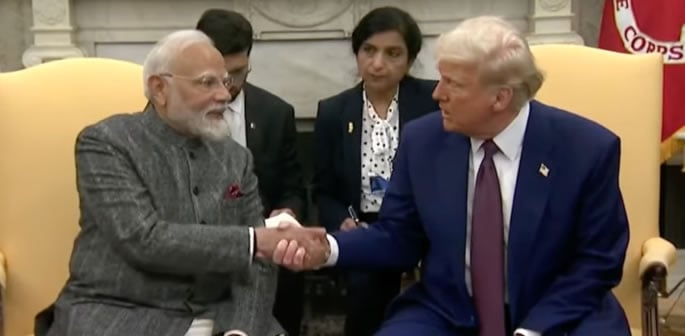
“The two leaders [Trump and Modi] laid out a simple concept in their first summit this year.”
“The US would focus on manufactured goods that are capital-intensive, while India would focus on items that are labour-intensive.”
But that vision has become harder to realise as both countries dig in on domestic priorities and political red lines.
If the current talks collapse, trade experts do not expect Trump to reimpose the 26% tariffs levied earlier this year.
While 57 countries were targeted, only the UK has managed to finalise a workaround deal.
Any move to single out India could raise concerns of unfair treatment.
Still, Srivastava offered a note of caution: “Targeting India specifically could seem unfair. Still, with Trump, surprises can’t be ruled out.”