

















































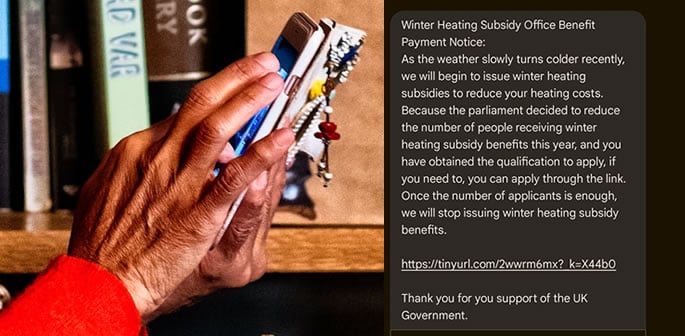
"Criminals are targeting people with them about fake winter grants"
Warnings have been issued to the elderly over fake winter heat subsidy texts.
Claiming to be from the UK government, the messages offer heating subsidies this winter.
The scam texts claim to be for a benefit with no age limit, which does not exist.
It will request potential victims to fill in an application by a certain date, pressuring them into doing so.
At the end of the text, potential victims are invited to click a link to ‘fill in the application’ or ‘update their information’.
Some of the links take recipients to a lookalike GOV.UK page, which could fool unsuspecting victims.
Recipients are then asked to input their name, email, phone number, home address and even card details into the fake GOV.UK page.
Martin Lewis Money Saving Expert shared a screenshot of an example text and warned:
“If you receive a text like this, IGNORE IT.
“Criminals are targeting people with them about fake winter grants and schemes.
“You can report scam texts to your provider by forwarding them to 7726.
“Please do spread the word to help people from getting caught out.”

One commenter said they had received two dodgy winter heat subsidy texts roughly three minutes apart.
But one tell-tale sign the message is fake is the poor spelling and grammar, something that would not be the case if it was legitimate.
The invitation to click the link is also a big giveaway.
Other Ways to Spot Scam Messages
Authority
Is the message claiming to be from someone official? For example, your bank, doctor, a solicitor, or a government department. Criminals often pretend to be important people or organisations to trick you into doing what they want.
Urgency
Are you told you have a limited time to respond (such as ‘within 24 hours’ or ‘immediately’)? Criminals often threaten you with fines or other negative consequences.
Emotion
Does the message make you panic, fearful, hopeful or curious? Criminals often use threatening language, make false claims of support, or tease you into wanting to find out more.
Scarcity
Is the message offering something in short supply, like concert tickets, money or a cure for medical conditions? Fear of missing out on a good deal or opportunity can make you respond quickly.
Current Events
Are you expecting to see a message like this? Criminals often exploit current news stories, big events or specific times of year (like tax reporting) to make their scam seem more relevant to you.
The scam warning comes just weeks after the government cut winter fuel payments from approximately 10 million pensioners.
Every year, the UK Department for Work and Pensions (DWP) provides winter fuel payments to help people of pension age with heating costs.
The 2024 Autumn Budget recently saw the number of people eligible for the credit fall from 11.4 million to around 1.5 million.
There are nearly 600 different fake website links connected to this type of scam.
Reports and recipients claim that the phone numbers sending the scam messages are connected to various countries, including Romania and Estonia.
The UK’s Regional Organised Crime Unit Network has warned pensioners to be “vigilant” against text messages claiming to be from any government department.
In a statement, the organisation said:
“Scam text messages talking about winter heating subsidies, and other support is being sent claiming to be from the Department of Work and Pensions and the Home Office to try to trick unsuspecting recipients into believing they will receive a heating subsidy.
“You should never click on the link, provide any personal details including bank details or make any sort of payment.”