
















































"Honestly, the story found me as much as I found it."
Aakash Odedra has spent much of his career exploring the spaces between cultures, traditions and artistic forms.
With Songs of the Bulbul, however, the acclaimed British South Asian choreographer turns inward, drawing on an ancient Sufi myth to create one of his most personal works to date.
The solo performance arrives at Sadler’s Wells East from July 7 – 11, bringing together Kathak, Sufi philosophy, live music traditions and deeply personal reflections on grief, artistry and belonging.
Created with renowned choreographer Rani Khanam and featuring an evocative score by composer Rushil Ranjan, the production examines beauty, captivity and transcendence through the story of a nightingale whose song becomes most beautiful in its final moments.
In an interview with DESIblitz, Aakash Odedra discussed the emotional origins of Songs of the Bulbul, his collaboration with Rani Khanam and what he hopes British South Asian audiences will recognise in the work.
Living an Entire Lifetime on Stage
At its heart, Songs of the Bulbul is built around an ancient Sufi myth of a captive nightingale whose final song becomes its most beautiful.
For Odedra, the story offered a way to explore not only performance and mortality but also the emotional cost of artistic expression itself.
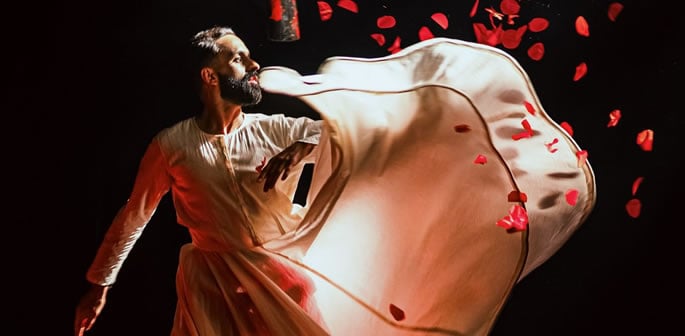
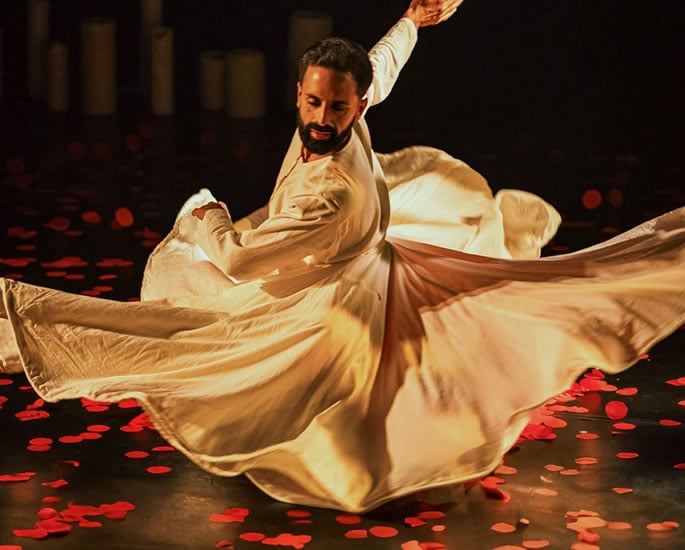
He said: “Songs of the Bulbul is a solo, just me on a stage scattered with rose petals, but in that hour I try to live an entire life in front of you: birth, curiosity, capture, and what comes after.
“It grows from an old Sufi myth about a nightingale kept in captivity, who sings more and more beautifully the closer it comes to the end.
“It is both ferocious and quiet; there is as much stillness as there is movement.
“So I’d say to a DESIblitz reader who doesn’t know my work: don’t come expecting only to watch dancing.
“Come to sit with something. At Sadler’s Wells East from the 7th to the 11th of July, I hope you leave having felt an entire lifetime pass in the space of an evening.”
The production marks another chapter in Odedra’s long-standing exploration of identity, spirituality and physical expression.
Unlike many contemporary dance works that prioritise spectacle, Songs of the Bulbul deliberately embraces restraint and contemplation alongside moments of intensity.
The story itself arrived in Odedra’s life during a period of profound personal reflection.
He detailed: “Honestly, the story found me as much as I found it.
“In the months before we made this, bulbuls kept appearing wherever I went – there was one in Goa that sat and sang while I was in the shower, which I couldn’t quite believe.
“And then Rani told me the myth, and it spoke straight to the life of an artist: you give a little of your soul away with every performance, and the beauty is somehow bound up with the loss.
“Beauty, captivity, transcendence – I don’t experience those as ideas, I experience them as grief.”
“This work is dedicated to my mother, who left us in 2020. She was my bulbul who left her cage.
“So when the bird sings its last and most beautiful song, I am not performing a metaphor. I am asking, every night, whether an ending can also be a release.”
Through this lens, the production becomes more than an interpretation of a traditional story. It evolves into a meditation on loss, memory and the ways personal grief can reshape artistic expression.
Finding Meaning through Stillness
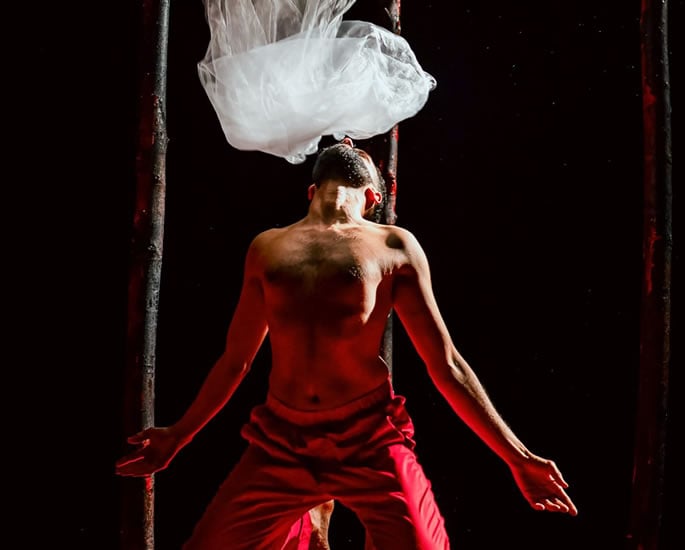
Central to Songs of the Bulbul is Aakash Odedra’s collaboration with Delhi-based choreographer Rani Khanam, widely recognised for her pioneering work bringing together Sufism and Kathak traditions.
Their creative partnership challenged many of Odedra’s own instincts as a performer.
He explained: “Rani is, to my mind, the first person to truly bring Sufism and Kathak together, and working with her I am constantly a student.
“She works completely differently from every other choreographer I’ve danced with. For her, it is all in the subtleness, the fine detail, the emotional and spiritual weight of a single gesture.
“My instinct as a dancer has often been toward speed and force; Rani kept pulling me back toward restraint, toward the smallest movement carrying the most meaning.
“We shaped the piece slowly, letting the bird’s story dictate the body rather than the other way around.
“What she expanded in me was patience, the confidence to be still, and to trust that stillness can say more than a hundred turns.”
That emphasis on stillness reflects a broader understanding of Kathak as not simply a technical dance form, but also a storytelling tradition rooted in emotional nuance and spiritual reflection.
The work’s musical landscape proved equally transformative during the creative process.
Composer Rushil Ranjan, whose previous collaboration with Odedra included Ghar Aa, developed a score that blends Indian classical traditions, qawwali and Western orchestral arrangements.
Emphasising the importance of the music, Odedra said:
“Rushil’s score is the body I dance inside.”
“This is our second collaboration, the first was Abi Sampa’s Ghar Aa, and he has this rare gift of holding Indian classical and Western orchestral traditions in the same hand without either losing itself.
“There are qawwali voices in it that carry the longing the bird cannot speak, and the poetry underneath is the old Sufi image of the nightingale singing to the rose – the lover and the divine Beloved, the same thing.
“In the studio, I don’t count the music so much as let it pull me; a phrase of the singing will open a gesture I didn’t plan.
“It guides the emotional journey more than the choreography does, in a way the body follows the ache in the sound.”
The result is a performance language where movement, music and poetry operate as interconnected forms of emotional storytelling rather than separate artistic disciplines.
The Physical and Emotional Cost of Performance
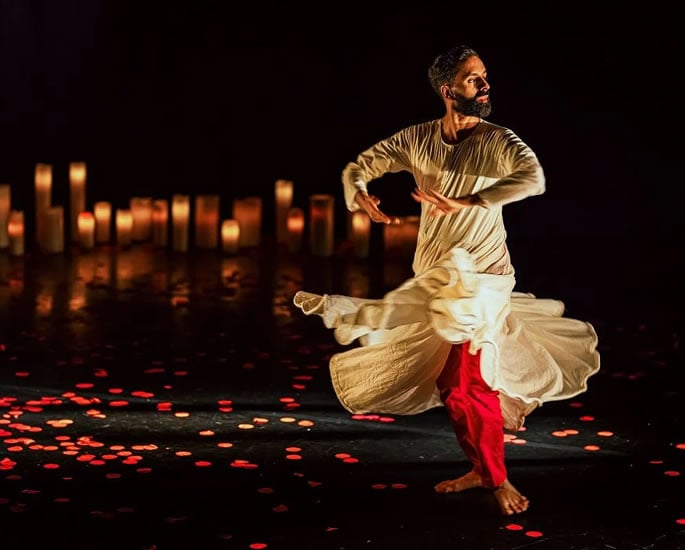
While Songs of the Bulbul presents audiences with a meditation on beauty and transcendence, its creation also required Odedra to confront the physical and emotional demands of inhabiting such a deeply personal work repeatedly.
Performing the solo, he explained, involves far more than technical endurance.
“It is exhausting in a way that is hard to explain, because the tiredness is not only in the legs. I go from birth to death in an hour, and some nights it feels as though it goes on forever.
“The ferocity takes the body; the contemplation takes something else.
“To enter it, I need quiet before I go on, a little time alone to let the noise fall away, so that by the time I step out, I am already somewhere else.
“And afterwards I need to come back gently; I can’t just walk off and into the world.
“I usually take a few minutes to sit before I speak to anyone, to let the bird leave me.
“It’s not superstition, it’s more that you can’t live a whole death every night and be careless about how you return to your own life.”
These reflections also inform the wider themes of artistic vulnerability explored throughout the production.
Aakash Odedra believes the myth’s enduring power lies partly in how it mirrors the pressures faced by contemporary artists, whose emotional labour often remains invisible to audiences.
He explained: “The myth is, when you look at it plainly, a story about a creature whose most beautiful song is extracted through suffering and I don’t think that is only a story about a bird.
“We ask artists to give and give of themselves, to leave a piece of their soul on the stage each time, and we don’t always ask what that costs them.
“I’ve made work before about difficult things, dyslexia, ageing, because I don’t believe the stage is only for beauty.”
“Underneath this beautiful piece, there is a harder truth about vulnerability, about how much of yourself you can pour out before there is nothing left.
“If the work opens even a small conversation about the care we owe the people who make things for us, I’d be glad of it.”
In this sense, Songs of the Bulbul extends beyond performance and enters wider conversations around creativity, wellbeing and the expectations placed upon artists.
A Bridge between the UK and South Asia
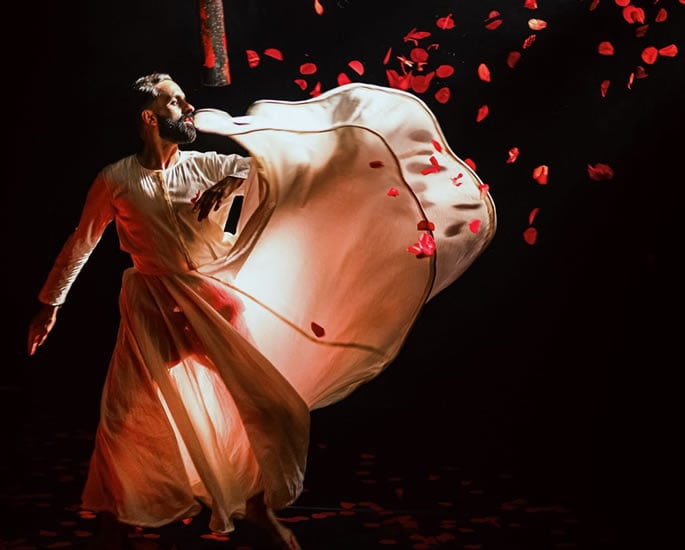
Throughout his career, Aakash Odedra has frequently been described as a bridge between Britain and South Asia.
Born in Birmingham, raised partly in Leicester and artistically shaped through extensive training in India, he sees Songs of the Bulbul as reflecting the complexities of diaspora identity.
“I was born in Birmingham and I built my company in Leicester, but I first went to India alone at fifteen, and life there became my university.
“So I have always carried two homes in one body, that is simply what it is to be a British South Asian artist.
“And there is something in this myth that mirrors that: the bulbul travels from Persia into the subcontinent; the story itself is a migration.
“Anyone from the diaspora knows what it is to sing of a place you cannot fully return to, to hold a longing for somewhere that is both yours and not yours.
“The classical forms I trained in, Kathak, Bharatanatyam, were my inheritance, but I’ve spent my life letting them speak to contemporary and international languages.
“Perhaps what audiences recognise is that you don’t have to choose. You can belong to more than one world at once.”
That sense of cultural movement and layered identity also resonates with the production’s London setting.
For Odedra, returning to Sadler’s Wells East carries particular significance because of both the venue’s artistic ambitions and its location within one of Britain’s most culturally diverse communities.
He said: “To return to Sadler’s Wells East after the premiere season means a great deal to me, especially as a Sadler’s Wells Associate Artist; it feels like being given a home rather than just a stage.
“And this is a genuinely East London space, in Stratford, in the Olympic Park, in one of the most gloriously mixed parts of this city. That matters for this piece particularly.
“Songs of the Bulbul comes from many places at once, Persia, the subcontinent, Britain, and East London is exactly that kind of meeting point, where so many stories and heritages sit side by side.
“I like the idea of the bird singing in a room full of people who each carry somewhere else inside them.”
The parallels between migration, identity and artistic inheritance remain embedded throughout the production’s narrative structure.
Building a Space for Aspiring British South Asian Artists
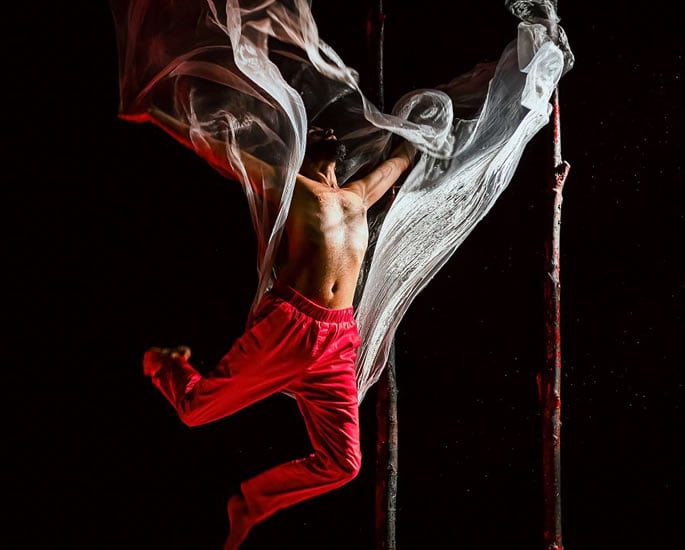
Alongside his international performance career, Aakash Odedra’s work through his Leicester-based organisation has focused heavily on community engagement, accessibility and supporting emerging artists.
He stated: “Everything I do is rooted in the hub we’ve built in Leicester, in Belgrave, where we run classes and masterclasses and open our doors to anyone who has faced any kind of barrier.
“That work isn’t separate from a piece like this; it’s the soil it grows in.
“When you teach young dancers, especially young South Asian dancers, you see how much they need to be told that their heritage is not a limitation but a strength. I carry that into the studio.
“With British Asian audiences, I suppose I’m hoping to spark a particular recognition that our classical forms are living, contemporary, world-class, and that a story from our own traditions can hold a stage anywhere.
“I want a young person in the audience to think: that could be mine to make, too.”
That message remains especially important for younger British South Asians considering careers in the arts, a path Odedra himself pursued despite uncertainty and isolation.
Reflecting on what he hopes audiences ultimately take away from Songs of the Bulbul, he added:
“I hope people carry away a feeling more than a message, the sense that they lived something, not just watched it, and that beauty and loss are not opposites but the same thing seen from two sides.
“And to a young British South Asian person wondering whether there is a life for them in the arts: when I was a child, imagination was the only way I had to get away from where I was. I turned that into a life.
“Nobody handed it to me; I went looking for it, alone, at fifteen.”
“So I would say the door is more open than it looks, and your background is not something to leave behind at the entrance.
“It is exactly the thing you have to give. The bird sings because it must. If you have that in you, don’t wait for permission.”
Aakash Odedra’s Songs of the Bulbul ultimately leaves behind more than a retelling of a Sufi myth.
It lingers on the idea of impermanence, where beauty is inseparable from its ending and performance cannot be separated from what it takes from those who create it.
The bulbul’s song, both fleeting and final, becomes a reminder of how quickly moments of expression vanish once they are lived.
Yet within that fragility sits the work’s enduring strength.
Through his collaboration with Rani Khanam and composer Rushil Ranjan, Odedra builds a production that holds intensity and restraint in constant tension, allowing movement, music and poetry to dissolve into one another without settling into certainty.
Songs of the Bulbul runs at Sadler’s Wells East from July 7 – 11. Tickets are available now.