














































"They were just true artists."
“LIGHTS, CAMERA, ACTION!” Whenever these three words were uttered on a film set in the 1950s, you just knew that magic would follow.
In this decade, Hollywood was enjoying its Golden Period, with stars like Marlon Brando, Cary Grant, Audrey Hepburn, and Marilyn Monroe dazzling all.
But on the other side of the world, India was also marking the beginning of its Golden Era.
While colour was still a bit far away for some, that didn’t stop companies from producing some of the finest Hindi movies ever made.
These films stand the test of time, with artists such as Dilip Kumar, Dev Anand, Raj Kapoor, Nargis, and Madhubala, reigning supreme.
Bollywood in this decade also rode high on its melodious music, composed by some legendary musicians and singers.
So, in this article, DESIblitz takes you on a journey through the ultimate classics, as we present 20 of the best Bollywood films, which were released in the 1950s.
Sangram (1950)
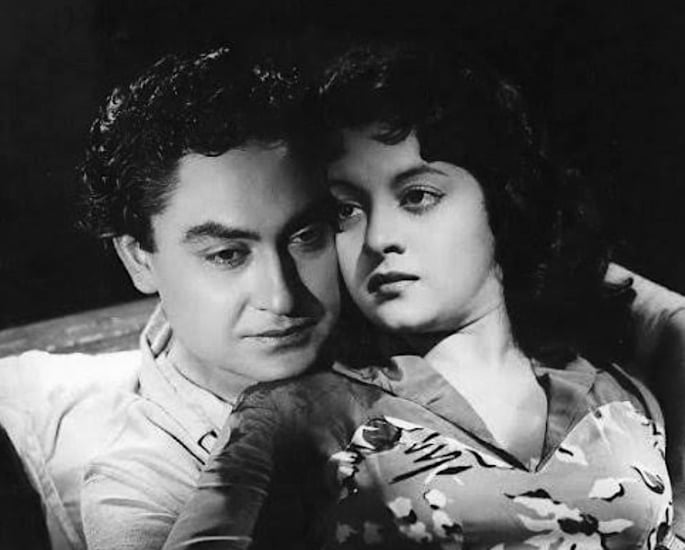 Director: Gyan Mukherjee
Stars: Ashok Kumar, Nalini Jaywant, Ramayan Tiwari, Nawab
Ashok Kumar remains a bonafide legend of Indian cinema. His name shone brightly in the 1940s and 1950s.
One of the films kicking off the latter decade is Gyan Mukherjee’s Sangram.
In the film, Ashok Sahab portrays a negative character in the form of Kunwar Rajendra K Singh.
Kunwar grows up into a spoiled criminal, and runs a casino disguised as a hotel.
This contrasts with his father, the police officer, Thakur Narendra Singh’s (Nawab) ideals.
As romance and blackmail engulfs him later in life, both Thakur and Kunwar are forced to make difficult choices.
Ashok Sahab excels in this role with villainous shades, making Sangram the classic it is.
The film also inspired the plot of Shakti (1982), which starred Dilip Kumar and Amitabh Bachchan.
Awaara (1951)
 Director: Raj Kapoor
Stars: Prithviraj Kapoor, Nargis, Raj Kapoor
Raj Kapoor produces, directs, and stars in this classic father-son drama.
Raj Sahab portrays Raj in the film, who grows up to be a criminal due to poverty.
His crimes eventually lead to Raj facing court, with none other than Judge Raghunath (Prithviraj Kapoor) deciding his fate.
However, Raj is unaware that the judge presiding over his case is his own father.
Prithviraj Sahab is also Raj Kapoor’s real-life father, making Awaara relatable and original.
The film is a gritty drama, described by Karan Johar as one of his favourite films.
Aawaara contains timeless chartbusters, including ‘Awaara Hoon‘ by Mukesh.
This film is regarded as one of Raj Kapoor’s finest works, opening a plethora of fame for him in Russia and China.
Baazi (1951)
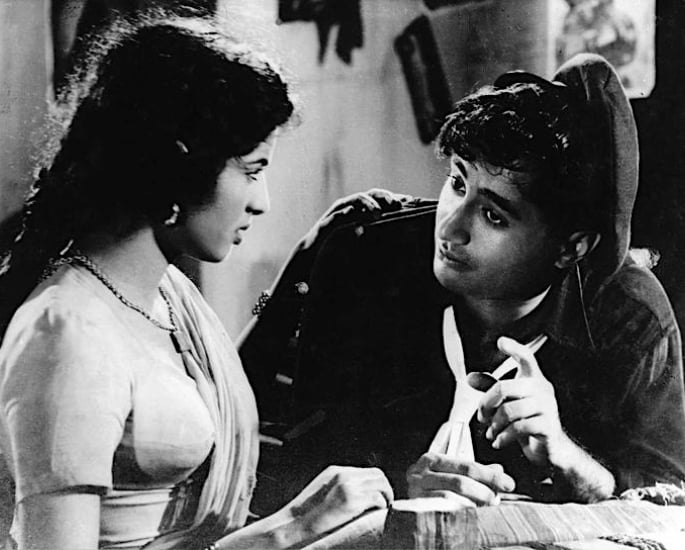 Director: Guru Dutt
Stars: Dev Anand, Geeta Bali, Kalpana Kartik
This crime-noir film marked the directorial debut of Guru Dutt, and stars Dev Anand as Madan.
Poor and unemployed, Madan turns to the dark world of gambling to survive and pay for his sister’s medical treatment.
While going down this road, he meets the alluring dancer, Leena (Geeta Bali), and Dr Rajani lpana Kartik).
Madan falls in love with Rajani, but secrets, lies, and deception threaten to keep them apart.
Baazi helped make Dev Sahab a star and also established Geeta Bali, lyricist Sahir Ludhianvi, and Balraj Sahni as a screenwriter.
Music composer, SD Burman, was also given a new lease of fame.
Praising the film, a writer on WordPress comments: “Dev Anand suits the role to perfection, and so does Geeta Bali.”
The writer adds that they didn’t dislike anything about the film.
Want to know where Bollywood crime first began onscreen? You will find the answer in the 1950s with Baazi.
Aan (1952)
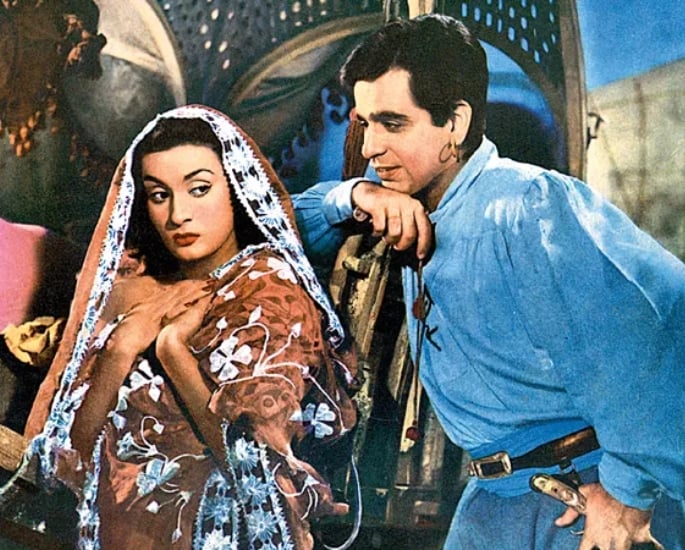 Director: Mehboob Khan
Stars: Dilip Kumar, Nadira, Nimmi, Premnath
Mehboob Khan’s Aan signified Hindi cinema’s first offering to include colour onscreen.
A swash-buckling adventure, Aan features Dilip Kumar as Jai Tilak.
Jai Tilak is a young man who challenges the royal, Prince Shamsher Singh (Prem Nath) to a fencing contest.
Jai soon falls for Princess Rajshree (Nadira), but things get complicated with the arrival of his previous romance, Mangala (Nimmi).
Aan was a unique experience for the audience and was the first Indian film to be released worldwide, including the UK, the US, France, and Japan.
The film benefits from a fantastic performance by Dilip Sahab, who is known for pioneering method acting long before Marlon Brando in Hollywood.
Aan paved the path for the emerging South Asian diaspora outside India to champion films from their homeland.
As well as being the first Bollywood film to be shot in Technicolour, Aan should be celebrated for putting down new roots.
Baiju Bawra (1952)
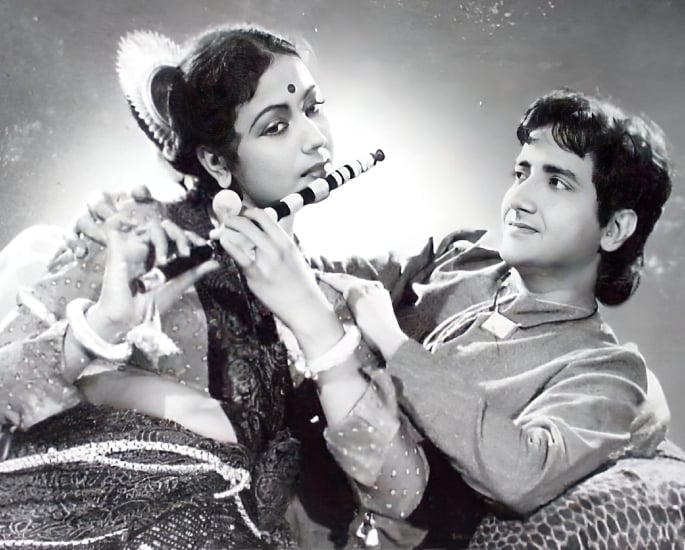 Director: Vijay Bhatt
Stars: Bharat Bhushan, Meena Kumari
Vijay Bhatt’s enduring film, Baiju Bawra, tells the story of Baiju (Bharat Bhushan) who is a gifted musician.
After his father is brutally killed, Baiju vows revenge. He later falls for the beautiful Gauri (Meena Kumari).
However, his quest for revenge proves a hindrance in his relationship with her.
He later resolves to achieve his mission through music as opposed to violence.
Baiju Bawra is known for its spellbinding music, especially Mohammad Rafi’s haunting song, ‘O Duniya Ke Rakhwaale‘.
It is said that a prisoner awaiting the death penalty asked to hear this song before he died, instead of seeing his family.
A review of the film says: “Baiju Bawra is terrific. I’m also not surprised that plans are underway to remake the movie.”
For her magical performance, Meena became the inaugural recipient of the Filmfare Award for ‘Best Actress’ in 1954.
Do Bigha Zamin (1953)
 Director: Bimal Roy
Stars: Balraj Sahni, Nirupa Roy, Meena Kumari, Ratan Kumar
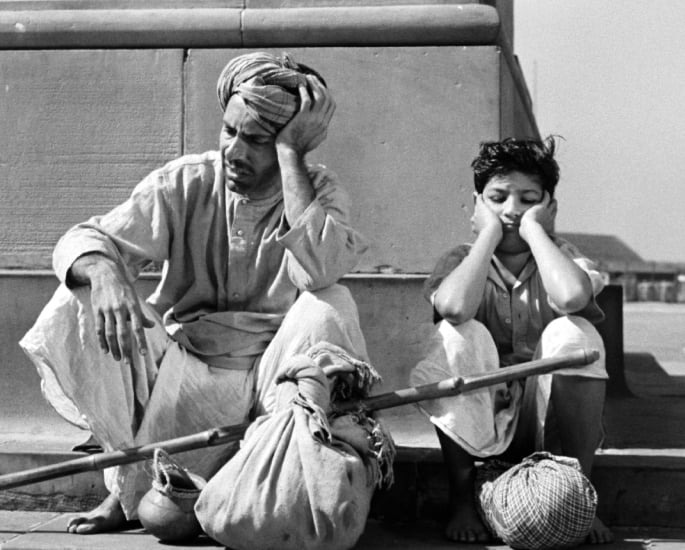
In Bimal Roy’s film, Do Bigha Zamin, Balraj Sahni plays Shambu Maheto, a poor farmer.
Shambu’s land is threatened by landlord, Thakur Harnam Singh (Murad).
On borrowed time to repay his debts, Shambu travels to Kolkata to become a rickshaw-puller.
Shambu and his family become entangled in a web of exploitation and illness, as they fight to save their land.
Do Bigha Zamin has several key strenghts. Bimal Da’s sublime direction, powerful performances, and a rousing story all make it endure.
Balraj Sahab writes: “I shall always look upon my role in Do Bigha Zamin with a sense of pride.
“Indeed, I shall cherish the memory of that role until I breathe my last.”
For the film, Bimal Da was the first ever awardee of the Filmfare Award for ‘Best Director’ in 1954.
Devdas (1955)
 Director: Bimal Roy
Stars: Dilip Kumar, Suchitra Sen, Vyjayanthimala, Motilal
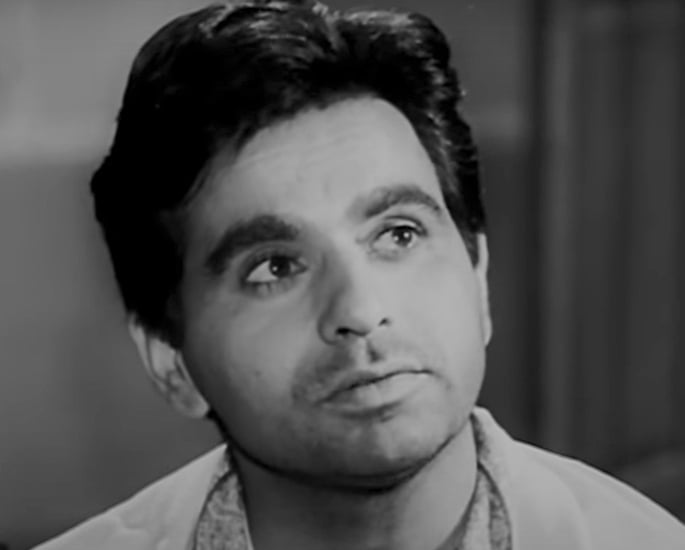
Continuing with the classic work of Bimal Roy, we come to Devdas, starring Dilip Kumar as the titular character.
Based on Sarat Chandra Chattopadhyay’s 1917 novel, this is the second film adaptation of the story.
Devdas tells the story of a young man descending into alcoholism, after he loses Paro Choudhury (Suchitra Sen), the girl he loves.
He finds comfort in the tawaif, Chandramukhi (Vyjayanthimala).
However, Devdas cannot abandon his alcohol, uttering the famous line: “Who drinks to tolerate? I drink so that I can breathe.”
All three leading actors of Devdas deliver captivating and gut-wrenching performances.
Although despondent, the film has enchanted viewers of the 1950s and newer fans alike.
For his performance, Dilip Sahab won the Filmfare Award for ‘Best Actor’ in 1957.
Shree 420 (1955)
 Director: Raj Kapoor
Stars: Raj Kapoor, Nargis, Nadira
After the humongous success of Awaara, Raj Kapoor returned to the director’s chair in Shree 420.
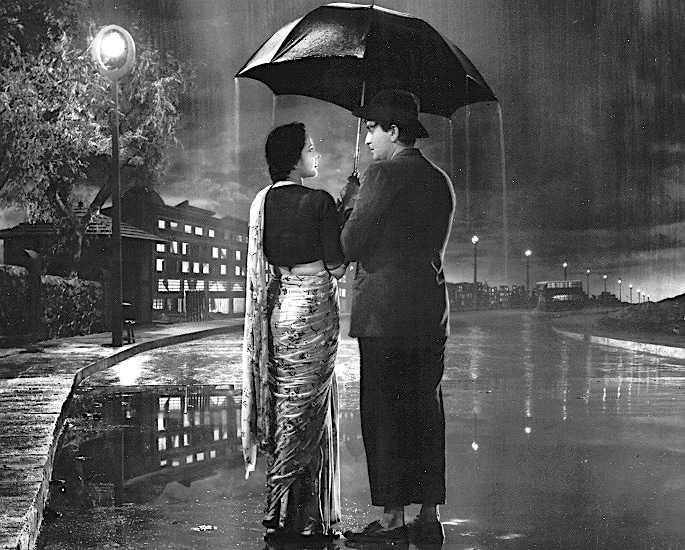
He also stars in the film as Raj, a country boy, who walks to the big city to find his fortune.
Despite falling in love with the virtuous Vidya (Nargis), he finds himself drawn to freewheeling and corruption.
He is also led astray by Seth Sonachand Dharmanand (Nemo).
Raj Kapoor and Nargis Ji keep their glorious chemistry intact in Shree 420.
Notably, Raj Sahab pays the ultimate tribute to his idol, Charlie Chaplin in the film, in that he moves and dresses like the Hollywood icon.
The film contains the evergreen numbers, ‘Mera Joota Hai Japani‘ and ‘Pyaar Hua Iqraar Hua’.
Shree 420 is not only a landmark for Raj Kapoor and Nargis, but it’s also a milestone in 1950s Bollywood.
CID (1956)
 Director: Raj Khosla
Stars: Dev Anand, Shakila, Waheeda Rehman, Johnny Walker
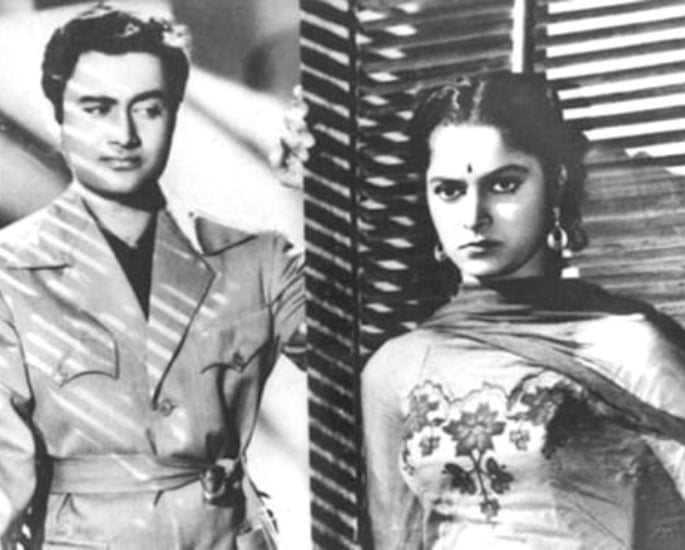
Raj Khosla’s CID presents Dev Anand as CID Inspector Shekhar.
Shekhar must investigate the murder of a newspaper editor, and in doing so, must face disturbing links hidden in the case.
Along the way, he develops feelings for Rekha (Shakila), underscored by the charming song, ‘Aankhon Hi Aankhon Mein‘.
The film also showcases the Hindi film debut of Waheeda Rehman, who dazzles as the vamp, Kamini.
CID also explores the underworld of Mumbai.
Splendidly shot and sensitively told, CID is an unmissable film for fans.
In 2023, to commemorate Dev Anand’s birth centenary, CID was one of the films that was restored and rereleased.
It opened to just as much endurance and appreciation as it did in the 1950s.
Chori Chori (1956)
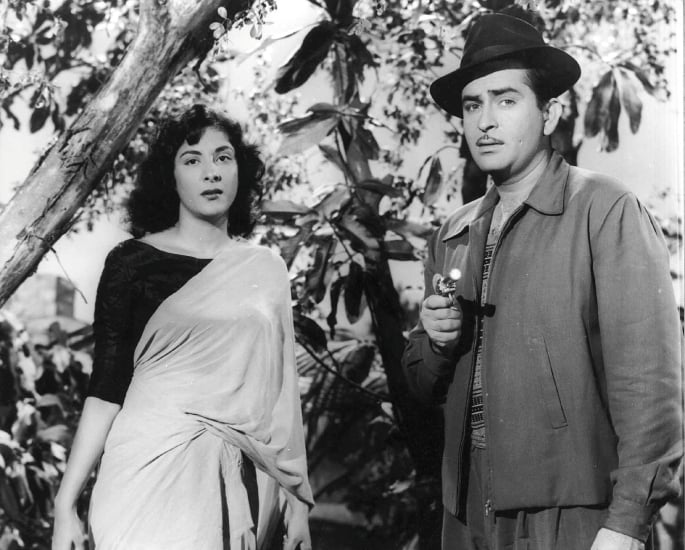 Director: Anant Thakur
Stars: Raj Kapoor, Nargis, Pran, Johnny Walker
In another magnificent collaboration between Nargis and Raj Kapoor, fans are swept off their feet with Chori Chori.
Inspired by It Happened One Night (1934), the film focusses on Sagar (Raj Kapoor) and Kammo (Nargis).
Kammo is the daughter of a millionaire, who is in love with the selfish pilot, Suman Kumar (Pran).
To unite with Suman, Kammo runs away from home, and meets Sagar, a freelance reporter.
As she spends time with him, Kammo falls for Sagar and forgets Suman.
Chori Chori is famous for its utterly divine soundtrack. It was also one of the final films that Nargis Ji and Raj Sahab did together.
Reflecting on their partnership, Raj Sahab says: “I must say that Nargis contributed a lot to what RK Films is.”
This contribution is evident in Chori Chori, a feel-good film suitable for all ages and generations.
Paying Guest (1957)
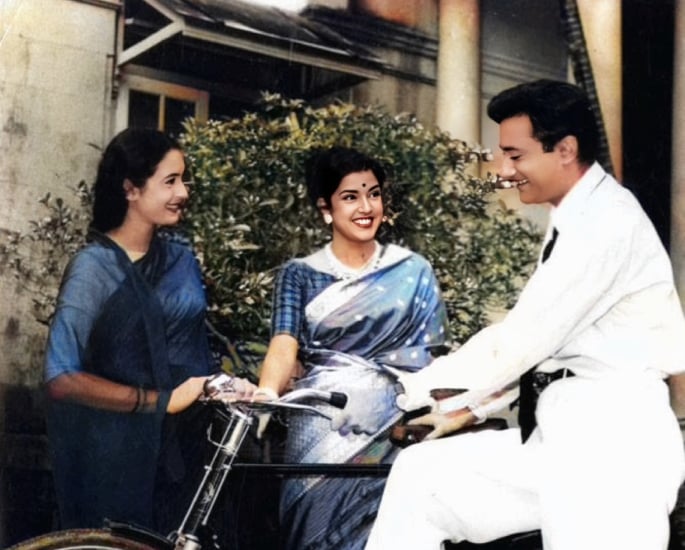 Director: Subodh Mukherjee
Stars: Dev Anand, Nutan
This fun-filled movie brings the popular onscreen pairing of Dev Anand and Nutan together.
Dev Sahab plays Ramesh, a lawyer who constantly gets evicted due to not paying rent.
The heart of Paying Guest is the romance between Ramesh and Shanti, played by Nutan.
SD Burman proves why he is a multifaceted composer with breezy songs, such as ‘O Nigahen Mastana‘ and ‘Chhod Do Aanchal’.
In the 1950s, Dev Sahab was known as the dashing and debonair ladies’ man.
He upholds that image gallantly in Paying Guest, which is one of his most loved films.
A review of the film says: “If you need an afternoon of harmless entertainment, Paying Guest is a good way to spend a couple of hours.”
Warm, gentle, and not too complicated, the film is an ode to pure romance – something that was at its zenith in the decade.
Pyaasa (1957)
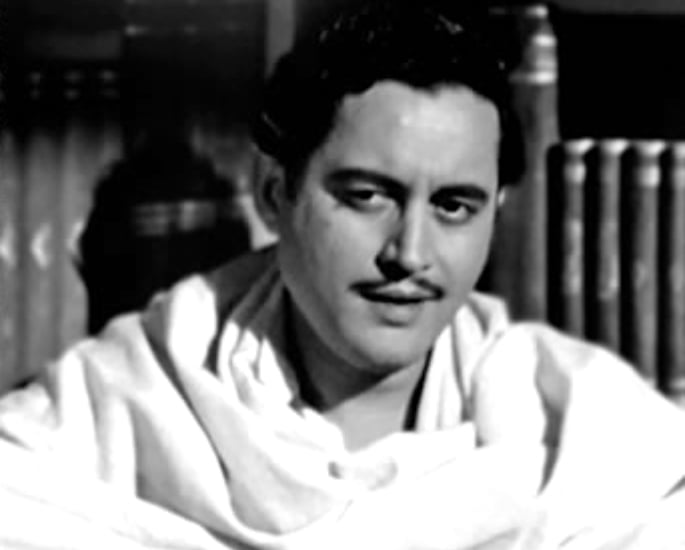 Director: Guru Dutt
Stars: Guru Dutt, Mala Sinha, Waheeda Rehman, Johnny Walker, Rehman
Guru Dutt’s timeless masterpiece, Pyaasa, is the only Hindi film to be mentioned on the BFI’s Sight and Sound list of The Greatest Films of All Time.
It narrates the tragic saga of Vijay (Guru Dutt), a struggling poet, who becomes disillusioned with the hypocritical world around him.
He finds companions in Gulabo (Waheeda Rehman) and Abdul Sattar (Johnny Walker).
Pyaasa was ahead of its time. In an era where romance was ruling, Guru Sahab’s tale of melancholy and realism stood out like moonlight in a sun-baked field.
SD Burman is at his finest with each song being a mellifluous classic.
Aamir Khan frequently terms Pyaasa as one of his all-time favourite films.
Interestingly, Guru Sahab wanted Dilip Kumar to play Vijay. After the latter declined, he undertook the role himself and shone like no other.
Watch the film, and it won’t be hard to see why.
Mother India (1957)
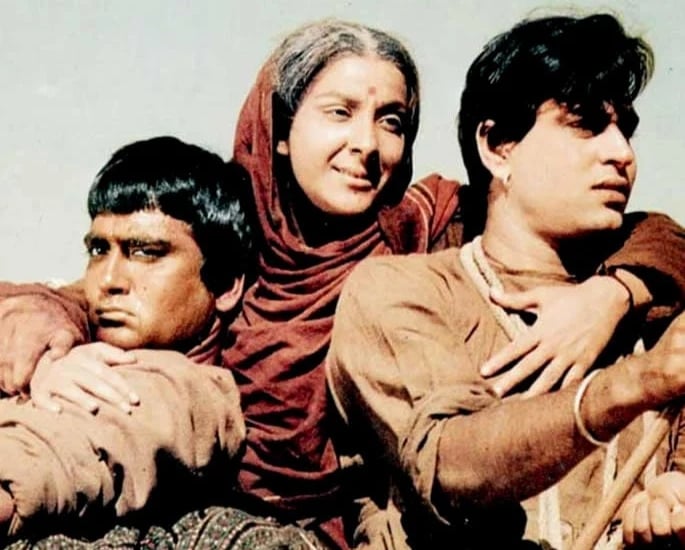 Director: Mehboob Khan
Stars: Nargis, Sunil Dutt, Rajendra Kumar, Raaj Kumar
Mother India showcases Nargis at her very best. In this epic movie, she inhabits the world of Radha.
Radha is an archetypal Indian woman, and is the mother of two sons – Birju (Sunil Dutt) and Ramu (Rajendra Kumar).
Both brothers have contrasting personalities. While Ramu is virtuous and noble, Birju is rebellious and short-tempered.
After Radha’s husband, Shamu (Raaj Kumar) abandons the family, Radha must raise her sons single-handedly.
When Birju’s behaviour becomes too much, Radha is faced with the hardest decision of her life.
Mother India defines the word ‘ageless’ in Bollywood. It was the first Indian film to be shortlisted for an Oscar in 1958.
Unfortunately, it lost the award to Nights of Cabiria (1957). However, it continues to find love as the years pass.
For her sterling act in the film, Nargis Ji won the Filmfare ‘Best Actress’ Award in 1958.
Tumsa Nahin Dekha (1957)
 Director: Nasir Hussain
Stars: Shammi Kapoor, Ameeta, Pran, BM Vyas
Nasir Hussain’s directorial debut, Tumsa Nahin Dekha, did wonders for Shammi Kapoor as an actor.
Before this film, Shammi Sahab was a struggling newcomer, with consecutive flops to his name.
His declining career improved with this film, in which he appears as Shankar Bhat, who must win the heart of Meena (Ameeta).
Shammi Sahab gives it his all to this film. With its release, the audience was introduced to an effervescent star.
His style, dance, and mannerisms would hypnotise the nation for over a decade to come.
As the film starred an unsuccessful actor and was helmed by a new director, producers were unwilling to invest too much money into it.
However, despite the lack of support, Tumsa Nahin Dekha became a rage.
The 1950s did not have the financial independence and resources that Bollywood producers enjoy today. However, the decade still churned great cinema.
Faith and perseverance were the building blocks of many movies in those days. Tumsa Nahin Dekha is a perfect example.
Naya Daur (1957)
 Director: BR Chopra
Stars: Dilip Kumar, Vyjayanthimala, Jeevan, Ajit Khan
Dilip Kumar and Vyjayanthimala amaze and enthral in BR Chopra’s Naya Daur.
Dilip Sahab plays Shankar, a hardworking horse-and-carriage-puller, who makes a living by taking passengers on his tonga.
He and his best friend, Krishna (Ajit), both love Rajni (Vyjayanthimala). However, she only loves Shankar.
When the ruthless businessman Seth Maganlal (Nazir Hussain) threatens the village’s economy, it is up to Shankar to take a risk and save the day.
Naya Daur capitalises on a beautiful score by OP Nayyar, which includes the evergreen, ‘Ude Jab Jab Zulfen Teri‘.
In a review of the film, Mansi Dua gushes: “Naya Daur is almost three hours long, but I couldn’t look away even for a second.
“As always, the legendary Dilip Kumar does not disappoint.”
It can be noted that its premise is also resonant of the Oscar-nominated Lagaan (2001).
For Naya Daur, Dilip Sahab won the Filmfare Award for ‘Best Actor’ in 1958.
Madhumati (1958)
 Director: Bimal Roy
Stars: Dilip Kumar, Vyjayanthimala, Pran, Johnny Walker
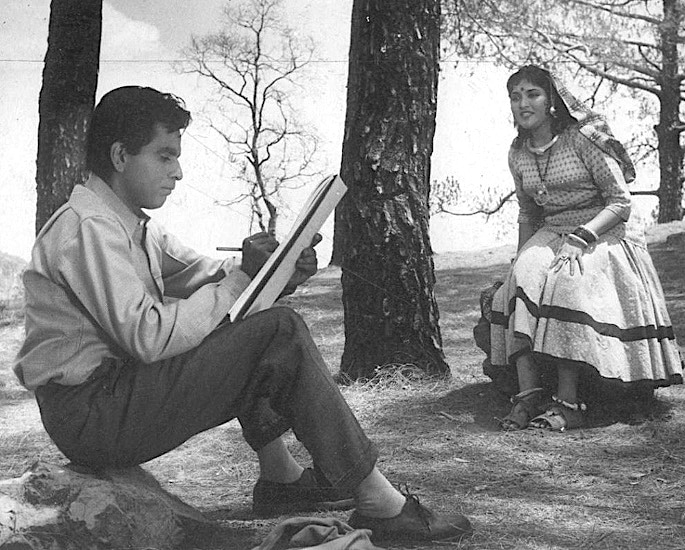
Continuing with the electrifying chemistry of Dilip Kumar and Vyjayanthimala, we come to Bimal Roy’s Madhumati.
The film is a paranormal romance – one of the first of its kind in Indian cinema.
We meet Devendra (Dilip Kumar) and his wife Radha (Vyjayanthimala).
The actors also play Anand and Madhumati, respectively, from a previous birth.
The viewers are taken through a cycle of love, betrayal, and revenge across two lifetimes, making Madhumati a satisfying and remarkable watch.
Madhumati was the template for many suspense films that followed it, including Om Shanti Om (2007) and Talaash: The Answer Lies Within (2012).
In an interview, Vyjayanthimala praises Bimal Roy: “Madhumati was not exactly the kind of film he would make.
“It was one of his most commercial ventures and yet, he added so much lyricism to it.”
Undeniably, Madhumati deserves its place among the must-watch Bollywood films of the 1950s.
Chalti Ka Naam Gaadi (1958)
 Director: Satyen Bose
Stars: Ashok Kumar, Madhubala, Anoop Kumar, Kishore Kumar
Many film connoisseurs know Kishore Kumar as one of Bollywood’s most loved playback singers.
While this is axiomatically true, Kishore Da was also a highly skilled actor, well-versed in comic timing.
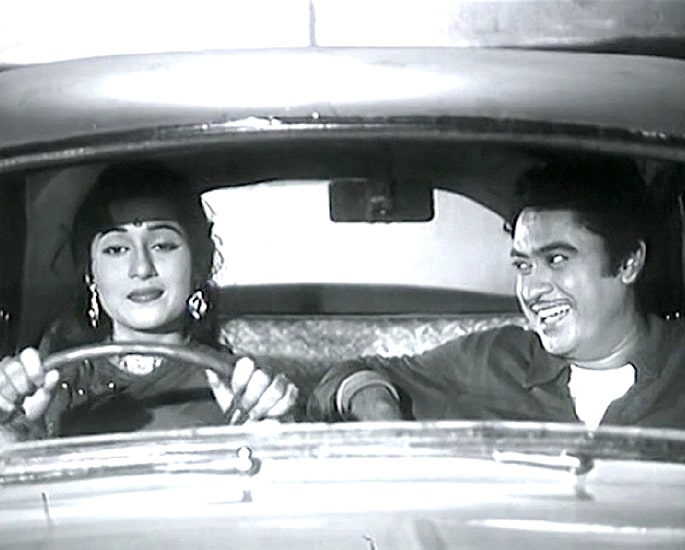
His home production, Chalti Ka Naam Gaadi is firm evidence of this.
In the film, he plays Manmohan Sharma, a mechanic.
He stars alongside his real-life brothers, Ashok Kumar and Anoop Kumar, as well as the ethereal actress, Madhubala (Renu).
Initially annoyed by Manmohan, Renu warms up to him, lighting the way for a sweet love story.
Kishore Da also lends his voice to several songs, making the movie a delight to watch.
His chemistry with Madhubala is also a winner. Shortly after Chalti Ka Naam Gaadi, the couple married.
Howrah Bridge (1958)
 Director: Shakti Samanta
Stars: Ashok Kumar, Madhubala
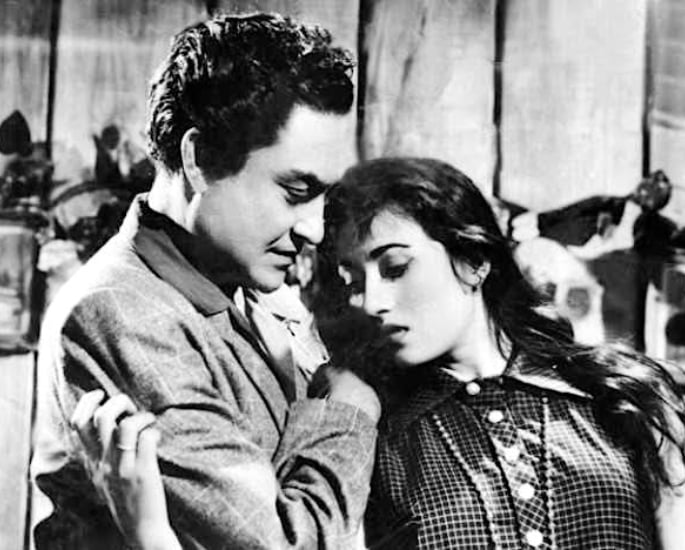
As we stay with Madhubala, we arrive at Shakti Samanta’s Howrah Bridge.
The iconic actress portrays Edna, a cabaret dancer who falls in love with Prem Kumar (Ashok Kumar).
Unbeknownst to Prem, Edna secretly works for a criminal enterprise.
She finally aids Prem in investigating his brother’s death and searching for a missing heirloom.
Madhubala is resplendent in Howrah Bridge. The song, ‘Aaiye Meherbaan‘, shows her gliding and swaying in a seductive dress.
Another song, Geeta Dutt’s mesmeric ‘Mera Naam Chin Chin Chu‘ was reused in Salaam Bombay (1988).
This shows the endurance of Howrah Bridge, which awaits your viewing!
You won’t be disappointed!
Anari (1959)
 Director: Hrishikesh Mukherjee
Stars: Raj Kapoor, Nutan, Motilal, Lalita Pawar
Hrishikesh Mukherjee’s comedy, Anari, is also a social drama encompassing innocence, class, and corruption.
The honest yet poor artist, Raj Kumar (Raj Kapoor), returns a lost wallet, earning the respect of Seth Ramnath Sohanlal (Motilal).
Raj falls in love with Aarti (Nutan), who has disguised herself as a maid to overcome the class barrier between them.
However, all hell breaks loose when Raj’s landlady, Mrs L D’Sa (Lalita Pawar) dies and Raj finds himself in a mess.
Anari shows the power of innocence and honesty prevailing over greed and exploitation, making the film relatable and gut-wrenching.
Decorated with great songs such as ‘Kisi Ki Muskurahaton Pe’ and the award-winning ‘Sab Kuch Seekha Humne,’ Anari is sure to provoke some thoughts in fans.
For this film, Raj Kapoor won his first Filmfare Award for ‘Best Actor’ in 1960.
Kaagaz Ke Phool (1959)
 Director: Guru Dutt
Stars: Guru Dutt, Waheeda Rehman, Kumari Naaz, Mehmood, Johnny Walker
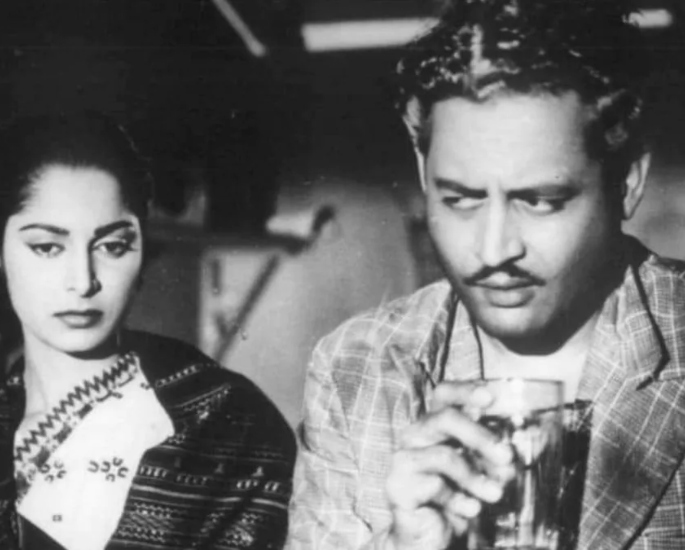
Guru Dutt’s semi-autobiographical film, Kaagaz Ke Phool, was the first Indian movie to be shot in CinemaScope.
Guru Sahab plays Suresh Sinha, a film director, whose marriage to Veena Sinha (Veena) is falling apart.
On a rainy night, Suresh meets Shanti (Waheeda Rehman). Seeing potential in her, Suresh casts her as a leading actress in his adaptation of Devdas.
Suresh and Shanti’s loneliness brings them together. However, Shanti soon moves away from cinema, devastating Suresh.
Kaagaz Ke Phool was Guru Dutt’s passion project. Unfortunately, at the time of its release, it failed at the box office.
The film’s debacle plunged Guru Sahab into despair and he decided not to direct films anymore.
However, over time, the film has gained renewed appreciation and is regarded as one of the best Indian films ever made.
Waheeda also calls this film one of her favourites.
When it comes to Bollywood, the 1950s is not just a decade – it is a shining mosaic of glittering movies.
These films are just some of the pictures that thrive in the history books of cinema.
Other notable movies include Mr & Mrs 55 (1955), Sujata (1959), and Nau Do Gyarah (1957), among several others.
In his 2014 autobiography, The Substance and the Shadow, Dilip Kumar writes:
“Today’s cinema sadly does not have the kind of emotional give-and-take that the cinema of the 1950s had.”
Ranbir Kapoor adds: “I think the 1950s was the Golden Time of Indian cinema. There was more mystery.
“They used to mortgage their houses to make a film. The way they used to explore Indian culture, music, and romance was just amazing.
“They were just true artists and were making it easy for us.”
So, whether you’re an older fan or a newbie looking to learn about this glorious era of Bollywood, prepare to embrace the cinema of the 1950s in all its wonder.