
















































The lack of visible role models is a significant factor
Netball is a sport that thrives in communities across the UK, yet a significant portion of the population remains largely absent from the court: British South Asian women.
England Netball proudly proclaims its vision to “grow the game and ensure that everyone feels they have a place in netball”.
However, the reality is that more needs to be done to get more British Asians playing.
This is something echoed by Farah Hasan, who plays for Hartlepool-based team Oaksway.
We look at the reasons behind this lack of representation and the initiatives aimed at finally bringing diversity to the forefront of the sport.
The Importance of Representation
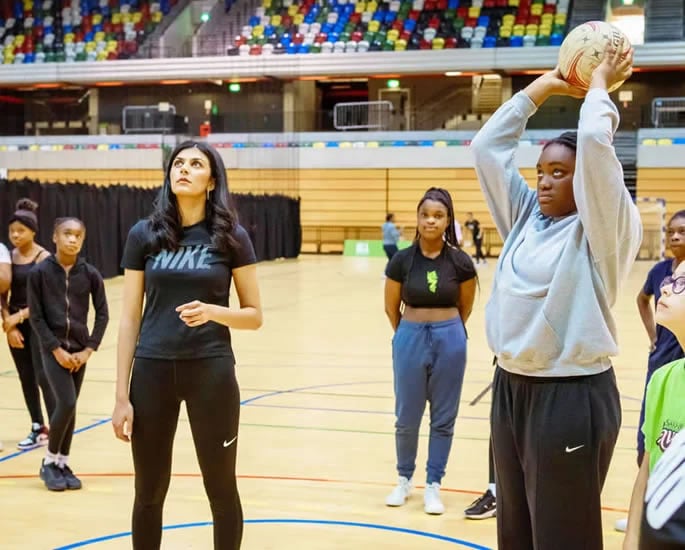
A recurring theme in the discussion around diversity in any field is the critical importance of role models.
For young South Asian girls, the lack of professional players who look like them can be a significant deterrent.
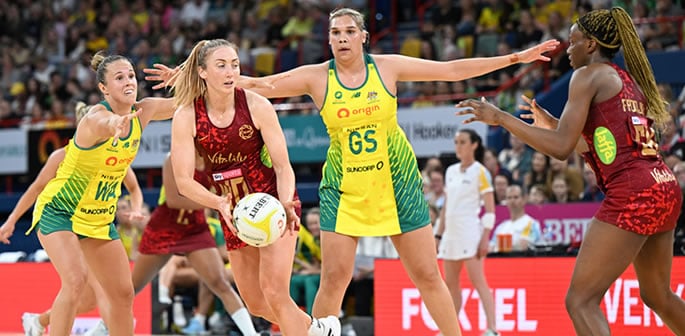
In the Netball Super League currently, there are no recognisable South Asian players. This absence at the elite level sends a powerful, albeit unintentional, message that netball is not a sport for them.
Ziana Butt, the first player of Pakistani heritage to represent England in netball, is a testament to the impact one individual can have.
Growing up in Ilford, she was often the only South Asian player at tournaments, an experience that fuelled her passion for advocacy.
Butt has since become a vocal champion for diversity, co-authoring a children’s book, Aisha’s Netball, to encourage more South Asian children to take up the sport.
Her story highlights the immense pressure and responsibility placed on the few who do break through, and the urgent need for more to follow in her footsteps.
Farah Hasan, who is of mixed Pakistani and white heritage, has also spoken about being the only Asian player in her teams in north-east England.
She is actively involved with the UK-based Pakistani Netball Academy, which aims to nurture promising players.
The lack of visible role models is a significant factor in the low participation rates, with one survey indicating that 87% of South Asian girls felt that a lack of role models from similar backgrounds played a part in why they did not participate in sports.
Cultural Hurdles

The reasons for the underrepresentation of South Asian women in netball are multifaceted and deeply rooted in cultural and societal norms.
For many, the expectation to prioritise academics over extracurricular activities can be a significant barrier.
Sport for girls is not largely promoted within some South Asian cultures, where it can be seen as a masculine pursuit.
This can lead to a lack of support from families who may not understand the pathways into professional sport or see it as a viable career.
Furthermore, preconceptions and stereotypes from coaches and scouts can create additional hurdles.
Hasan has spoken about the challenge of breaking down stereotypes, stating:
“It takes a lot to break a stereotype of what someone thinks of you.”
These biases, whether conscious or unconscious, can lead to South Asian players being overlooked, regardless of their talent.
Financial constraints and social deprivation can also play a role, as Hasan points out.
In areas where people are “living on that breadline”, the cost of participating in a sport like netball can be a significant barrier.
The Push for Inclusivity

In response to these challenges, England Netball has acknowledged that more work needs to be done to increase the sport’s diversity.
The organisation launched a “Diversity and Belonging” report and an action plan to drive inclusion and tackle barriers in the sport.
A key part of this strategy is to work with state primary schools to introduce children to the game in diverse communities.
During the last academic year, this initiative engaged over 60,000 children, with 9% from an Asian background, a figure that aligns with the 9.3% of the population in England and Wales who identify as Asian.
England Netball has also been involved in Race Equality Week, underlining its commitment to creating a more inclusive culture.
The organisation’s “Dedicated to Difference” action plan outlines its ambition for its leaders to be role models in creating a proactively inclusive culture and to celebrate and empower underrepresented groups.
The work of individuals like Ziana Butt, who was awarded the British Empire Medal for her contributions to the sport and promoting inclusivity, is also crucial in driving change from the ground up.
Her volunteer work and advocacy are helping to shift perceptions and create a more welcoming environment for future generations of South Asian players.
Making netball a truly inclusive sport for British South Asian women is an ongoing journey.
While the challenges are significant, the tide is beginning to turn.
Through the concerted efforts of governing bodies like England Netball, and the tireless work of trailblazers like Ziana Butt and Farah Hasan, the barriers are slowly being dismantled.
The conversation is happening, and the will for change is there.
The hope is that in the not-too-distant future, the netball courts of Britain will reflect the rich diversity of the nation, and that every young girl, regardless of her background, will feel that she has a place in the game.