















































"Firstly, the detection is done in a non-invasive way"
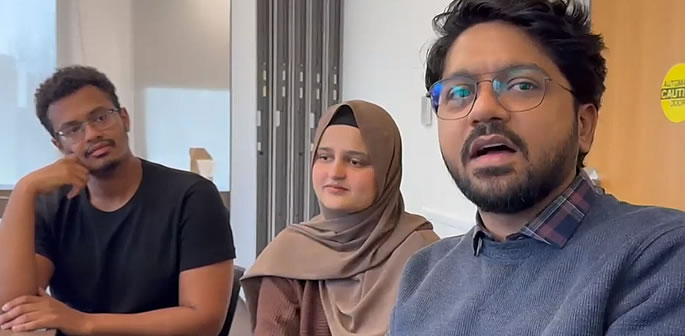
Three international students at the University of Windsor (UWindsor) in Canada are creating an app that can detect skin cancer.
Users upload images of areas on their skin they are concerned about and AI can identify whether it is melanoma.
In 2022, approximately 9,000 Canadians were diagnosed with melanoma and 1,200 died from it. If caught early, it can be treated.
Indian national Ifran Andleeb is in Canada studying for a Master’s in Electrical and Computer Engineering.
“We are done with the theoretical researching part [and we] are trying to deploy our model in a web app so that everyone in the country can use the app — it will be on your fingertips.
“Even though this research was medically based, we did not have any medical background, so we had to go through some resources so that we totally understand.”
Almiqdad Elzein, who is from Sudan, is also a Master’s student in Electrical and Computer Engineering.
He has been working in AI for four years and he explained how the app’s efficiency in identifying skin cancer will set it apart from more conventional and slower methods.
He told CBC: “Right now, most skin cancer detection is done through biopsies.
“There are works in the artificial intelligence community that are currently attempting to apply machine learning and artificial intelligence to skin cancer detection, but it has not yet gone mainstream — you would not find this in regular hospitals.
“It’s a work in progress.”
On how AI works in a medical app context, Almiqdad continued:
“[If] we imagine that we analysed pictures of different skin conditions and we teach a model, through millions or hundreds of thousands of samples, how to differentiate between skin cancer, melanoma, and specific versus other more benign skin conditions.”
The app can potentially provide three main benefits.
He added: “Firstly, the detection is done in a non-invasive way, in contrast to biopsies, which is quite invasive.
“Secondly, it does not require a lot of advanced medical technology, which may not be available in all areas. Thirdly, it is a way to mainstream detection.
“Doing it on a periodic basis allows for an earlier detection if such condition exists.”
Vaibhav Patel, who is from India, believes this technology will become more vital as temperatures continue to rise.
“That’s what we learned about while researching this particular topic.”
“It’s going to be more and more dangerous going forward, so making it accessible for everyone, and enabling everyone to have routine checks themselves can really reduce the mortality rate.”
UWindsor’s vice-president of research and innovation Shanthi Johnson said:
“International students are incredibly important. They bring so many assets from their own home countries.
“They have tremendous life and world experience, but they’re also making a big difference in taking learning experience back to their country, and also enriching our local community and other students.”
Ifran admitted that as an international student, it can be challenging.
She said: “You also have your own research going on because this research is an outcome of a course.
“And being an international student, you have a lot going at home.”