

















































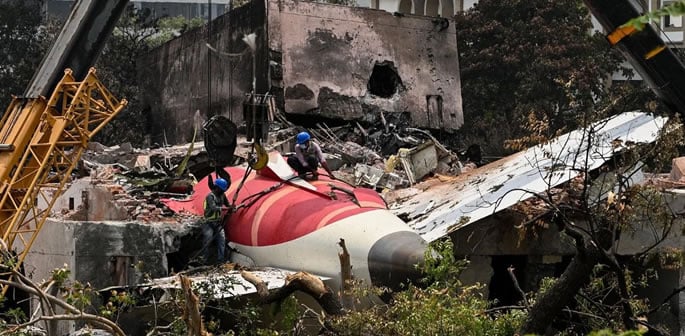
"The fuel cutoff switches were actioned shortly after lift off"
Fears are mounting that the Air India crash, which killed 260 people, may have been a case of pilot suicide, as a leading aviation expert claimed there was a small chance the fuel was accidentally cut.
Former pilot Terry Tozer told The Sun that a mechanical failure was highly unlikely. Instead, he said the plane’s fuel switches were shut off manually, an action that required deliberate effort.
Tozer said: “The fuel cutoff switches were actioned shortly after lift off from RUN to CUTOFF.
“And that implies that somebody did that as a conscious human action, because so far as we understand, these switches have a lock mechanism.”
“They have to be lifted in order to be moved. Otherwise they lock in position.”
The claims come after a preliminary report into the crash was released. It detailed the aircraft’s final moments but stopped short of identifying who was responsible.
According to Tozer, the design of the aircraft makes it “vanishingly small” that both switches could be disengaged accidentally.
He explained: “The fact that the fuel cutoff was initiated first with one engine and then the other… kind of implies a conscious lifting of a switch – moving it and lifting it.”
Tozer said that unless a “weird electromechanical process” caused the fuel cutoff without human input, “somebody lifted and moved one switch followed by the other”.
He said: “I find it hard to believe that something you would do by accident.”
Tozer also pointed out that pilots would not normally have their hands near the switch area during takeoff.
He said: “The first officer was flying the aircraft, whose hands would have both been on the control column?
“The captain would have been monitoring what was going on. So he had his hands free.”
The preliminary report included cockpit dialogue where one pilot said, “Why did you cutoff,” after the switches were moved. Tozer believes investigators deliberately avoided naming who said what.
He said: “The full report will basically come up with final conclusions.
“But of course, if the locking mechanism didn’t actually function on this aircraft, you can’t entirely rule out the fact that someone inadvertently touched them and they flicked off.
“Having said that, I can’t see why any pilot would have their hands anywhere near the area where these switches are located.”
Tozer said another pilot in India suggested the incident could be a suicide, but cautioned against speculation.
He said the theory was “rather presumptuous because we simply don’t know”.
Despite the mounting speculation, Air India’s CEO Campbell Wilson has urged caution.
In a leaked memo, Wilson defended the pilots and emphasised that no firm conclusions had yet been drawn.
He said in the memo: “The release of the preliminary report marked the point at which we, along with the world, began receiving additional details about what took place.
“Unsurprisingly, it provided both greater clarity and opened additional questions.”
“The preliminary report identified no cause nor made any recommendations, so I urge everyone to avoid drawing premature conclusions as the investigation is far from over.”
The crash killed 241 passengers and crew on board, and 19 people on the ground. Both major commercial pilots’ unions have rejected the suggestion that human error was to blame.
Investigators are now reportedly reviewing the medical records of Captain Sumeet Sabharwal following claims that he may have had a history of mental health problems.