















































The films traced how people negotiate survival.
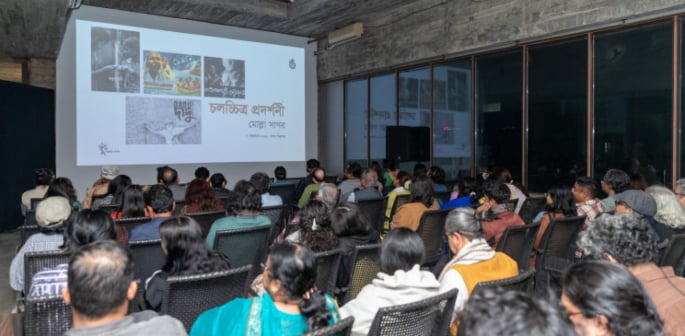
A focused evening of Molla Sagar’s documentary cinema unfolded at Bengal Shilpalay in Dhanmondi, Dhaka, on February 7, 2026.
It drew audiences into lived histories rarely centred onscreen, offering an immersive encounter with marginalised social realities.
At a time when documentary practice remains largely sidelined within mainstream filmmaking, the event created space for reflection and dialogue.
The selected works, Dudh Koyla, Siren, Gangaburi, and Dadu, traversed diverse geographies and deeply personal community experiences.
Together, the films traced how people negotiate survival under pressures shaped by industrial expansion, state policy, and economic restructuring.
From Dinajpur’s coal-rich Phulbari to Khulna’s silent jute mills, the narratives revealed fragile intersections of labour, land, and identity.
The screening highlighted how documentary cinema can function as an archive of resistance, memory, and everyday endurance.
Molla Sagar’s engagement with nonfiction filmmaking began in 2002 with O Pakhi, which examined the killing of migratory birds in southern Bangladesh.
Trained in graphic design at the University of Dhaka’s Institute of Fine Arts, Sagar’s visual grounding shaped his observational filmmaking language.
His early relationship with photography later informed his preference for patient, intimate, and trusting documentation.
Produced between 2006 and 2007, Dudh Koyla centres on the Phulbari coal movement and the Santal community.
The film documents how agrarian life transformed into organised resistance when indigenous land faced acquisition for open-cast mining.
Sagar spent months building relationships there, allowing the camera to enter domestic spaces with rare openness.
Siren shifts focus to Khalishpur in Khulna, where closed jute mills dismantled once thriving labour communities.
Rather than narration, the film relies on routine, ambient sound, and silence to convey unemployment and hunger.
In Gangaburi, Sagar turns toward river rituals, reflecting on spiritual bonds between water, belief, and cultural continuity.
The documentary recognises the river as sustenance and vulnerability, shaping lives through seasonal uncertainty and inherited faith.
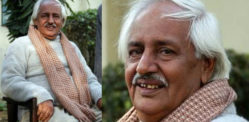
Dadu offers a quieter portrait of Momin Ali Mridha, a centenarian model at the Faculty of Fine Arts.
His personal journey intersects with Bangladesh’s artistic history, revealing dignity within ordinary labour and overlooked contributions.
Across these works, folk music operates as narrative memory rather than background texture.
Sagar has often noted that songs “express philosophy, grief, joy and resistance”, embedding emotion within regional soundscapes.
Influenced by Ritwik Ghatak’s cinematic ideology, Sagar prioritises duration and lived proximity over spectacle.
His films deliberately avoid sensationalism, instead allowing credibility to emerge through sustained observation.
Nature, water, and labour recur not as motifs but as material conditions shaping everyday existence.
The screening reaffirmed documentary cinema’s power to record social histories absent from dominant visual culture.
In a landscape offering little institutional support, the evening stood as a reminder of the form’s enduring urgency.
Molla Sagar’s work continues to engage critically and empathetically with people whose stories demand attention, patience, and respect.