
















































"plug-in solar panels will give more people greater control"
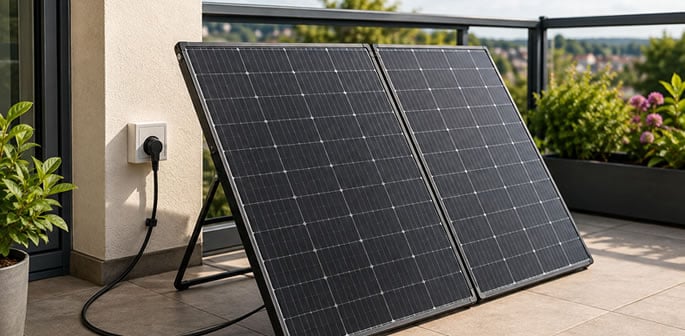
Plug-in solar panels are now legal across UK, giving more households the chance to generate their own electricity and cut their energy bills.
According to the government, the easy-to-install panels could save households up to £110 a year.
Each plug-in solar kit can produce up to 800W of power, which could provide up to 20% of an average home’s electricity use.
When the sun is shining, this could generate enough electricity to run a typical fridge, television, Wi-Fi router, laptop, phone charger and Xbox Series S at the same time.
The panels can be installed without professional installation, meaning households do not face the upfront installation costs associated with traditional rooftop solar.
However, the amount households save will depend on factors including the size and position of the panels, sunlight levels and how much electricity is used while the panels are generating power.
Joanna O’Loan, Knowledge Manager at Energy Saving Trust, said:
“The arrival of plug-in solar panels represents a significant milestone in expanding access to clean energy for households across Great Britain.
“While the savings will vary from home to home, plug-in solar panels will give more people greater control over their energy use and costs.
“As these products become more widely available, access to clear and reliable information is essential to help people make informed choices that are right for their home and budget.”
The government said the legal change follows independent safety testing covering the key electrical elements of plug-in solar systems.
The testing found compliant panels are safe and compatible with UK wiring, while the UK safety specification is more stringent than Germany’s.
Germany already has widespread use of the technology, with around half a million new plug-in solar panels connected there in 2025.
Energy Secretary Miatta Fahnbulleh said: “Plug-in solar is a simple, affordable way for households to take control of their energy bills and start saving straight away.
“From this summer, we’re giving more families the ability power their homes with clean homegrown energy.”
The panels can be placed in outdoor spaces or on some balconies, potentially making solar power more accessible to renters and people living in flats.
However, households should check whether they need permission before buying or installing a plug-in solar system.
This could include permission from a landlord, building owner or freeholder, as well as planning permission or listed building consent.
The government said decisions on individual requests remain with landlords, freeholders and councils, although it encouraged them to consider applications on their individual merits.
Major retailers including Currys, B&Q, Screwfix and Amazon have worked with the government on the rollout.
Amazon, Argos, Currys and Wickes have also committed to stocking plug-in solar panels, with products expected to become available online and in stores.
John Boumphrey, UK & Ireland Country Manager, Amazon said:
“Amazon is the largest corporate buyer of carbon-free energy in the UK, and we’ve invested in 50 solar and wind projects to date.
“The government’s announcement on plug-in solar panels is a practical step that gives households a simple way to generate their own power, reduce bills, and contribute to the UK’s net zero goals.
“We’re looking forward to helping customers benefit from this technology.”
The government says plug-in solar is part of wider measures aimed at helping households manage energy costs.
In July, the Prime Minister announced plans to cut VAT on energy bills, while the government has also highlighted £150 of costs taken off energy bills in last year’s Budget.
The £150 Warm Home Discount has also been expanded to around six million households.
Chris Hewitt, CEO Solar Energy UK, said: “This is a great example of industry and government coming together and delivering quickly for Britain.
“Solar and batteries are already the most effective way for homes and businesses to slash their energy bills by more than half, and making plug-in solar lawful will bring cheap, clean power to households that have not been able to access these benefits before.
“Our industry continues to work closely with government to ensure that all customers can have confidence in the safety and reliability of these new technologies.”
David Boyer, Director of Electricity Systems, at Energy Networks Association, said:
“This is a major step forward for incorporating micro generation safely and efficiently onto the UK’s energy grid.”
“Network operators will continue to work closely with government, Ofgem and manufactures to ensure the registration process for micro generation evolves to meet consumer demands.”
The move comes as demand for solar power continues to grow across the country.
MCS figures showed almost 150,000 certified solar panel installations in the first six months of 2026.
That was 17% higher than the previous record start to a year, recorded in 2025, and equates to one installation approximately every 74 seconds.
Battery installations have also increased significantly, with almost 36,000 certified installations recorded during the first six months of 2026.
The government said plug-in solar builds on the potential savings available through rooftop solar, with households already able to save up to £480 a year through the technology.