


















































“I was inspired by my own struggles at the time."
French-Mauritian musician Ched William’s ‘Towards Ether’ is an introspective song about the uneasy relationship between ambition, perfection and happiness.
Released on February 20, 2026, it centres on a character travelling by train who cannot bring himself to leave, always believing something better may be waiting ahead.
The song captures the frustration of being caught between wanting more and recognising that perfection may be impossible.
Its accompanying music video takes those themes into a deeply personal setting, connecting the story to William’s relationship with Mauritius and his family heritage.
Together, the song and film explore how the things people pursue can shape their understanding of who they are and what they truly value.
In an interview with DESIblitz, Ched William discusses the personal experiences behind ‘Towards Ether’, the creative decisions that shaped the track and the thinking behind its music video.
The Pursuit of Perfection

‘Towards Ether’ began with a personal realisation that having everything Ched William thought he wanted did not necessarily bring happiness.
The song explores the tension between constantly seeking something better and learning to appreciate what already exists. Its central character is trapped on a train, repeatedly considering whether to leave at each stop before choosing to remain on board.
William’s own struggles provided the starting point for that idea:
“I was inspired by my own struggles at the time.
“I felt like I had everything one could ask for, and yet I didn’t feel any happiness from it.
“It made me feel ungrateful, so I took a hard look at my life and realised that I wanted everything to reach a perfect standard, while nothing is ever perfect in this life.
“I felt I had two options: either be endlessly unhappy about that fact, or learn to appreciate things for what they are, no matter their imperfections.”
The train became a natural extension of that conflict, as the musician reveals:
“Funnily enough, I wrote it when I was actually on a train. I think the train is a strong metaphor for life because it’s on set rails.”
“It’s not like a car, where you can turn wherever you want and go as you please. There is a set time for departure and arrival, and in between you’re on parallel lines that won’t let you go out of your way.
“You don’t control the speed or the direction. The only things you can choose are whether you get on, where you get off, and how you spend your time inside.”
That distinction is important to the character’s repeated indecision.
The journey itself continues regardless of whether he feels ready to make a decision, leaving him with control over only certain parts of the experience.
Rather than presenting happiness as the result of reaching a perfect destination, William uses the train to consider how people respond to the circumstances they cannot change.
When the Music Takes Over

The song’s arrangement follows the character’s changing perspective, beginning with an intense flow of words before gradually allowing the instrumentation to carry more of the emotional weight.
Ched William combines folk guitar, percussion, electric-guitar textures, saxophone, cello and orchestral elements.
He says: “I think the song reflects the internal journey by first being very talkative.
“There are lots of lyrics, and I sing them really fast. Then, after the second chorus, when the character once again realises that he needs to take the world in without criticising everything, the lyrics stop and give way to the music.”
The reduction in lyrics marks a change in how the character experiences the world. Instead of continuing to analyse his surroundings, the music creates room for observation and emotion.
“There’s a powerful saxophone solo first, followed by several instrumental breaks, so the song can focus entirely on the emotions of looking at the world for what it is rather than what you’re trying to impose on it. I think all the solos and instrumental parts really support that idea.”
William also deliberately avoids following a conventional pop structure in which the chorus is repeatedly brought back to reinforce the central hook. Instead, the song leaves listeners without the expected final chorus.
He says: “I like the idea of being economical in your songwriting and not being too heavy-handed.
“If you have a strong chorus and feed it to the audience four or five times, by the end of the song they may not want to go back and listen again.
“By having the chorus only twice, and then replacing the final chorus they’re expecting with an instrumental orchestral passage, I think it makes people yearn for it and perhaps come back to the song more easily.
“Emotionally, the orchestral passage is the culmination of everything the song has been about.
“Throughout the song, different instruments have had their time to shine (cello, violin, saxophone and guitar) and at the end they all come together, like so many fragments of our vision of reality finally forming a coherent look at the world.
“That’s the musical equivalent of an epiphany, where the character can finally tell himself, ‘Well, I have everything I need’.”
The scale of that passage is then contrasted with the intimacy of the character whispering to himself, allowing the song’s realisation to remain personal rather than turning it into an overt declaration.
Looking Back to Move Forward

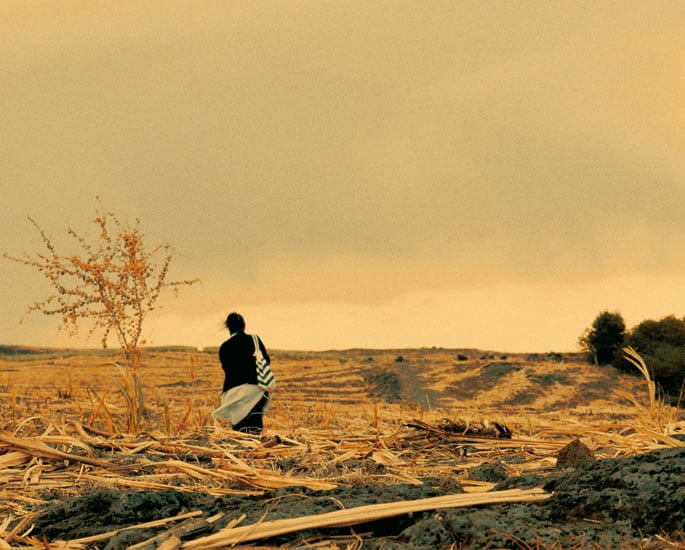
The music video takes the themes of ‘Towards Ether’ into a different setting, following a woman who lives in the West and returns to Mauritius after receiving a letter about an inheritance.
Her initial motivation is financial, but the journey exposes her to a part of herself that she has largely left behind. The people, landscapes and culture she encounters gradually force her to reconsider how she has constructed her life.
Ched William explains: “Towards Ether is about questioning your life choices, realising that the way you look at the world may be wrong, and trying to align your internal state with your values and your experience of the world.
“This is pretty much what happens in the music video.”
The woman’s return to Mauritius introduces questions of heritage and belonging that complement the song’s focus on the journey ahead, as William continues:
“It’s about a woman who lives in the West, who receives a letter asking her to return to her birth country in the East to collect an inheritance.
“When she arrives in Mauritius, she is taken aback by the people she meets, the gorgeous landscapes, and all the culture she had ignored even though it is part of herself.
“The culture, religion and spirituality of her ancestors have travelled for thousands of years and ended up with her.”
“She now has to decide whether to completely ignore that part of herself or allow it to inform who she is and what she wants her life to be moving forward.”
While the song is concerned with where someone is going, the music video looks at the origins that shaped the person making that journey.
“I also think that to question where you’re going, you have to look at where you come from.
“While the song focuses on the constant journey forward and on where you might end up, I felt the right visual approach was to take a strong look backwards.
“Only after examining where you come from can you understand exactly who you are, and therefore what is best suited for you in the future.”
The woman’s transformation is therefore not simply about rediscovering a country. It is about understanding the parts of herself that were separated from the life she had built.
Turning Family Memories into Film

The music video’s emotional foundation came directly from Ched William’s own family.
He filmed it in Mauritius during his grandfather’s Barkhi (funeral ceremony), meaning parts of the footage were captured during a period of genuine loss.
The artist elaborates: “Those real-life moments are the film.
“I went to Mauritius with my mother for my grandfather’s Barkhi, his funeral ceremony, and because he had passed away, I had an acute sense of what I had lost.
“I didn’t want to lose anything else, so I wanted to preserve everything I came across at that time.”
That desire to preserve what remained shaped the way William approached filming:
“I made a real effort to film all the precious moments we had together as a family, from the ceremony and family visits to walks on the beach and very mundane acts that, to me, are the essence of life.
“I set out on a mission to capture the most trivial aspects of my close family’s life in the hope that this would somehow capture who they are.”
The approach gives the fictional narrative a documentary foundation.
“All of that gave me the story, the emotional moments and the strong visual identity of the music video.”
That personal experience also connected with an idea William had been developing around the consequences of pursuing material success at the expense of other parts of a person’s identity.
He says: “I’ve been playing with this idea for a long time: the idea of a character who has succeeded materially in life but goes through an identity crisis because they’ve loped off so many parts of themselves in order to be successful that they’re not really sure who they are anymore.
“This family trip to Mauritius felt like the perfect moment to actually materialise that.”
The resulting character is not presented as someone who has simply made the wrong choices. Instead, William uses her situation to examine how different aspects of a fulfilling life can become disconnected when they are treated as separate priorities.
Choosing Roots over More Success
For Ched William, the music video’s story focuses on what happens when one form of achievement becomes so dominant that everything else is pushed aside.
He explains: “I think today a lot of discussions about life are very radical and partial.
“It’s either that the only thing that matters is material wealth and success, or that it’s family and friends. But as with most things in life, I think the answer is more nuanced and more holistic.”
That belief informs the music video’s final image, when the woman chooses earth from Mauritius instead of the pearls that represent her inheritance. The contrast gives a physical form to her changing priorities.
William says: “To me, a fulfilling life is one where you are where you want to be in terms of career and lifestyle, but also where your internal values are aligned with your actions and with the external world.
“Those three things have to be looked at and shaped in coherence with one another, rather than carved independently, because otherwise it becomes very difficult to fit them all together.”
William associates the image with The Alchemist by Paulo Coelho, although his reference comes with a qualification:
“That moment reminds me of The Alchemist by Paulo Coelho, even though I’m not a huge fan of that book.
“It represents the fact that, in this particular story, she was already successful, and yet she wanted more of the same.
“She came to Mauritius for the money, for the material inheritance, because that was all that was on her mind.
“She had become so hyper-focused on her success that even though she already had it, and was lacking in other departments of her life, what she wanted was simply more success.
“Through what she sees and learns in Mauritius, she finally realises that what she has is enough, and that now it’s time to focus on everything else.”
That change is represented through the earth itself, which Ched William describes as a direct connection to roots, identity and origins:
“And everything else means her identity, her internal life, and embracing her past and her origins in order to become someone she feels comfortable being.
“I represented that by having her let go of the pearls, which are extremely valuable, for a handful of earth, the place that literally holds your roots and allows them to grow.”
The same question of what is enough runs through the song, where the character must confront his instinct to keep searching for a better alternative.
“I hope that when people listen to the song and watch the music video, they get a little bit of everything because, once again, I think the answer is always nuanced rather than one very strong, definitive thing.
“I hope people take it as a reminder to ask themselves whether the things in their life actually fulfil them.
“If the answer is mostly yes, then learn to focus on that feeling and appreciate it. If it’s mostly no, then take the time to find the courage to change those things.”
For Ched William, that assessment cannot happen without acknowledging the full complexity of a person’s past.
Difficult experiences and unwanted aspects of identity still form part of the story, even when someone chooses to move beyond them.
“I also think you cannot ignore any part of who you are.
“Even if there are things in your story or your life that make you unhappy, you can’t act as if they never existed. You have to take everything into account, and only then can you actively choose to let certain things go, or to remember them and allow them to remain part of who you are.
“The music video is also a reminder that, as time goes on, we will lose some of the things we find essential.”
“So before it’s too late, we should learn to appreciate the beauty of everything around us and, in order to honour it properly, be strong enough to discard the parts of our lives that do not hold up to it.”
‘Towards Ether’ is ultimately a reflection on how easily the pursuit of something better can distract from what already matters.
The song and music video approach that idea through different stories, but both question whether fulfilment comes from reaching a particular destination or understanding what is already part of your life.
By grounding the music video in Mauritius and his family’s real experiences, Ched William gives those questions a personal dimension.
Memory, heritage and belonging become part of a wider consideration of what can be lost when people become too focused on where they are going.
Rather than offering a definitive answer, ‘Towards Ether’ leaves listeners with a more personal question: whether the life they are pursuing reflects the things that genuinely matter to them.
Watch ‘Towards Ether’