
















































This makes the peacock an active part of the visual story.
The peacock is one of the most recognisable motifs in Indian art, but it is far more than a beautiful bird.
Across India’s artistic traditions, its distinctive feathers and graceful form have been used to express love, fertility, devotion, beauty, royalty and divine power.
Yet the peacock does not carry one fixed meaning across Indian art.
Its symbolism changes depending on the region, artistic tradition and story being depicted.
From Mughal court paintings that captured the bird with remarkable naturalism to Pichwai works filled with Krishna’s devotional imagery, the peacock has repeatedly been transformed into something more than decoration.
Mughal Miniature Painting
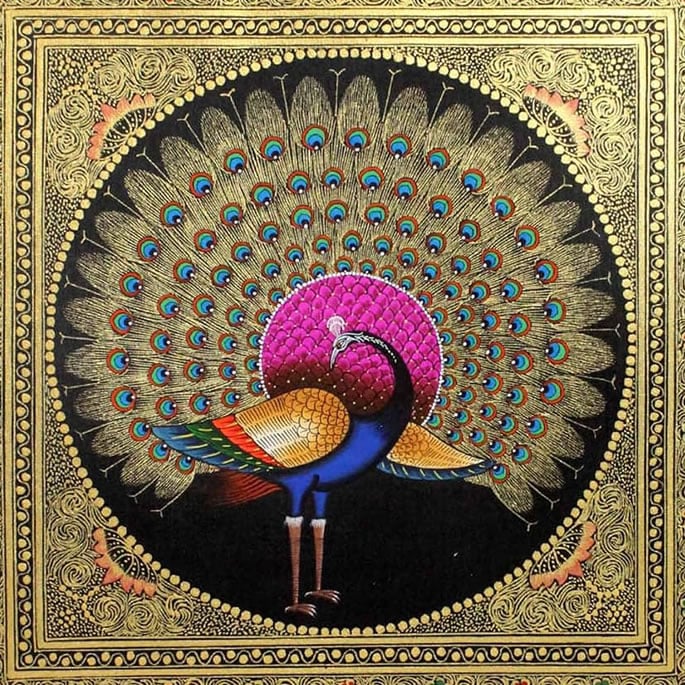
In Mughal miniature painting, the peacock became an opportunity to observe nature with extraordinary precision.
Rather than using the bird solely as a symbolic motif, Mughal artists studied its anatomy, plumage and behaviour and reproduced them in remarkable detail.
This interest was particularly strong during the reign of Emperor Jahangir, whose fascination with the natural world encouraged detailed paintings of birds, animals and plants. Ustad Mansur became one of the leading artists associated with this natural-history tradition.
Mughal paintings of birds could therefore function almost like visual records of the natural world. The peacock’s elaborate feathers provided artists with an especially demanding subject, requiring close attention to pattern, colour and form.
The bird also acquired a very different association with imperial magnificence during the Mughal period.
Shah Jahan’s Peacock Throne famously incorporated the peacock into an extraordinary expression of royal wealth and authority.
The contrast is revealing. In one context, the peacock could be carefully observed as part of the natural world. In another, it could become an emblem of imperial luxury.
Pichwai
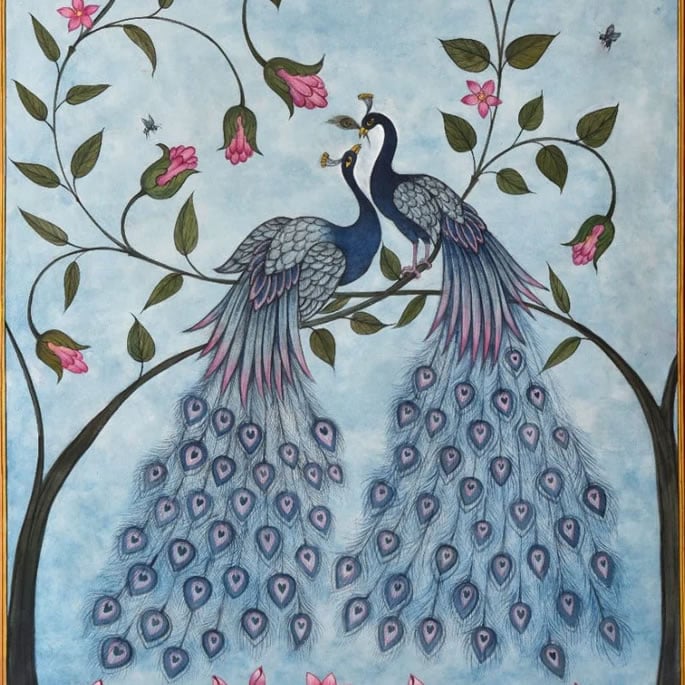
In Pichwai painting, the peacock is closely associated with the devotional world of Krishna.
These large painted textiles were traditionally displayed behind the image of Shrinathji at Nathdwara in Rajasthan, where they form part of the visual environment of worship.
So, what does the peacock represent in Pichwai? It helps evoke Krishna’s connection with nature, particularly the landscape and stories associated with Vrindavan.
Krishna’s iconic association with the peacock feather is central to this imagery. The bird therefore carries a devotional meaning rather than functioning simply as an attractive element within the composition.
Pichwai artists often depict peacocks among lotus ponds, vegetation and monsoon landscapes. Their bodies may be shown in movement, with elaborate tails creating a sense of rhythm across the textile.
This makes the peacock an active part of the visual story.
It helps establish an environment in which Krishna’s divine presence is surrounded by nature. The bird’s connection with Krishna is also reflected in Shrinathji’s traditional mor mukut, or peacock-feather crown.
Pichwai therefore demonstrates how an animal can become a devotional symbol without losing its connection to the natural world.
Madhubani
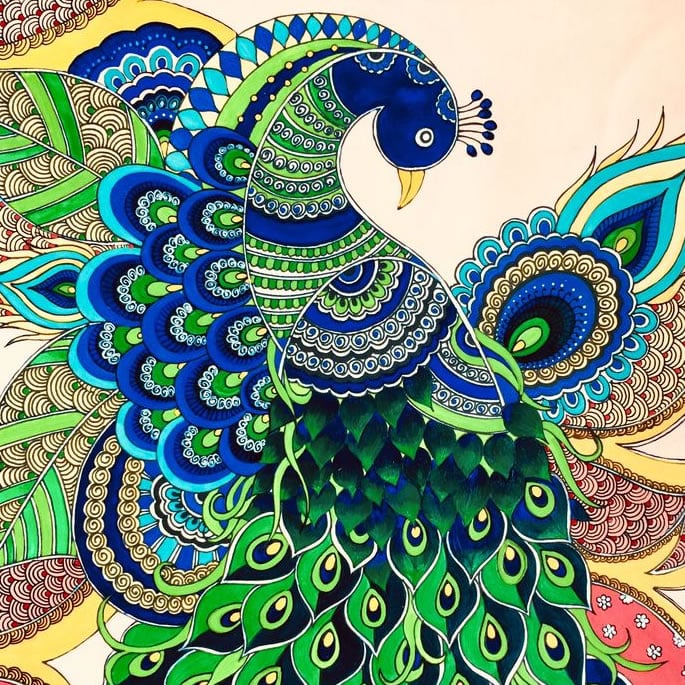
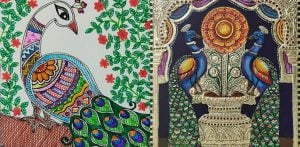
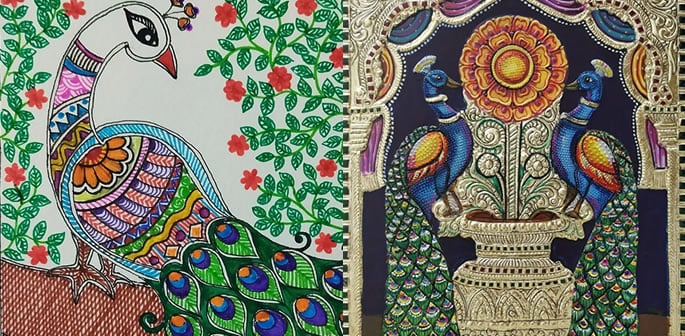
In Madhubani painting from Bihar’s Mithila region, the peacock is strongly associated with love, fertility and abundance.
Its symbolism becomes particularly significant in ceremonial and wedding-related imagery.
The peacock is a recurring motif in Madhubani, where artists use bold outlines, intricate patterns and densely decorated surfaces to transform the bird into an expressive visual symbol.
Art historian Jyotindra Jain has associated the peacock with love and fertility in Mithila art.
Pairs of peacocks are especially significant in Kohbar wedding imagery. Facing one another, they can represent the enduring relationship between a bride and groom.
The bird’s association with the monsoon adds another layer.
In the agricultural landscape of Mithila, the arrival of rain is connected with fertility, crops and abundance.
The peacock’s association with the rainy season therefore gives the motif an additional connection with prosperity.
There is also a religious dimension.
The peacock can be linked with Krishna through his distinctive peacock-feather crown, bringing mythology into a tradition already rich in symbolic motifs.
Kalamkari
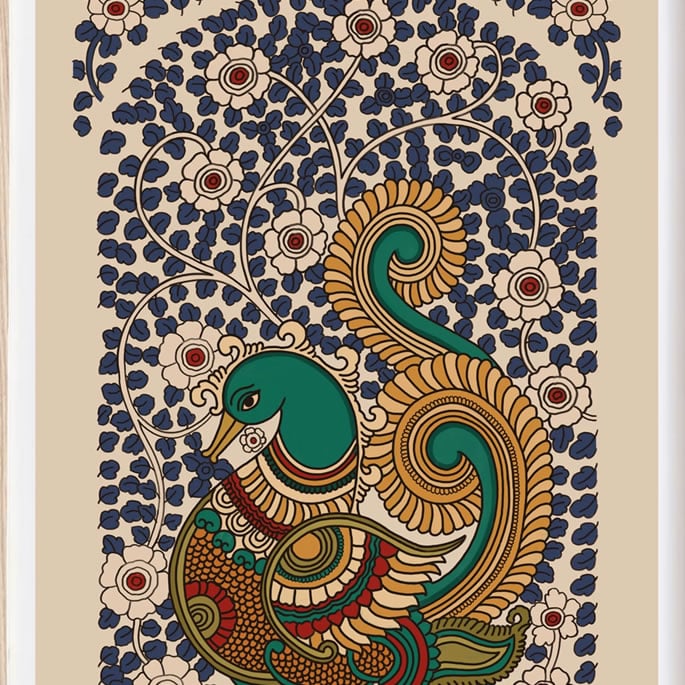
Practised historically in centres including Srikalahasti and Machilipatnam in Andhra Pradesh, the Kalamkari tradition is known for its detailed painted and printed textiles, natural dyes and religious storytelling.
In Kalamkari, the bird is commonly associated with beauty and grace, while some interpretations of the Srikalahasti tradition connect it with peace and harmony.
Its importance is also visual.
Kalamkari’s characteristic fine lines give artists considerable scope to describe the peacock’s elaborate feathers. Repeated patterns, curved forms and intricate detailing can turn the bird into a highly decorative component of a larger composition.
Kalamkari frequently combines figurative imagery with elaborate botanical and ornamental designs.
The peacock can consequently operate on two levels. It can carry symbolic meaning while simultaneously demonstrating the artist’s technical control.
That makes its feathers especially important. Their complex patterns naturally complement Kalamkari’s emphasis on line, repetition and detailed decoration.
Tanjore
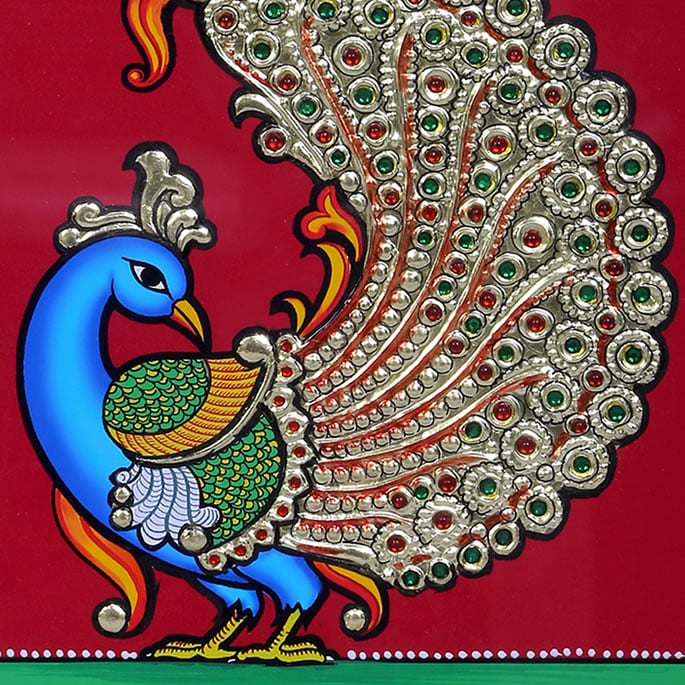
Tanjore painting, or Thanjavur painting, gives the peacock perhaps its most overtly opulent treatment.
Originating in Tamil Nadu, the tradition is known for rich colours, gold leaf, raised decoration and devotional imagery.
The peacock is particularly appropriate to this visual language because it already carries associations with beauty and divinity.
It is strongly associated with Lord Murugan, whose traditional mount is the peacock, giving the bird connections with divine power and courage.
The peacock is also associated with Goddess Saraswati in Indian iconography. The Government of India’s Handlooms portal similarly identifies the peacock with Saraswati and describes it as a symbol of beauty, love and courtship.
In Tanjore painting, these associations gain additional force through the technique itself.
Gold leaf and raised relief transform the surface into something visually luxurious.
A peacock surrounded by jewel-like colours and gilded details therefore feels less like a study of wildlife and more like an emblem within a sacred composition.
That distinction separates Tanjore from the Mughal approach.
The result is a peacock that bridges beauty and symbolism, turning a familiar bird into part of a larger sacred visual language.
Why is the Peacock Important in Indian Art?
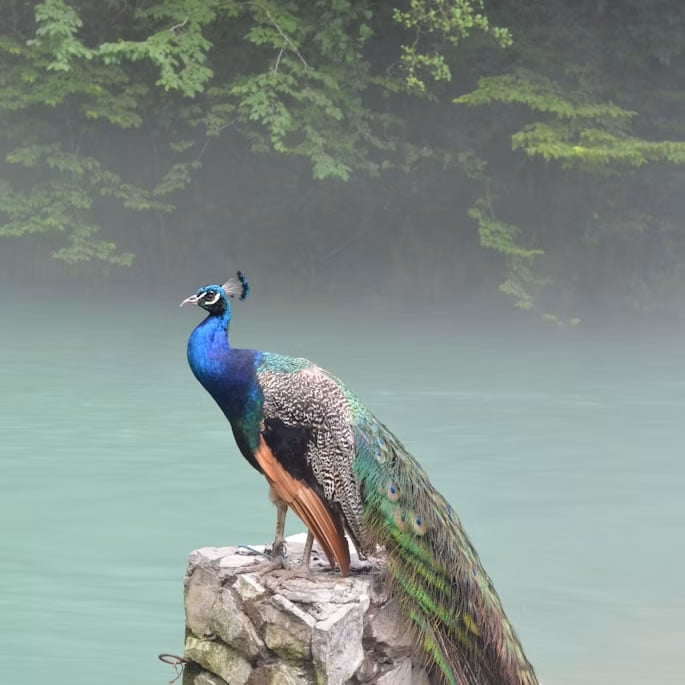
The peacock is important in Indian art because its visual beauty is closely intertwined with mythology, nature and cultural symbolism.
It can represent different ideas depending on the artistic tradition, including love, fertility, devotion, wisdom, beauty and power.
The bird’s significance also has a long history.
5 Facts about Peacocks in Indian Art
- Mughal artists studied peacock anatomy, plumage and behaviour.
- Peacocks are an active part of the visual story in Pichwai art.
- Peacocks are strongly associated with love, fertility and abundance in Madhubani art.
- In Kalamkari, the peacock is commonly associated with beauty and grace.
- A peacock feelsmore like an emblem within a sacred composition in Tanjore art.
Peacock imagery appears across Indian artistic traditions and periods, including ancient artefacts, Buddhist sculpture, Mughal miniatures, textiles and regional painting traditions.
The Government of India’s Handlooms portal notes that the motif has remained a potent symbol across different periods, while cautioning that its meaning was not necessarily identical in every age.
There is no single definition of what a peacock means in Indian art.
Instead, artists have repeatedly adapted the bird to suit the visual language and cultural context of their work.
The peacock’s place in Indian art is ultimately about far more than its striking appearance.
Across centuries, artists have used the bird to explore ideas that remain central to Indian visual culture, from devotion and love to fertility, power and the beauty of the natural world.
What makes the motif particularly fascinating is its ability to change meaning without losing its identity.
That versatility explains why the peacock has endured across such different artistic traditions. Its feathers may be instantly recognisable, but the meaning behind them depends on the artist, the tradition and the story being told.
In that sense, the peacock offers a glimpse into the richness of Indian art itself: familiar forms can carry very different meanings, and beauty can be both the subject and the message.