
















































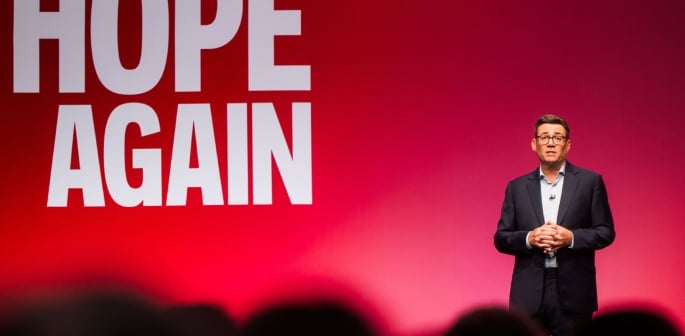
placing “hope again” at the centre of his message.
Andy Burnham used his first Labour Party conference speech as Prime Minister to promise a new direction for Britain, placing “hope again” at the centre of his message.
Speaking in Liverpool on September 29, 2026, Burnham said Britain had been on the wrong path for decades.
He criticised deindustrialisation, deregulation, privatisation, austerity and Brexit, arguing that too much economic and political power had become concentrated in too few hands. He promised to put more control in communities’ hands.
Burnham outlined plans covering housing, energy, water, transport and social care.
He said Labour would publish a long-term plan for Britain later this year, setting out how it would make essential services more functional.
The Prime Minister also used the speech to address the cost of living.
His government has announced measures including changes to electricity bills and bus fares, while wider plans are expected to focus on household finances and economic growth.
However, many of Burnham’s biggest proposals are long-term.
He confirmed plans for a National Care Service, with funding linked to changes to the pensions triple lock if Labour wins the next general election.
He also announced that Labour would make electoral reform a manifesto commitment. A national commission will examine possible changes to the voting system before the next election.
Brexit was another key issue. Burnham said the UK needed to consider a new long-term relationship with the European Union, arguing that Brexit had not delivered the control promised during the referendum campaign.
He is expected to set out different options for Britain’s future relationship with the EU, ranging from closer cooperation to potentially more significant changes.
Immigration also featured at the conference, with Home Secretary Shabana Mahmood defending stronger controls while announcing new safe routes for refugees, including Afghan women and girls.
The government is also reviewing proposed settlement reforms after concerns about their impact on migrants, including care workers.
Burnham’s speech represented a clear change in tone from the previous Labour leadership.
Rather than focusing primarily on the constraints facing government, he presented a longer-term vision centred on public services, economic growth and greater local power.
However, the Prime Minister acknowledged that major change would take time and would involve difficult decisions while working with existing financial constraints.
His conference message has given Labour a renewed focus, but the government now faces the challenge of turning its promises into policies that affect people’s everyday lives.
For Burnham, “hope again” is therefore not simply a conference slogan. The coming months will show how much of his long-term programme can be translated into action.